In the heart of old Hungary, where rolling plains met deep, whispering forests, there lived a young prince named Nemtudomka, beloved for his gentle nature and quiet strength. Though raised in a palace shimmering with gold and tradition, his truest companion was not a courtier or a noble tutor, but a magical horse, an otherworldly creature of shimmering mane and bright, knowing eyes. The prince and the horse shared a bond deeper than words, a connection that seemed woven into the very fabric of fate.
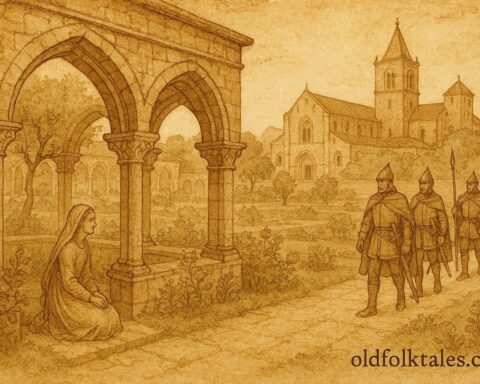
But harmony cannot always endure. A day came when jealousy, suspicion, or danger, depending on how the elders whispered the tale, forced the prince to flee the life he had always known. His only refuge was the faithful horse who carried him into the wide world, far from the palace gates. Together they crossed fields, streams, and shadowed woods until the prince found safety in a distant kingdom where no one knew his name, his lineage, or the magic that traveled beside him.
To protect himself, the young prince chose a curious disguise: he would answer every question with the same phrase, “Nem tudom”, meaning “I don’t know.” No matter what the villagers asked, his name, his origins, his trade, his answer remained unchanged. The people soon began calling him Nemtudomka, “Little I Don’t Know,” imagining him a harmless wanderer with simple ways and an innocent spirit.
Despite his silence about the past, the prince worked hard wherever he went. Some days he labored in the royal stables, brushing down horses until their coats glimmered. Other times he helped in the fields or carried water from the river. Though he spoke little, his quiet dedication earned him small kindnesses: a bowl of warm soup, a place to sleep, or a moment of friendly laughter from those who found his constant “nem tudom” amusing.
Yet destiny, like a river, always finds its path.
One year, the distant kingdom was stirred by preparations for a great festival. The king had decided to host a ceremonial gathering, some say it was in honor of the seasons, others say for his daughter’s coming of age, but every telling agrees it was a grand event that drew crowds from every corner of the realm. Musicians arrived with their violins and cimbaloms, merchants erected colorful stalls, and nobles paraded in satin garments that shone beneath the summer sun.
Among the spectators stood Nemtudomka, dusty from work yet drawn by the music and life around him. What he did not expect was that his magical horse, hidden away for safety, would choose this moment to reveal its true splendor. With a flash like moonlight over water, the horse appeared before the crowd, its coat gleaming, its hooves striking sparks of brilliance. The onlookers gasped; the king himself rose to his feet.
A proclamation spread through the crowd: whoever could master the magnificent horse, approach it without fear, and earn its trust would be rewarded. Some claim the prize was honor; others whisper it was a royal marriage, but whatever the reward, it was enough to stir every brave soul present.
One by one, young men stepped forward, only to be startled as the horse reared or danced out of reach. But when Nemtudomka approached, dusty, unassuming, and silent, the horse bowed its head in recognition. Their bond, forged long before this kingdom ever knew his name, could not be hidden.
The crowd fell silent.
The king’s gaze turned sharp, measuring, as if he finally saw through the shabby clothes and simple answers. With each breath, the prince stood taller, as though the weight of secrecy began lifting from his shoulders. When the king asked, “Who are you?” Nemtudomka felt his voice change. For the first time since his flight, he did not give the old reply.
No one knows the exact words he spoke, for the folktale keeps its mysteries, but all agree on this: his identity as a prince and the horse’s magical nature were revealed, restoring him to the dignity he had set aside to survive.
In every Hungarian hearthside retelling, this moment shines as the turning point, proof that truth cannot remain hidden forever, and that destiny waits patiently until fear loosens its grip.
The king honored him, the people admired him, and the prince reclaimed his rightful place in the world, standing beside the horse who had never left his side.
And so the tale of Nemtudomka, the prince who once said only “I don’t know,” became a cherished reminder that courage sometimes begins with silence, and identity may sleep before waking into its full power.
Moral Lesson
The tale teaches that humility and patience can protect us in times of danger, but eventually truth must be embraced. Destiny unfolds in its own time, rewarding courage, loyalty, and authenticity.
Knowledge Check
1. Who is Nemtudomka in the Hungarian folktale?
Nemtudomka is a disguised prince who protects himself by answering every question with “nem tudom,” meaning “I don’t know.”
2. What role does the magical horse play in the story?
The magical horse is the prince’s loyal companion and ultimately reveals his true identity during the kingdom’s festival.
3. Why does the prince hide his identity?
He is forced to flee danger in his homeland and uses anonymity to survive safely in a distant kingdom.
4. What triggers the revelation of the prince’s true status?
The magical horse appears at a festival, recognizing him and exposing the bond that only a noble rider could share.
5. What cultural theme does the folktale highlight?
It emphasizes humility, destiny, and the idea that true worth is eventually recognized, themes common in Hungarian storytelling.
6. What does “nem tudom” symbolize in the tale?
It represents protection through silence, shielding the prince until the right moment to reveal the truth.
Source: Adapted from traditional Hungarian folktale traditions, specifically the tale-type ATU variant commonly known as “Nemtudomka.”
Cultural Origin: Hungary