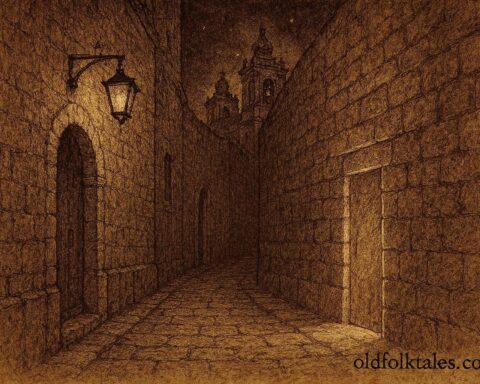
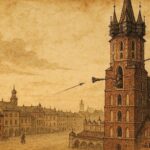
Long ago, when Kraków’s streets echoed with the clatter of horses’ hooves and the glow of candlelight marked the boundary between knowledge and superstition, there lived a nobleman known as Pan Twardowski. He was a man of learning, refined manners, and restless ambition. Though born into comfort, he was never satisfied with what ordinary education could offer. Where others studied law or theology, Twardowski sought the hidden laws of the universe, the forces said to govern fate, matter, and the unseen world.
From his youth, he showed an uncommon talent for languages and symbols. Latin, Greek, and Hebrew came easily to him, and with them the ancient texts that warned as much as they promised. He read of alchemists who claimed to transmute metals, of astrologers who charted destinies in the stars, and of magicians who dared to command spirits. While priests urged humility before God, Twardowski believed knowledge itself was the highest virtue.
As years passed, this belief hardened into pride.
He traveled widely, learning from scholars and secret practitioners alike, until his reputation returned to Kraków ahead of him. Whispers followed him through taverns and courts: that Twardowski could summon visions, that he understood the speech of demons, that he had crossed boundaries no Christian should approach. Some admired him; others feared him. Twardowski, however, cared only that his name was remembered.
It was during one such night of study, alone, surrounded by books and instruments, with storm clouds pressing low over the city, that a visitor appeared unannounced in his chamber. The man was elegantly dressed, his voice smooth, his presence commanding yet polite. He did not knock. He did not give his name. He simply spoke as though the conversation had long been agreed upon.
He offered Twardowski power.
Not vague promises, but certainty: mastery over magic, influence over kings, wealth without labor, fame without effort. In return, there would be payment, Twardowski’s soul, to be claimed at a time of the Devil’s choosing.
Many men would have recoiled in terror or fallen to their knees. Twardowski did neither. Instead, he listened carefully, weighing each word. His ambition burned too brightly for fear to extinguish it, but his intellect demanded caution. He asked for a written contract.
The Devil agreed.
As Twardowski examined the document, he smiled to himself. Here, he believed, lay his advantage. With calm precision, he added a clause of his own: the Devil could claim his soul only in Rome. Confident that this city, seat of the Pope and heart of Christendom, would never willingly receive him, Twardowski signed.
The Devil signed as well.
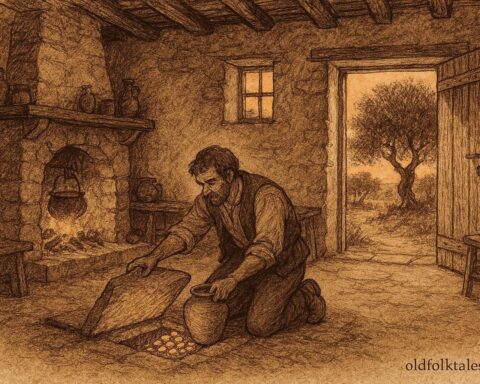
From that moment on, Twardowski’s rise was swift and spectacular. His experiments succeeded where others failed. His words carried authority, his demonstrations stunned audiences, and his counsel was sought by nobles and scholars alike. Gold flowed into his coffers. Doors opened at his approach. His name became synonymous with brilliance and danger.
Yet with every triumph, something subtle shifted. Gratitude faded. Humility vanished. He trusted no one but his own cleverness. Though he married and attempted the appearance of a settled life, restlessness gnawed at him. He laughed at sermons and dismissed warnings. The pact, once a calculated risk, became an afterthought.
Years passed. Then decades.
The Devil, patient beyond measure, waited.
One evening, while traveling far from home, Twardowski stopped at a modest roadside inn. Weary and distracted, he barely noticed its name carved above the door: Rome. It was a common enough name, chosen to impress travelers, and meant nothing to him.
Until the air changed.
The laughter of other guests faded. The fire dimmed. The innkeeper froze mid-step. From the shadows emerged the same well-dressed stranger from years before, unchanged by time.
The Devil had come to collect.
Twardowski protested at once, insisting this was no true Rome. But the Devil calmly pointed to the contract. No distinction had been made. A name, once agreed upon, carried its own power. Words, after all, were Twardowski’s chosen tools.
For the first time in his life, his cleverness failed him.
Desperation seized him. He pleaded, argued, and cursed himself for his arrogance. At last, with no spell or trick remaining, he did something he had long neglected: he prayed. He called upon the Virgin Mary, confessing his pride and begging for mercy, not escape, but relief from eternal damnation.
The prayer did not break the pact, but it changed its ending.
Instead of being dragged to Hell, Twardowski was lifted violently from the inn, torn upward into the night sky. The earth fell away beneath him. Clouds closed around him. When the motion ceased, he found himself cast upon the Moon, suspended between heaven and earth, neither damned nor redeemed.
There, legend says, Pan Twardowski remains to this day, gazing down at the world he sought to master, a warning etched into the night sky for all who mistake cleverness for wisdom.
Discover Polish, Russian, Ukrainian, and Belarusian folktales where magic and morality meet
Moral Lesson
The story of Pan Twardowski teaches that intelligence without humility invites ruin. Clever bargains may delay consequences, but pride ensures they eventually arrive. True wisdom lies in knowing where human ambition must end.
Knowledge Check
-
Who was Pan Twardowski in Polish folklore?
A nobleman and magician who made a pact with the Devil for power and knowledge. -
What condition did Twardowski add to the pact?
That his soul could only be claimed in Rome. -
How did the Devil succeed despite this condition?
By confronting Twardowski in an inn named “Rome.” -
Why was Twardowski not taken to Hell?
His prayer to the Virgin Mary altered the pact’s outcome. -
What does the Moon symbolize in the legend?
Eternal consequence and the cost of unchecked ambition. -
What is the central lesson of the folktale?
Pride and overconfidence lead to inevitable consequences.
Source: Polish oral tradition; literary versions by Józef Ignacy Kraszewski, Mid-19th century folklore adaptations (c. 1840–1850)
Cultural Origin: Poland