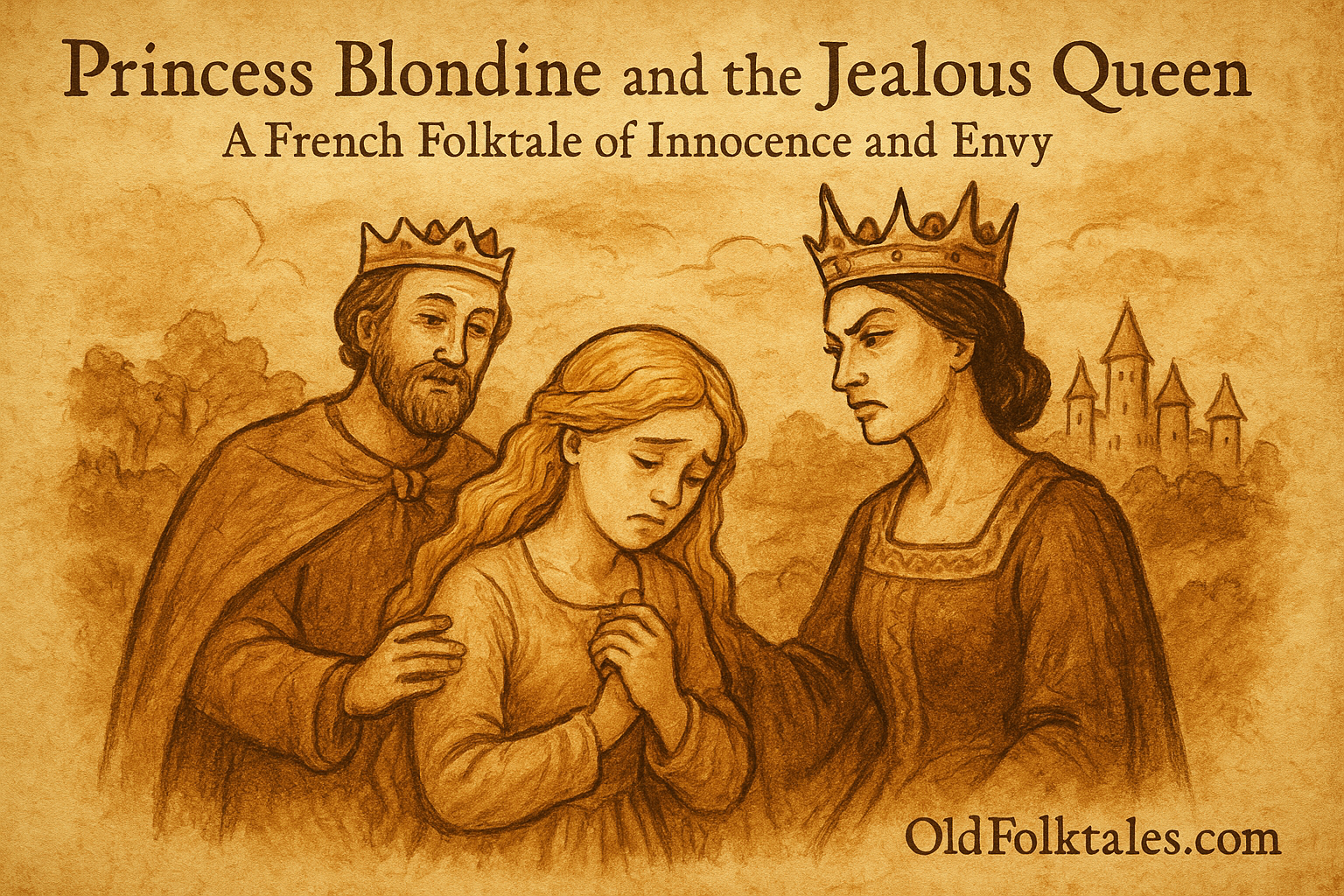
In a faraway kingdom ruled by a noble and just monarch named King Benin, peace and happiness flourished under his reign. The people adored him for his fairness and kindness, and the wicked trembled at the sound of his name. His queen, the gracious and gentle Queen Doucette, matched him in every virtue beloved by all who knew her.
Their happiness was crowned with the birth of a daughter, a child so radiant and golden-haired that they named her Blondine. Her golden locks gleamed like the morning sun, and her laughter filled the palace with joy. Yet fate was cruel soon after Blondine’s birth, Queen Doucette fell ill and died, leaving King Benin heartbroken.
For many months, he mourned, his court draped in sorrow. Only the innocent laughter of his little Blondine could soften his grief. The child was too young to understand her loss, smiling and playing as her father wept. King Benin, moved by her sweetness, devoted his life to her happiness. He surrounded her with beautiful fine jewels, rare fruits, and toys of every kind. Blondine, bright and affectionate, grew up in warmth and love.
A New Queen for the Kingdom
Years passed peacefully until the king’s ministers and people began to plead with him to remarry. “Your Majesty,” they said, “our hearts grieve for your loneliness, but the kingdom needs an heir, a prince to one day take your place.”
At first, King Benin refused. The memory of Queen Doucette was too sacred to him. But as his people insisted, he finally agreed, saying to his trusted minister, Leger:
“My dear friend, my heart cannot bear to seek another wife. Go, find me a princess worthy of this kingdom, one kind and virtuous enough to make my sweet Blondine happy. I desire nothing else.”
Faithful Leger set forth across many lands, visiting courts and kingdoms far and wide. Yet everywhere he went, the princesses he met were proud, selfish, or cruel. His search seemed hopeless until he reached the court of King Turbulent, whose daughter, Princess Fourbette, appeared beautiful, graceful, and pleasing in manner.
Deceived by her charm, Leger requested her hand for King Benin, unaware of her true nature jealous, deceitful, and hard-hearted. King Turbulent, who secretly disliked his daughter’s temper and arrogance, was delighted to be rid of her. With false joy, he agreed to the match.
Fourbette set out with a grand retinue: four thousand mules laden with jewels, silks, and treasures, and a heart filled with bitterness and envy.
The Cruel Gaze
When news of her approach reached King Benin, he rode out with pomp to welcome his bride. Fourbette was indeed beautiful, but her expression lacked the gentleness that had once shone in Queen Doucette’s face.
At the sight of the little Princess Blondine, then three years old, Fourbette’s eyes darkened with jealousy and hatred. Her cruel gaze fell upon the child like a shadow, and Blondine began to tremble. She burst into tears and clung to her father.
“What troubles you, my dear one?” asked the king softly.
“Papa, please,” Blondine sobbed, “do not let that lady come near me. Her eyes are cruel, they frighten me!”
The king turned swiftly toward his bride and, for a brief moment, caught the expression of malice she had failed to hide. His heart sank. He realized, though he said nothing, that this woman’s love would never be given to his daughter.
He commanded that Blondine should remain under the care of her devoted nurse, who had cared for her since birth, and that she was never to be left alone with the new queen. Fourbette concealed her anger behind a smile but vowed silently that Blondine would one day suffer for this insult.
A Sister’s Cruelty
A year later, the queen bore a daughter. She was named Brunette, for her dark hair that gleamed like a raven’s wing. The king rejoiced, hoping the two little girls would grow in sisterly love.
But though Brunette was lovely, she lacked her sister’s gentle spirit. From her mother, she inherited envy and malice. As soon as she could walk and speak, she delighted in tormenting Blondine, breaking her toys, tearing her fine dresses, pinching and biting her.
Sweet Blondine never complained. Her heart was too kind, her soul too pure. When her father noticed her bruises or tears, she would only say:
“Oh, Papa, do not scold Brunette! She is so little, she does not mean to hurt me. It is only in play.”
King Benin embraced his daughter tenderly, but deep within, he knew the truth: Blondine was an angel of goodness, while Brunette’s heart was hard and selfish. His love for Blondine grew even stronger, and Queen Fourbette’s hatred deepened in return.
The queen watched with bitterness as the king’s affection warmed the gentle Blondine and cooled toward her own daughter. Jealous and angry, she longed to harm the child but dared not disobey the king’s strict orders. He was a ruler, both kind and firm, and even the queen feared his justice.
So Fourbette waited, smiling in pretense, while the venom in her heart grew stronger each day.
Moral of the Story
The tale of Princess Blondine teaches that true goodness shines even in the shadow of envy. While cruelty may wear a crown, innocence and virtue remain unshaken. Those who hold fast to kindness, no matter how others treat them, will always win the affection of the wise and the just.
Knowledge Check
- Who were Princess Blondine’s parents?
Her parents were King Benin and Queen Doucette, beloved rulers known for their goodness and justice. - Why did King Benin agree to remarry?
He did so at the urging of his people, who wished for a son to inherit the throne. - What was Queen Fourbette’s true nature?
Despite her beauty, she was jealous, proud, and wicked, hiding her cruelty behind a charming smile. - How did Blondine respond to her sister Brunette’s cruelty?
She forgave her every time, believing her too young to understand the pain she caused. - What moral does the story of Blondine teach?
The story reminds readers that innocence, kindness, and patience are stronger than envy or malice. - What is the cultural origin of this story?
This folktale comes from France, where it has long been cherished as a tale of purity and virtue tested by jealousy.
Source: Adapted from the French folktale “Blondine.”
Cultural Origin: France