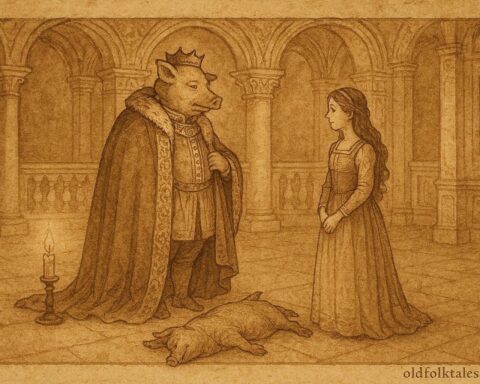
Long ago, in a kingdom nestled beyond the mountains and seas of Poland, there lived a noble king and queen who were blessed with a single child, a daughter named Princess Miranda. From the moment of her birth, Miranda was the joy of the royal household. Her laughter filled the marble halls, and her gentle heart won the love of every subject in the realm. Yet, fate, the guiding force of every folktale, had already written a strange destiny for her.
When Miranda was still a baby, a wicked witch appeared at the palace gates. Her face was shadowed by envy, for she despised beauty and joy. The witch raised her gnarled hand and declared, “When the princess reaches her sixteenth year, the Wind shall claim her as its own!” With those words, she vanished, leaving behind a hush of terror.
The king ordered his guards to search every forest and cave for the witch, but she was nowhere to be found. Determined to defy the curse, the royal couple built high walls around the palace, placed charms on every window, and filled the air with prayers. For fifteen years, Princess Miranda lived in perfect peace, unaware of the storm that fate had prepared for her.
The Day the Wind Came
When Miranda’s sixteenth birthday dawned, the skies were calm, and the kingdom rejoiced. The palace shimmered with banners, music, and the scent of roses. The king and queen, hoping the curse had faded with time, gave thanks and celebrated their daughter’s coming of age.
But as the sun sank below the mountains, dark clouds gathered without warning. A sudden gale tore through the kingdom, howling like a beast. The doors flew open, and the Wind, wild and alive, swept into the hall. Before anyone could act, it wrapped Miranda in invisible arms and carried her high into the stormy sky. Her cry of fear faded into the thunder, and then she was gone.
The kingdom fell into mourning. The queen wept day and night, and the king, in his grief, proclaimed a decree:
“Whoever rescues my daughter from her captivity shall have her hand in marriage and receive half my kingdom as reward!”
Princes and knights from distant lands came in great numbers, each seeking to prove his courage. Some vanished into the forests and never returned. Others came back defeated, whispering of strange winds and ghostly lights guarding the princess’s prison. None could reach the tower where she was held.
The Brave Prince Hero
Among those who heard the king’s proclamation was a poor but valiant young man known as Prince Hero. Though his name seemed bold, he owned little, no army, no fortune, only his faith and an unshakable heart. “If fate grants me strength,” he said, “I shall bring Princess Miranda home.”
He set out across mountains, valleys, and dark woods until he reached a desolate plain where the air itself seemed to shimmer. There, as night fell, a gentle voice spoke from the shadows, it was a fairy, radiant and kind.
“Brave youth,” said the fairy, “I know why you have come. The princess is imprisoned in a tower of crystal, guarded by the spirits of the Wind. Take this enchanted sword. Only its touch can shatter her prison.”
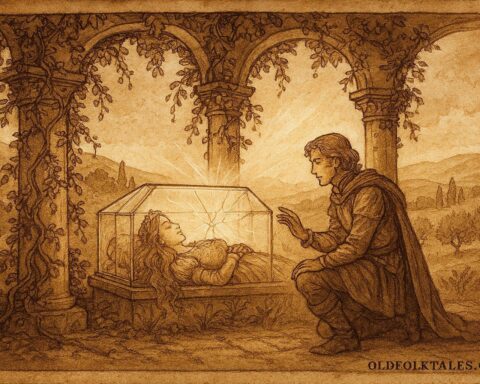
With gratitude, Hero accepted the sword and followed the fairy’s guidance. After three days and nights of travel, he reached a lonely tower that rose like a shard of ice against the clouds. Within its transparent walls, he saw Miranda, pale and sorrowful, her golden hair drifting as if in a breeze that never ceased.
The Battle Against the Wind
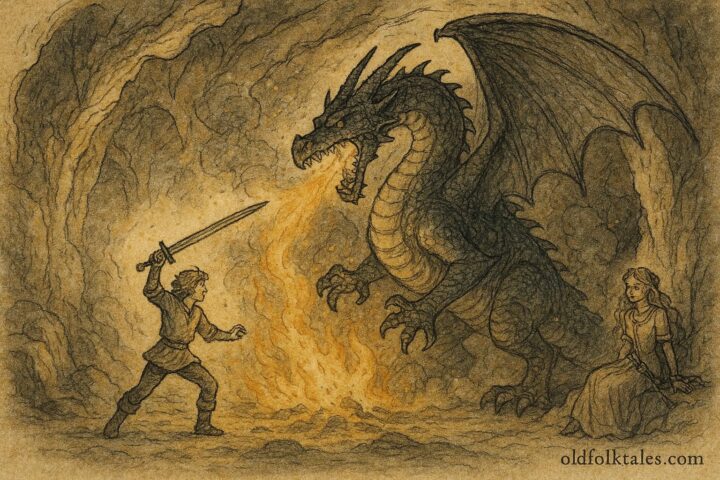
As Prince Hero approached, the Wind’s spirits emerged, swirling mists with voices like storms. They circled him, whispering threats and curses, but the young prince stood firm. “I come not to harm, but to free!” he cried.
He swung the fairy’s sword, and each stroke glowed with pure light. The spirits shrieked and vanished into the clouds. When at last he struck the crystal tower, it trembled, cracked, and shattered into a thousand glittering pieces.
Miranda stepped forth, free once more. Her eyes filled with tears of joy as the endless winds stilled, and sunlight poured over the land. The spell was broken.
Peace Restored
Prince Hero led the princess back to the palace, where the king and queen embraced their long-lost child. The kingdom rejoiced with music and feasting that lasted for days. True to his word, the king gave Hero half the kingdom and Miranda’s hand in marriage.
Their union brought lasting peace and prosperity. The storms ceased, the fields flourished, and every year the people celebrated the day the Wind was tamed by courage and love.
Moral Lesson
The tale of Princess Miranda and Prince Hero teaches that bravery and faith can overcome even the strongest curses. True nobility lies not in birth or wealth, but in a steadfast heart guided by goodness.
Knowledge Check
-
What curse was placed upon Princess Miranda?
A wicked witch declared that the Wind would carry her away on her sixteenth birthday. -
Who promised to rescue Miranda?
A poor but courageous young man named Prince Hero. -
What magical item did Prince Hero receive?
An enchanted sword from a fairy to break the spell. -
Where was Miranda imprisoned?
In a crystal tower guarded by the spirits of the Wind. -
How did Prince Hero free the princess?
By striking the crystal walls with the fairy’s sword, breaking the enchantment. -
What lesson does this Polish folktale teach?
Courage and faith can defeat dark forces, and goodness brings peace to all.
Source: Adapted from Princess Miranda and Prince Hero in Polish Fairy Tales, collected by Antoni Józef Gliński, translated by Maude Ashurst Biggs. Project Gutenberg eBook.
Cultural Origin: Poland (19th-century rural oral tradition)