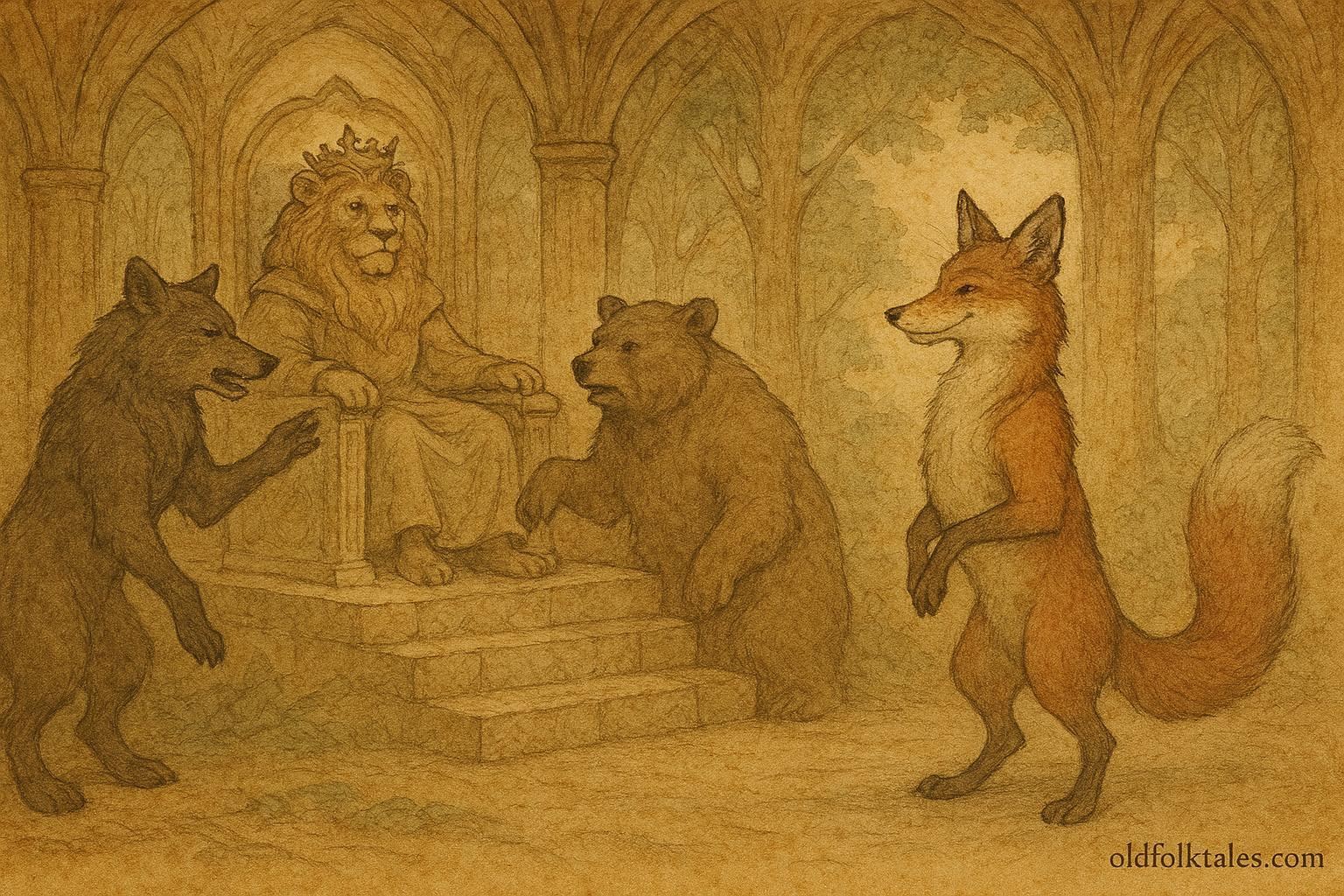
In the age when beasts spoke as men do and forests echoed with councils and courts, the animal kingdom gathered under the rule of King Noble the Lion. His reign was meant to embody order and justice, yet beneath the appearance of authority lay simmering resentment, rivalries, and corruption. No creature embodied these tensions more fully than Reynard the Fox, clever, smooth-tongued, and infamous for his endless misdeeds.
Reynard’s crimes were many and widely known. He had stolen food from his neighbors, deceived friends and foes alike, and humiliated creatures stronger than himself through trickery. Worst of all, he showed no remorse. His laughter echoed through the woods long after his victims had licked their wounds. Eventually, the outrage grew too great to ignore, and King Noble summoned a grand court of beasts to judge Reynard once and for all.
From every corner of the land, animals gathered. The Bear came, heavy and proud. The Wolf arrived, sharp-toothed and eager for vengeance. The Cat, the Cock, the Hare, and countless others assembled, each nursing grievances against the fox. The air was thick with accusation and anticipation. Justice, it seemed, would finally be done.
Yet Reynard did not appear.
The court murmured. Messengers were sent, but the fox ignored them, remaining hidden in his den. His absence angered the king and emboldened his enemies, who seized the moment to recount Reynard’s offenses in vivid detail. Each accusation painted him as a villain beyond redemption. The Wolf spoke bitterly of betrayal. The Cock described the loss of his children. Even those who had once benefited from Reynard’s schemes now turned against him, eager to appear righteous.
At last, under threat of condemnation in absentia, Reynard emerged. Thin, calm, and smiling, he approached the court as though invited to a feast rather than a trial. His manner was respectful, his speech eloquent. He bowed deeply to King Noble and addressed the assembly with humility so convincing that some beasts hesitated, wondering if they had misjudged him.
One by one, the accusations were raised again, and one by one, Reynard answered them, not with denial, but with redirection. He admitted to faults while subtly shifting blame, exposing the greed, pride, and cruelty of his accusers. The Bear, he suggested, was motivated by gluttony. The Wolf, by envy. Others, he implied, were no better than he, merely less clever.
The court grew uneasy. Reynard’s words cut sharply, revealing that the supposed guardians of justice were themselves compromised. Yet satire and truth did not equal innocence. The charges remained grave, and King Noble ordered that Reynard be sentenced.
Cornered at last, Reynard unveiled his greatest deception.
He claimed to possess knowledge of a hidden treasure, gold and jewels buried deep within the forest, stolen long ago and meant to enrich the kingdom. He spoke of conspiracies, of secret plots against the king, and of rivals who wished to overthrow the throne. His voice was urgent, his details precise. Fear spread through the court like wildfire.
King Noble hesitated. Power, after all, is easily unsettled by the promise of greater power, or the threat of its loss.
Reynard was granted temporary freedom to reveal the truth of this supposed treason. Escorts were assigned, but the fox easily outwitted them, leading his captors on exhausting paths, spinning tales that grew more elaborate with every step. Along the way, he manipulated alliances, turned enemies against each other, and ensured that confusion reigned.
By the time the court realized the deception, Reynard was gone.
He vanished into the forest, leaving behind outrage, embarrassment, and silence. Justice had not been served, but neither had the court proven itself worthy of delivering it. Reynard remained a criminal, yet the animals were forced to confront an uncomfortable truth: their legal system was as flawed as the fox they sought to punish.
Thus Reynard escaped once more, undefeated not because he was innocent, but because he understood power better than those who claimed to wield it.
Moral Lesson
The tale of Reynard the Fox teaches that intelligence can expose corruption, but not always correct it. Authority without integrity is easily manipulated, and justice fails when hypocrisy governs the court. Reynard is neither hero nor villain alone, he is a mirror reflecting society’s flaws.
Knowledge Check
1. Who is Reynard the Fox in Flemish folklore?
Reynard is a trickster figure known for wit, deception, and satire in medieval animal epics.
2. Why is Reynard summoned to court?
He is accused of numerous crimes against other animals, including theft and betrayal.
3. What role does King Noble the Lion play?
He presides over the animal court as king and judge, representing authority.
4. How does Reynard escape punishment?
Through clever speech, deception, and exploiting the corruption of the court.
5. What does the trial reveal about the animal court?
That those in power are hypocritical, greedy, and morally compromised.
6. Is Reynard portrayed as a hero or a villain?
He is morally ambiguous, both a criminal and a satirical exposer of injustice.
Source & Cultural Origin
Source: Van den vos Reynaerde, Middle Dutch epic poem (c. 1250)
Cultural Origin: Flemish folklore: Medieval Low Countries (present-day Belgium)