In the rolling green lands of Dyfed, where rivers curved through misted valleys and the wind whispered through ancient oaks, lived Rhiannon, a noblewoman of extraordinary presence. She was admired not only for her beauty but for her wisdom and dignity, which seemed almost otherworldly. Her voice was clear and measured, her movements graceful, and all who encountered her felt a quiet, compelling authority. Tales spoke of her magical bearing, and many believed she carried the blessing of the Otherworld itself.
Rhiannon had married Pwyll, the Prince of Dyfed, who was known for his honor and prudence. Their union was celebrated throughout the land, bringing together nobility and inspiring loyalty among their people. Yet even in a realm where magic and valor often intertwined, Rhiannon’s path was marked by trials that tested the limits of patience and courage.
Discover the moral heart and wild spirit of the north through timeless Nordic storytelling
When Rhiannon became pregnant, anticipation swept through the kingdom. Courtiers and commoners alike awaited the birth, eager to welcome a child who would carry the legacy of such noble blood. On the night of the birth, however, tragedy seemed to strike. The child vanished, stolen by unseen hands under the cover of darkness. Rhiannon’s attendants, shaken and fearful, searched tirelessly, but the newborn could not be found. Soon, whispers began circulating through Dyfed’s courts. Suspicion fell unfairly on Rhiannon herself.
Those who should have known better accused her of a heinous act: that she had harmed or killed her own son. Such allegations struck fear and anger into the hearts of the people, for they believed that to harm one’s child was the gravest crime imaginable. Though the accusations were baseless, the court demanded justice. Rhiannon, calm in demeanor but burdened by sorrow, was brought before Pwyll and the assembled nobles to answer for a crime she had not committed.
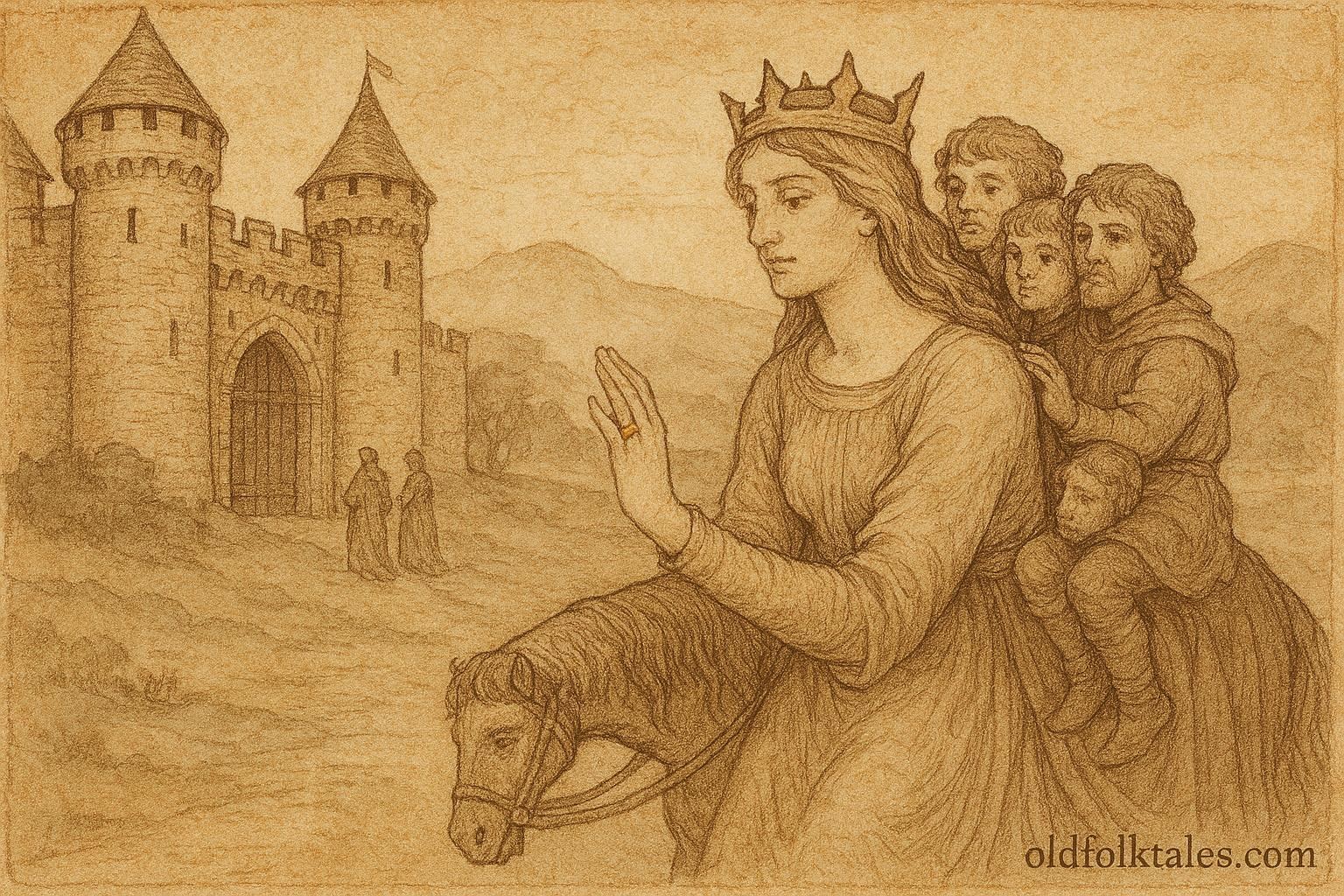
The punishment decreed was cruel, a reflection not of law but of fear and social pressure. Rhiannon was to sit each day by the gates of the castle, a golden ring upon her finger, and to carry visitors on her back as they passed, a mark of humiliation designed to shame her publicly. Many whispered as they passed, some with cruelty, others with pity, yet Rhiannon bore it all with dignity. She did not falter in her composure, nor did she utter resentment or despair. She accepted her suffering with patience, knowing in her heart that truth could not remain hidden forever.
Days became months, and months became years. Through the trials of public scorn, Rhiannon retained her grace, tending to her household with quiet authority and offering wisdom to those who sought it. Her spirit remained unbroken, a testament to her endurance and strength of character. Even those who doubted her slowly began to notice that no trace of cruelty or malice lay in her conduct. Her patience and composure became a silent rebuke to the injustice imposed upon her.
Meanwhile, the child who had been taken from her at birth was nurtured in secret by loyal attendants. The boy grew strong and intelligent, unaware of the scandal that had surrounded his mother. Time passed, and he became a capable young man, loyal to the crown and courageous in deeds, embodying the virtues his mother exemplified in every moment of her endurance.
Eventually, the truth of the child’s disappearance emerged. The attendants who had cared for him revealed the story of his survival, and the kingdom learned that Rhiannon had never harmed her son. Relief and awe swept through the land, for the noblewoman who had endured so much had maintained dignity throughout, proving her innocence through patience and unwavering virtue. Rhiannon was restored to her rightful honor, her reputation untarnished in the eyes of history and her people.
Upon her reinstatement, Pwyll and the court celebrated Rhiannon, recognizing not only her innocence but the strength and wisdom that had carried her through such unjust suffering. Her son was acknowledged publicly, and Rhiannon’s guidance and sovereignty were respected without question. The ordeal became a story repeated throughout Dyfed for generations, a tale of endurance, virtue, and the triumph of truth over falsehood.
Rhiannon’s story remained a lasting lesson in the kingdom: even in the face of slander and public humiliation, patience, dignity, and adherence to truth could overcome injustice. Her magical bearing, once admired for its otherworldly beauty, became legendary for the courage and composure she exhibited in adversity. Though she had been wronged, Rhiannon’s resilience transformed suffering into a testament of honor and moral strength.
Journey into the charm of British wit and Irish wonder through centuries of folk tradition
Moral Lesson
Rhiannon’s tale teaches that endurance, patience, and unwavering integrity can overcome injustice. False accusations and humiliation may strike even the noble, but truth, courage, and dignity endure, restoring honor and inspiring generations.
Knowledge Check
1. Who is Rhiannon in Welsh folklore?
Rhiannon is a noblewoman of magical bearing in The Mabinogion, known for her dignity and wisdom.
2. What false accusation is made against Rhiannon?
She is falsely accused of killing her newborn son.
3. How is Rhiannon punished during her trial?
She is made to sit by the castle gates, wearing a golden ring and carrying visitors on her back.
4. Who secretly cares for Rhiannon’s child?
Loyal attendants secretly nurture her son, protecting him until he can be publicly acknowledged.
5. What virtues help Rhiannon endure her punishment?
Patience, dignity, resilience, and steadfast adherence to truth.
6. What lesson does the story of Rhiannon teach?
That enduring injustice with integrity and patience ensures that truth and honor are ultimately restored.
Source & Cultural Origin
Source: The Mabinogion, translated by Lady Charlotte Guest (1849)
Cultural Origin: Wales (Brythonic Celtic tradition)