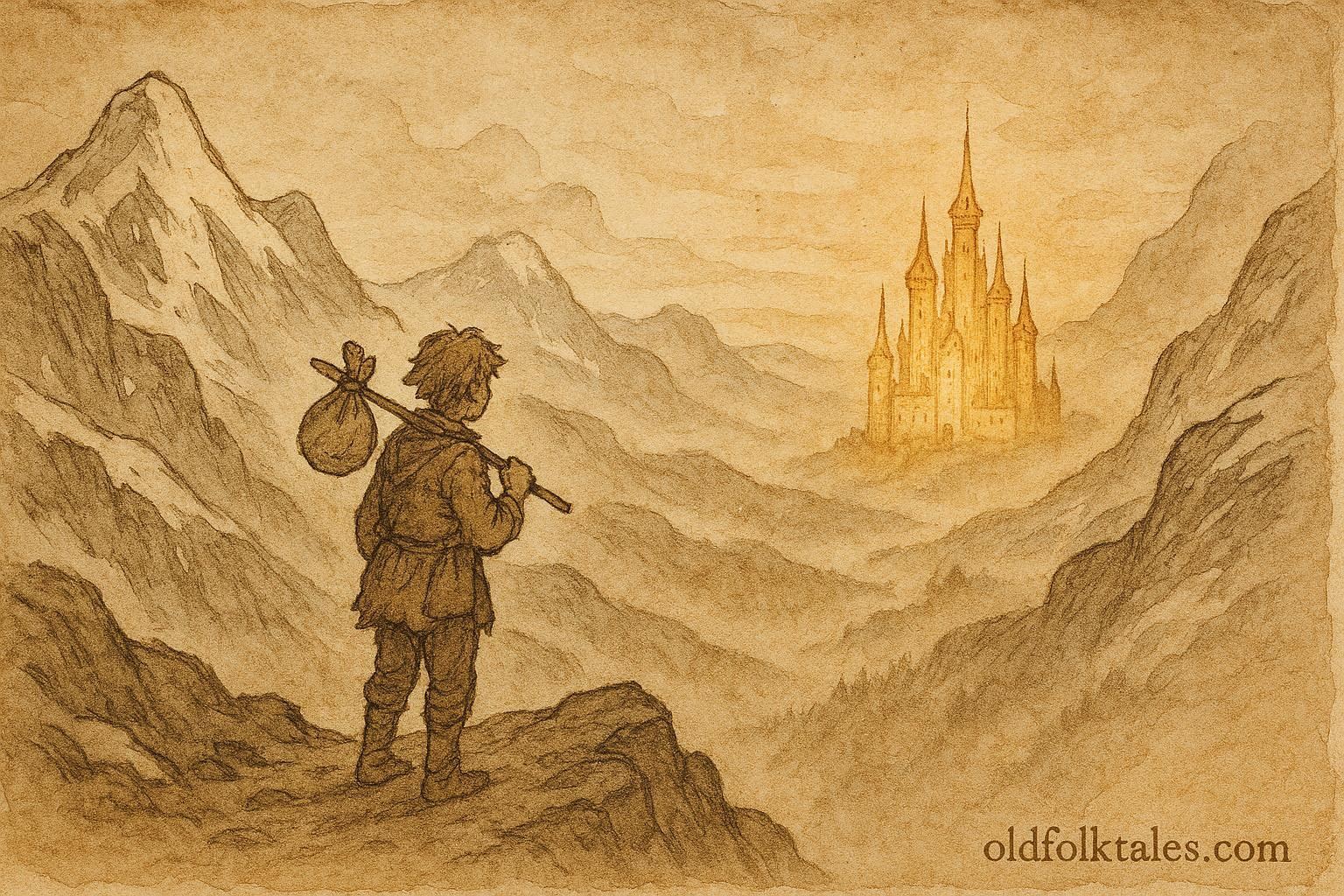
In a poor valley bordered by dark forests and distant mountains, there lived a boy so quiet and dreamy that the villagers believed him slow-witted. His clothes were patched, his meals were simple, and his days were spent tending animals or doing small tasks for others. Yet while his hands worked, his thoughts wandered far beyond the fields and hills he knew. For as long as he could remember, the boy had dreamed of Soria Moria Castle.
In his dreams, the castle stood high and shining beyond mountain after mountain, its walls gleaming like gold beneath the sun. Towers rose into the clouds, and light poured from its windows as though joy itself lived inside. Each time he awoke, the image remained clear in his mind, more real to him than the worn paths of his village.
When he spoke of the castle, the others laughed.
“Soria Moria?” they said. “There is no such place. Dreams do not build houses, and castles do not rise from wishing.”
But the boy did not argue. He only listened, and continued to dream.
Leaving Home
One morning, after another night filled with the shining vision of the castle, the boy rose before dawn. He knew then, with a certainty that surprised even himself, that he could no longer remain where he was.
If Soria Moria existed, he would find it.
He packed what little he owned and set out toward the mountains. As he walked, the land grew harsher. Paths vanished. Forests thickened. Hills rose into steep slopes of stone and wind.
Along the way, he met people who mocked him for his question.
“Have you seen Soria Moria Castle?” he asked each one.
Some shook their heads. Others laughed outright. A few warned him to turn back before hunger or cold ended his foolish journey.
But he did not turn back.
The First Mountain
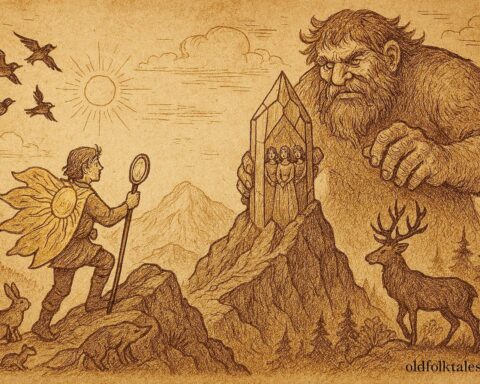
After many days, he reached the foot of a great mountain. Its peak vanished into cloud, and the wind cut sharply across the slopes. Climbing it tested his strength and resolve. His hands bled. His legs shook. At times he thought he would fall.
At the summit, he found an old man sitting beside a small fire.
The old man looked at him closely. “Where are you going, boy?”
“To Soria Moria Castle,” he answered simply.
The old man did not laugh.
Instead, he nodded. “Many have dreamed of it. Few are willing to walk.”
He shared his food with the boy and pointed toward another range beyond the valley below.
“There are more mountains yet,” he said. “If your dream is strong, it will carry you.”
The Long Road
The journey continued through valleys of mist and forests so dense that daylight barely touched the ground. The boy worked when he could, earning bread or shelter in exchange for labor. At night, he slept beneath the stars, always dreaming of the castle that called him onward.
He grew thinner, but his resolve grew stronger.
Each mountain crossed seemed to bring him closer, not only to the castle, but to himself.
The Second Mountain
At the next mountain, higher and colder than the first, he encountered another old man. This one watched over a herd of goats scattered across the rocky slope.
Again, the question was asked. Again, the answer given.
“Soria Moria Castle lies beyond what the eye can see,” the old man said. “Those who reach it do so because they cannot forget it.”
He gave the boy a piece of advice: “Do not measure the road by distance alone. Measure it by faith.”
Trials of Doubt
As the boy traveled farther from all he had known, doubt sometimes crept into his thoughts. The laughter of the villagers echoed in his memory. Hunger and weariness whispered that the castle was only a dream.
Yet each time doubt rose, the image of Soria Moria shone brighter in his mind, its golden walls untouched by fear.
He walked on.
The Third Mountain
The third mountain was the hardest of all. Snow lay thick upon its slopes, and storms came without warning. At times the boy could see nothing but white wind and rock.
At the summit, he found a final old man, older than the others, wrapped in a cloak as pale as frost.
“You have come far,” the man said. “Few come this far.”
“Is Soria Moria beyond this mountain?” the boy asked.
The old man smiled. “It is closer than you think, and farther than you know.”
He pointed toward a narrow path descending into a valley glowing with strange light.
Soria Moria Revealed
As the boy descended, the air grew warmer. The mist lifted. And there, rising beyond the valley, stood Soria Moria Castle, just as he had seen it in his dreams.
Its towers shone like gold. Its walls reflected the sky. The sight filled him with awe so deep that he fell to his knees.
He had not imagined it.
The castle was real.
Within the Castle
Inside the castle, he was welcomed, not questioned, not mocked, but received as one expected. The halls were bright and warm. Music echoed softly. Food was plentiful, and kindness flowed freely.
In time, he met a maiden whose wisdom and gentleness matched the beauty of the castle itself. Through patience and effort, he proved himself worthy—not by boasting of his journey, but by living with humility and care.
He learned that Soria Moria was not a place for those who sought wealth alone, but for those who carried vision through hardship without surrender.
Fulfillment
The poor boy who had once been laughed at became lord of the castle, not through force or inheritance, but through perseverance. He gained love, wisdom, and prosperity, just as his dreams had promised, though not always in the way he had imagined.
And though he never forgot where he came from, he no longer belonged to doubt.
Moral Lesson
Soria Moria Castle teaches that dreams demand endurance, and that faith in one’s vision, when matched with perseverance, can carry even the humblest person beyond ridicule and hardship to fulfillment.
Knowledge Check
-
What is Soria Moria Castle in Norwegian folklore?
It is a legendary golden castle representing destiny and fulfillment. -
Why is the boy mocked at the beginning of the story?
Because others believe dreams without proof are foolish. -
What role do the old men play in the story?
They serve as guides who test and encourage perseverance. -
What does the journey symbolize?
The long struggle required to achieve meaningful dreams. -
Why does the boy succeed where others fail?
Because he refuses to abandon his vision despite hardship. -
What cultural value does the tale reflect?
Norwegian respect for endurance, humility, and inner strength.
Source: Norske Folkeeventyr, collected by Peter Christen Asbjørnsen & Jørgen Moe, 1843
Cultural Origin: Norwegian folklore