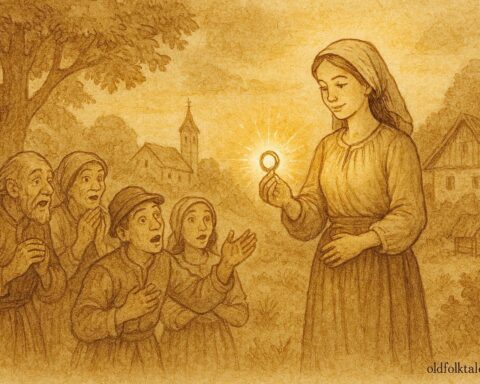
In a quiet Welsh village, nestled between green hills and misty streams, there lived a widow named Mair. Her cottage stood on the edge of a meadow where sheep grazed, and her life, though humble, was peaceful. Mair earned her living tending a few animals and doing small tasks for neighbours, mending clothes, milking cows, or spinning wool by the hearth. Though her days were long, her heart had grown somewhat cold with solitude.
One stormy evening, as the wind howled around the chimney, there came a knock at her door. Mair opened it to find a hooded stranger, pale from travel, holding a small bundle.
“Good lady,” the stranger said softly, “I must journey beyond the mountains and cannot take my child with me. Will you keep him safe for a fortnight? I can pay you well.”
The widow, tempted by the silver coins glinting in the stranger’s hand, nodded quickly. “Leave him with me,” she said. “He will be cared for.” The stranger smiled faintly and placed the bundle, warm and light as a loaf of bread, into her arms. “Remember,” the stranger whispered, “a child’s cry calls not only to human ears.” And before Mair could ask what that meant, the figure vanished into the rain.
At first, the baby was quiet and content. But soon, as babies do, he cried often. Mair, busy tending her cows and hens, found the wailing bothersome. “You’ll have your milk when I’m ready,” she muttered. Days passed, and the child’s cries grew louder. One evening, she left him alone in the cottage while she fetched water. When she returned, the fire had dimmed, and a strange, sweet lullaby filled the air, though no one was there to sing it.
Mair froze. The sound drifted like wind through heather, and the baby was silent, fast asleep. Uneasy, she crossed herself and whispered, “Fair folk, leave me be.” But her fear passed as quickly as it came. She told herself it was only the wind and went to bed.
The next morning, she awoke to eerie stillness. The baby’s cradle was empty. Heart pounding, she searched the cottage and field. There was no trace of him, only the faint echo of the lullaby she’d heard the night before. Trembling, she fell to her knees.
But as the sun rose higher, she heard a faint coo. There, in the cradle, the baby lay once again, unharmed but strangely quiet, his bright voice gone. Relieved yet puzzled, Mair held him close. That evening, however, she found that every one of her animals had fallen ill. The cow refused to give milk, the hens would not lay, and even her faithful dog whimpered at the door.
Then, for the first time in years, Mair felt shame. She remembered the stranger’s words: “A child’s cry calls not only to human ears.” In her neglect, she had not only failed her promise but also offended the spirits that watched over children. Tears welled in her eyes as she cradled the silent infant.
From that day, she changed. Mair began to care for the child with devotion, rocking him by the hearth, singing softly even when he did not answer. She cleaned her cottage, fed her livestock tenderly, and brought food to her neighbours’ children. At night, she placed a bowl of milk and a piece of bread by the door, offerings to the unseen ones she had wronged.
One dawn, as the light touched the hills, Mair awoke to the sound of laughter. The baby, rosy and bright-eyed, was babbling happily in his cradle. Outside, the cows lowed contentedly, the hens clucked again, and the wind carried the same lullaby she had once feared, now sweet and joyful.
Mair fell to her knees and whispered, “Thank you.” She never again treated a child’s cry as a burden, but as a blessing. And in her small village, people said that the fair folk had forgiven her, for kindness had returned to her home.
Moral Lesson
This Welsh folktale teaches that compassion and care for the vulnerable, especially children, invite blessings, while neglect and selfishness bring quiet punishment. The unseen world mirrors our hearts: when kindness fades, misfortune follows; when love is restored, harmony returns.
Knowledge Check
- Who is the main character in The Baby-Farmer?
The main character is Mair, a widow living in a Welsh village. - What promise did Mair break?
She neglected the baby entrusted to her care, ignoring her duty and compassion. - What supernatural event occurs in the story?
The baby vanishes and returns mysteriously, while a fairy lullaby fills the air. - What causes Mair’s misfortune?
Her neglect offends the fair folk, leading to illness among her livestock. - How does Mair regain her good fortune?
By repenting, showing love and care to the child, and offering thanks to the spirits. - What is the moral of this Welsh folktale?
It teaches the importance of empathy, responsibility, and respect for the unseen world.
Source: Adapted from Welsh Fairy-Tales and Other Stories by P. H. Emerson (1894).
Cultural Origin: Wales (Welsh folklore).