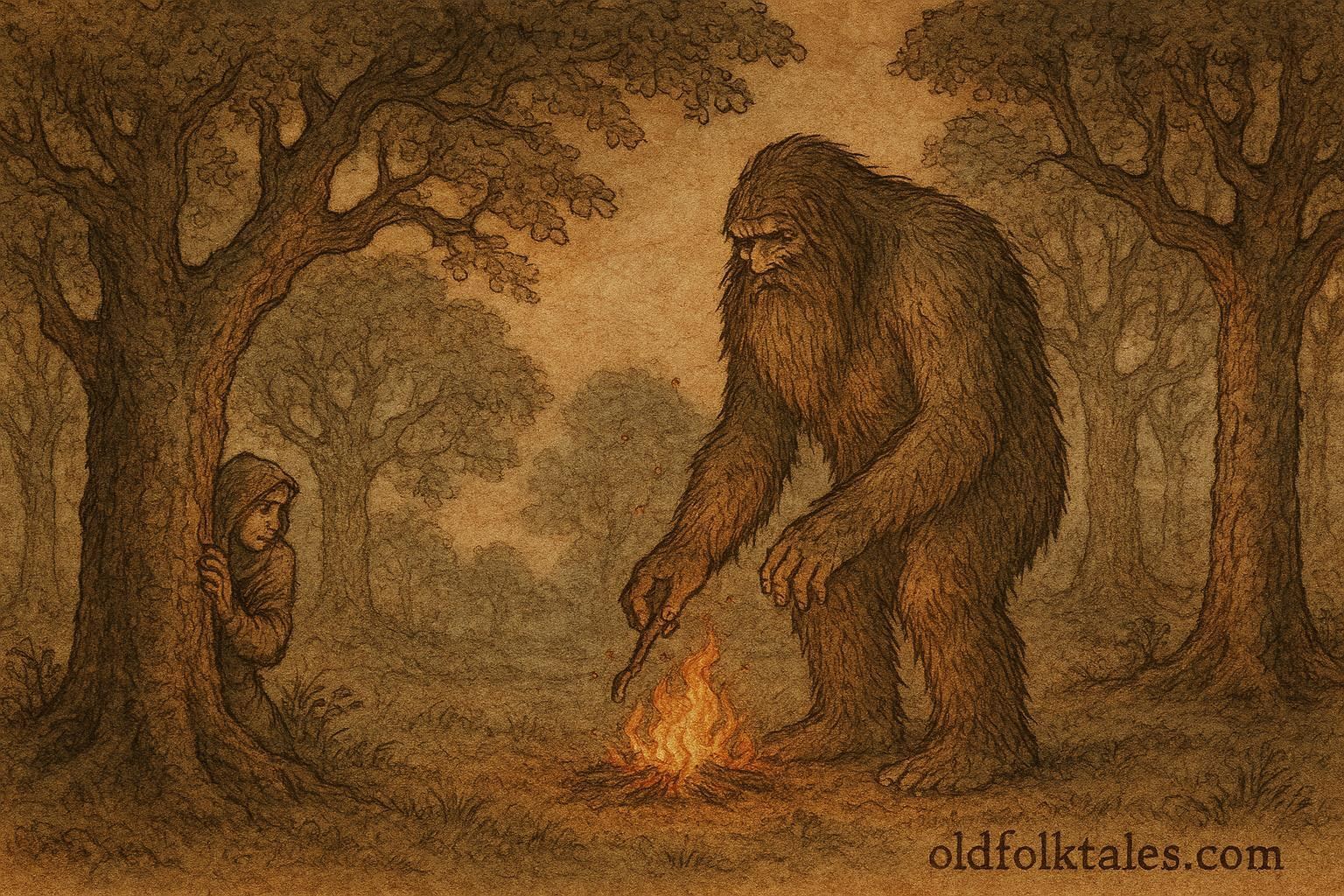
In the deep forests of the Basque Country, where mountains rise like ancient sentinels and mist coils through oak and beech trees, there lived a being older than villages, older than plowed fields, older even than memory given shape in words. He was known as Basajaun, the Lord of the Forest.
To those who glimpsed him from afar, Basajaun appeared as a towering giant, his body covered in thick hair like bark and moss, his feet broad and powerful, one larger than the other. His voice could roll through the valleys like thunder, yet he was no mindless brute. He was the keeper of order in the wild, guardian of flocks, knower of seasons, and holder of secrets that sustained life itself.
Discover the moral heart and wild spirit of the north through timeless Nordic storytelling
Among these secrets were fire and agriculture, the twin forces that would one day define human civilization.
The Age Before Fire
In those early days, humans lived on the edges of the forest, fearful of its depths. They survived by hunting and gathering, shivering through cold nights and struggling to store food beyond the moment of its capture. The land was fertile, yet they did not know how to make it yield grain. Storms destroyed what little they managed to grow, and winter brought hunger with ruthless certainty.
Fire was known only as a terrifying force, glimpsed when lightning struck trees or when volcanic heat scarred the land. Humans had no command over it. They feared it as much as they feared the dark.
Basajaun, however, lived differently.
Within the forest, he kept fire burning, not wild and destructive, but contained, obedient. With it, he warmed his shelter and cooked his food. He knew how to coax grain from the soil, how to sow and reap in harmony with the seasons. The forest animals followed his rhythms, and even the weather seemed to heed his presence.
Though humans feared him, Basajaun did not despise them. He watched them struggle, observing their camps from the shadows. Sometimes, it was said, he even protected their flocks from wolves when storms approached, shouting warnings that echoed through the valleys.
Yet he did not share his knowledge.
For Basajaun understood something humans did not: fire and farming change the balance between people and the land. Once learned, such knowledge could never be unlearned.
The Clever Observer
Among the humans was one whose mind worked differently from the rest. He was neither the strongest nor the loudest, but he was patient and observant. While others spoke of stealing Basajaun’s secrets by force, he knew such an attempt would end in disaster. The giant was too powerful, too deeply bound to the forest itself.
Instead, the man watched.
He noticed that Basajaun sang while working, deep, rhythmic chants that echoed through the trees. He noticed that smoke always rose from the same clearing. He noticed patterns in the seasons, in the way the giant moved from place to place.
Most importantly, he noticed that Basajaun did not guard his knowledge with walls or weapons, but with distance and assumption. The giant believed humans too fearful or impatient to learn by watching alone.
The man waited for the right moment.
Stealing Fire Without Force
One day, when Basajaun left his fire unattended, the man crept close. He did not rush. He did not try to seize flame itself. Instead, he observed how the fire was made, how embers were fed, how dry wood was chosen, how sparks were preserved.
When he finally acted, he did so with care.
He took a burning ember, hiding it within a hollowed branch, shielding it from the wind. He did not extinguish the fire, nor did he destroy Basajaun’s hearth. He took only what could be shared without immediate loss.
By the time Basajaun returned, the man was gone.
That night, for the first time, human fire burned by human hands. Warmth spread through the camp. Food cooked instead of rotting. Darkness retreated.
The forest felt the change immediately.
The Gift of Agriculture
Fire alone was not enough. Survival required food that could last beyond the hunt.
Again, the man watched Basajaun. He observed how the giant sowed grain, how he prepared the soil, how he waited rather than demanded. He noticed that Basajaun worked with the land, not against it, never planting more than the earth could sustain.
Over time, the man carried this knowledge back to his people. Fields appeared where none had been before. Harvests followed seasons instead of chance. Hunger loosened its grip.
Human life changed forever.
Basajaun’s Response
Basajaun knew.
He smelled human fire on the wind. He saw fields growing where forests once stretched unbroken. He heard axes biting into trees that had stood for generations.
Some say he roared in anger, his voice shaking the mountains. Others say he simply watched, silent and sorrowful.
He did not destroy the villages. He did not reclaim the fire. Instead, he withdrew deeper into the forest, retreating to places where human footsteps grew rare.
From that day on, Basajaun became more distant, still present, still watching, but no longer guiding. The bond between humans and nature had shifted. Knowledge had been gained, but innocence lost.
The Price of Progress
Humans prospered. Villages grew. Fields expanded. Fire became commonplace.
Yet with progress came consequence.
Forests thinned. Animals retreated. Storms grew harsher without the old balance maintained by the forest lord. People spoke of Basajaun less as a guardian and more as a legend.
Still, shepherds claimed that when storms threatened their flocks, a deep voice sometimes echoed warnings across the hills. And those who respected the land—who took only what they needed, found their herds strangely protected.
Basajaun had not abandoned humanity entirely. But he would never again walk openly among them.
Fire and agriculture had been taken, not stolen by violence, but by clever observation. And with that gift came responsibility humans would forever struggle to uphold.
Moral Lesson
This Basque folktale teaches that human ingenuity can unlock great power without violence, but every advance carries a cost. Progress brings comfort and survival, yet it also alters humanity’s relationship with nature. True wisdom lies not just in gaining knowledge, but in respecting the balance it disrupts.
Knowledge Check
1. Who is Basajaun in Basque mythology?
Basajaun is a wild forest giant who guards nature’s secrets, including fire and agriculture.
2. How do humans obtain fire in the story?
A clever human gains fire through observation and patience, not force or confrontation.
3. What does fire symbolize in the folktale?
Fire symbolizes the beginning of civilization, knowledge, and human transformation.
4. Why does Basajaun withdraw into the forest?
He withdraws because human progress disrupts the natural balance he protects.
5. What lesson does the story teach about progress?
That progress brings benefits but also responsibility and unintended consequences.
6. How is nature portrayed in Basque folklore through Basajaun?
Nature is powerful, intelligent, and deserving of respect rather than domination.
Source: José Miguel de Barandiaran, Mitología Vasca (1960), compiled from earlier Basque oral traditions
Cultural Origin: Basque Country, Northern Spain