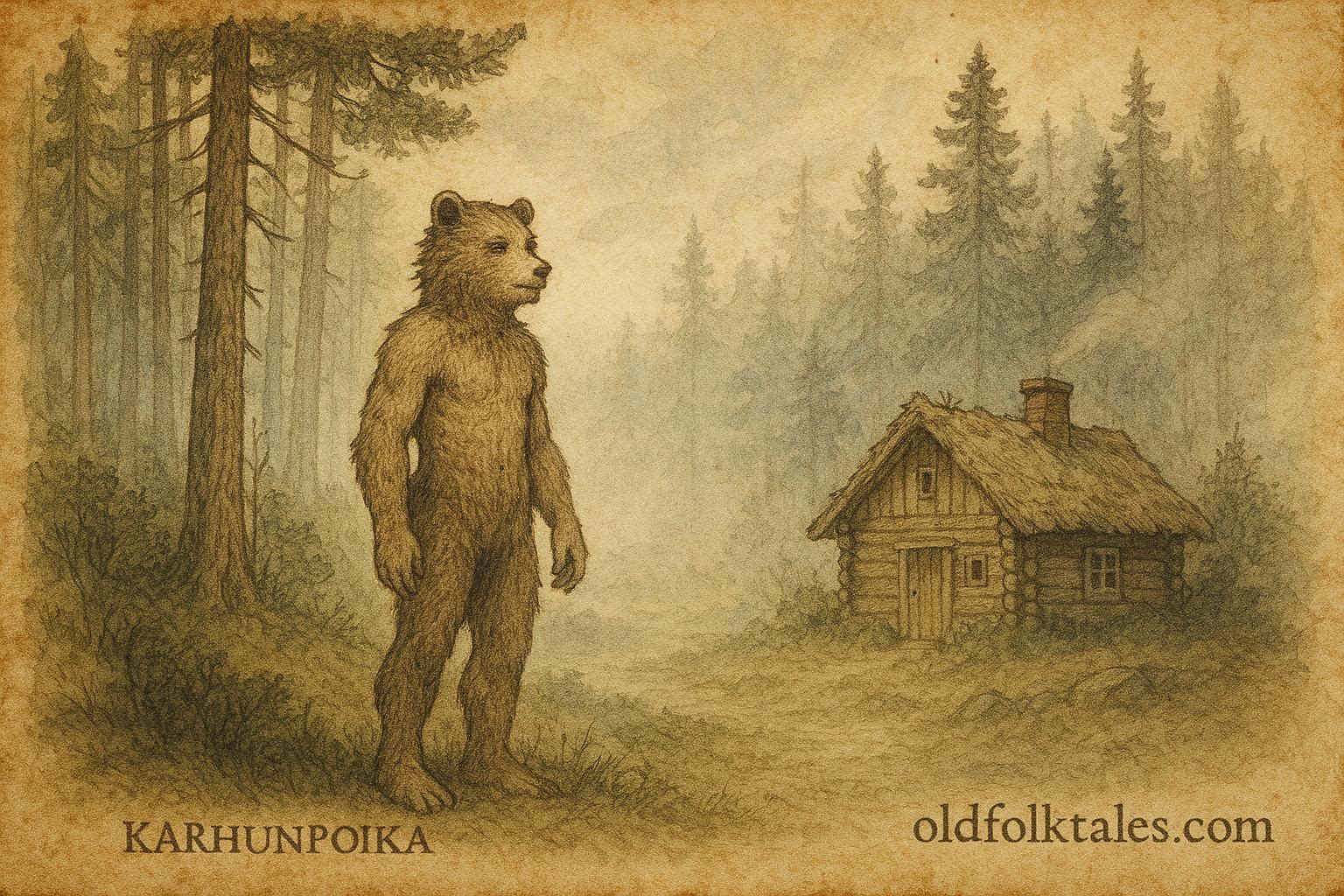
In the deep forests of Finland, where pine and spruce grow so thick that daylight falls in narrow beams and the land seems older than memory, there once lived a woman alone at the edge of the wilderness. Her cottage stood where the fields ended and the forest began, a place where human life met the realm of animals, spirits, and ancient powers.
The woman worked hard and lived quietly, gathering berries in summer, cutting wood before winter, and speaking aloud only when loneliness pressed too hard upon her. She knew the forest well and treated it with respect, for she believed, as many did, that the forest listens and remembers.
One winter night, when snow lay heavy on the ground and the moon hung pale and full above the trees, the woman gave birth to a child.
But the child was no ordinary infant.
He was half-human and half-bear. His body was strong and broad even at birth, his limbs covered in dark fur, his face bearing both human eyes and the blunt strength of a bear’s muzzle. When he cried, his voice echoed like a low growl through the cottage walls.
The woman trembled in fear, but she did not abandon him.
She wrapped the child in warm skins and held him close.
“You are my son,” she whispered. “However, you came into this world.”
She named him Karhunpoika, the Bear Son.
A Child Between Worlds
Karhunpoika grew swiftly, faster than any child in the villages. By the time he could walk, he could lift logs meant for the fire. By the time he could speak, his voice carried deep and rough, like wind moving through the forest.
His strength was immense. He could uproot saplings, break stones, and outrun horses. Animals did not fear him, yet humans did.
When Karhunpoika followed his mother to nearby settlements, people stared and whispered. Some crossed themselves. Others shut their doors.
“He is not one of us,” they said.
“He belongs to the forest,” others murmured.
Karhunpoika felt their fear like cold rain. Though his body was powerful, his heart was sensitive. He longed to sit among people, to laugh and share bread, but wherever he went, silence followed.
Only his mother showed him kindness without hesitation.
“Your strength is a gift,” she told him. “But a gift must be guided, or it becomes a curse.”
Trials of Strength
As Karhunpoika grew into a young man, his strength drew both need and danger. When wolves threatened the village herds, people called upon him. When roads were blocked by fallen trees, they sought his help. Yet after the work was done, they sent him away.
Once, mocked and angered, Karhunpoika nearly lashed out. A single blow of his hand could shatter a door or break a man’s bones.
But he remembered his mother’s words.
Strength alone, he learned, did not make one human.
Seeking his place, Karhunpoika left home and ventured deeper into the wilderness, where he faced trials meant to test not his power, but his heart. He encountered dangerous beasts and hostile men, yet he spared those who showed humility and helped those weaker than himself.
Again and again, he chose restraint over rage.
Understanding Himself
In the forest, Karhunpoika came to understand his dual nature. From the bear, he carried endurance, instinct, and connection to the land. From humanity, he carried compassion, memory, and choice.
He learned that to belong was not to resemble others, but to live with integrity.
When he returned home at last, he no longer sought the approval of fearful villagers. He stood firm in who he was.
The people, seeing his calm strength and steady kindness, slowly changed. Children approached him without fear. Elders greeted him with cautious respect.
Karhunpoika cared for his aging mother and protected the land without demanding praise.
He had found his place, not by rejecting either side of himself, but by accepting both.
Moral Lesson
This folktale teaches that true belonging comes from self-acceptance and moral choice, not outward appearance. Strength must be guided by kindness, and identity is shaped not by origin alone, but by how one lives.
Knowledge Check
-
Why is Karhunpoika feared by villagers?
Because his bear-like form challenges human norms. -
What does Karhunpoika’s strength symbolize?
Raw power that requires moral guidance. -
Why does Karhunpoika leave home?
To seek understanding of his identity and place. -
What lesson does his mother teach him?
That strength without kindness becomes destructive. -
How does Karhunpoika change by the end of the story?
He accepts both his human and animal nature. -
What cultural belief does the story reflect?
Harmony between humans and the natural world.
Source: Collected in Suomalaisia Kansansatuja by Kaarle Krohn, 1880s
Cultural Origin: Finnish oral folklore