In the heart of the Dalmatian countryside, the town of Sinj sat surrounded by rolling hills and fertile valleys. For many months, the land had suffered under a merciless drought. Wells ran dry, crops withered beneath the relentless sun, and the villagers whispered anxiously about the wrath of forgotten spirits. Livelihoods were threatened, and fear had begun to weigh on even the bravest hearts.
One evening, as the sun dipped behind the distant hills, a shadow appeared on the horizon. At first, it seemed like a trick of the light, but soon the villagers saw it more clearly: a magnificent black horse, sleek and powerful, moving alone through the cracked fields. Its coat shone like polished obsidian, reflecting the last rays of daylight, and its eyes held a strange, almost human intelligence.
The villagers approached cautiously. “Who does this horse belong to?” asked Stjepan, an elder. “None of us have seen it before.”
No one answered. The horse moved with such grace that it seemed almost to float above the parched earth. Children followed it at a distance, their laughter breaking the oppressive silence, but even their play could not hide the tension in the village.
Among the villagers was a young man named Luka. He was neither the strongest nor the wealthiest, but his mind was sharp, and his heart brave. Upon seeing the black horse, he felt a stirring of curiosity and purpose. There was something more to this creature than met the eye.
“Let me try to approach it,” Luka said, his voice steady. “Perhaps it has come to help us.”
The villagers murmured their doubts. “It may be wild! Dangerous!” some warned. Others shook their heads, afraid that anyone who dared to approach the horse might be cursed. But Luka ignored their caution.
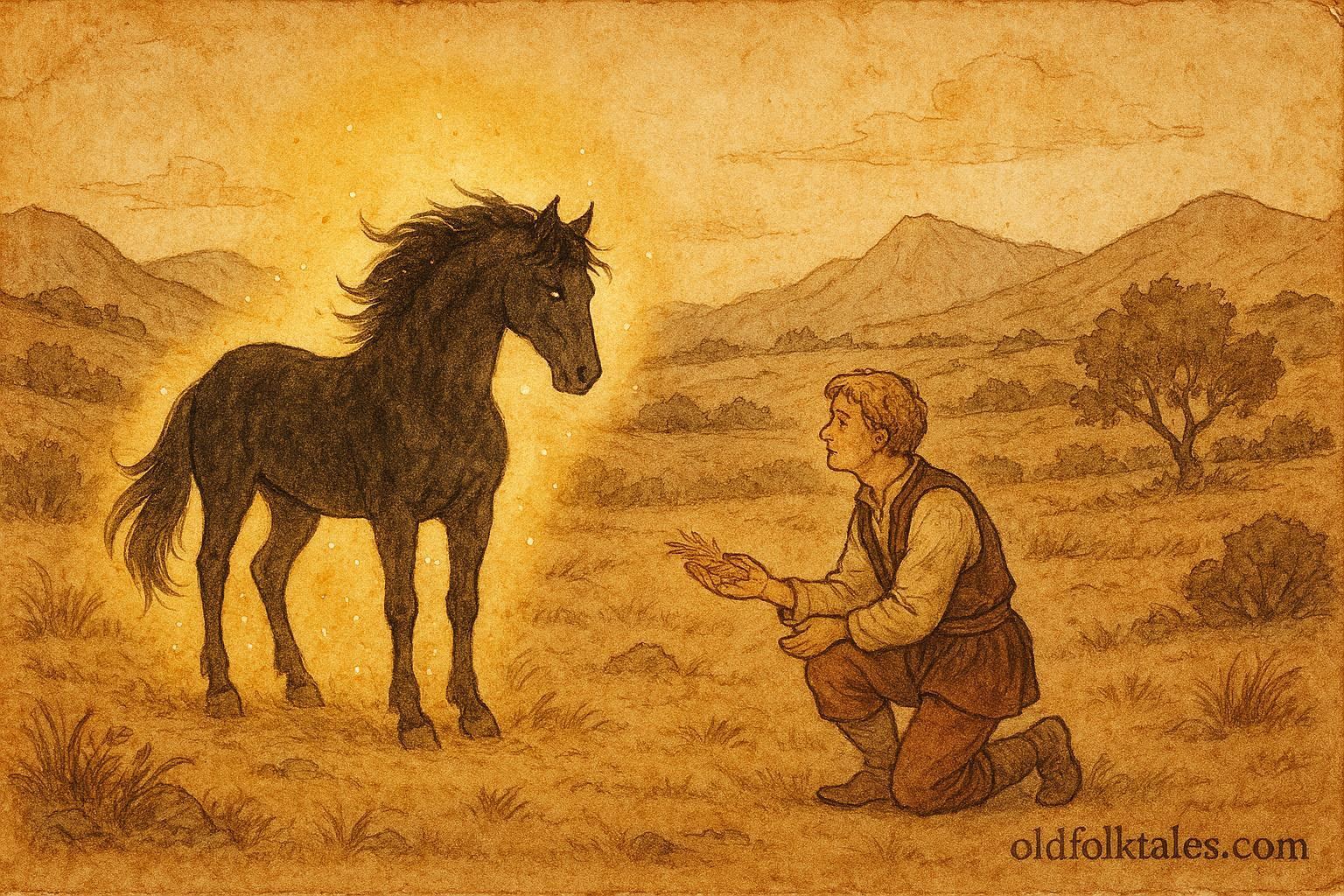
The next morning, Luka set out across the dry fields. He carried nothing but a small satchel of oats and a rope. The black horse watched him silently from the ridge, nostrils flaring with the scent of the wind. Luka did not rush. He knelt on the cracked ground, offering the oats with a gentle voice.
To his surprise, the horse lowered its head and ate, its dark eyes softening as though testing Luka’s intentions. For hours, Luka stayed, speaking softly and moving slowly, never attempting to touch the horse until it allowed him. By nightfall, a bond had begun to form between them.
But the villagers were restless. “He will bring trouble upon us,” some whispered. Yet when Luka returned the next day, the horse followed him willingly. It seemed to respond to his words, almost understanding him. The young man realized that this was no ordinary animal; the horse was enchanted, bound to some distant kingdom and some forgotten spell.
Determined to uncover the truth, Luka ventured into the forest beyond Sinj, guided by the horse. Birds chirped nervously, and the shadows of the trees seemed to whisper secrets. As they reached a hidden glen, a shimmering portal appeared, barely visible among the moss and ferns. Luka recognized it immediately as a magical doorway, pulsing with light.
A voice, soft and melodious, spoke from the air itself. “Only one who proves kindness and cleverness may free the horse and restore balance to your village.”
Luka nodded. “I will do whatever is needed,” he replied.
The first trial was simple in theory but complex in practice. A riddle appeared before him, carved into a stone tablet by shimmering letters:
“I have no wings, yet I can soar.
I speak no words, yet I tell much more.
What am I?”
Luka pondered, recalling the animals and signs of nature he had observed as a child. The answer came to him: a bird. He spoke it aloud, and the ground trembled softly in acknowledgment. The horse stamped its hoof, approving.
The next challenge tested both his courage and his cleverness. Luka had to cross a river filled with illusions. The waters showed visions of treasures and dangers alike, tempting him to stray or turn back. With calm focus, Luka ignored the illusions, stepping carefully from stone to stone, letting the black horse guide him by its subtle movements. At the far bank, the river parted briefly, allowing him to cross without harm.
Finally, Luka faced the enchantment itself. The black horse, now glowing faintly with a magical aura, was trapped in a circle of silver flames. The fire was not meant to burn, but to test the heart of anyone who sought to free the horse. Luka remembered the lessons of his village: kindness, patience, and clever thinking.
He took a deep breath and spoke to the horse: “I will not leave you, and I will not harm you. Together, we will find the path to freedom.” He then used a mirror from his satchel to reflect the sunlight onto the flames. To the astonishment of both Luka and the horse, the flames shimmered and vanished, breaking the spell.
The horse’s coat glowed brighter, now radiant with the power of its true form. It neighed, a sound like rolling thunder softened by magic, and bowed its head to Luka. The young man mounted it, and together they returned to Sinj.
The villagers watched in awe as the black horse galloped across the valley, the earth seeming to flourish beneath its hooves. Wells refilled, fields sprouted new shoots, and the drought that had plagued them vanished as if it had never been.
Stjepan and the other elders approached Luka with gratitude. “You have not only saved our village but shown us the power of courage, cleverness, and respect for the forces beyond our understanding,” Stjepan said.
The black horse, now free, belonged to a hidden kingdom, and it would return there. But before departing, it allowed the villagers to ride it once, feeling the magical connection that had restored balance to Sinj. Children laughed as they trotted along its back, farmers marveled at its strength, and Luka felt a deep sense of fulfillment, knowing that he had honored both his village and the enchanted being.
The story of Luka and the black horse spread far and wide. Travelers passing through Sinj would hear of the brave young man who approached a mysterious horse, solved riddles, navigated illusions, and broke an ancient spell. They told of the drought ended, the land revived, and the village united by one individual’s courage and clever thinking.
Years later, the elders would tell the tale to their children and grandchildren, emphasizing that true heroism was not measured by strength or wealth, but by kindness, intelligence, and the willingness to act in service of one’s community. The black horse, though gone, became a symbol of hope, reminding every generation that even in times of despair, courage and cleverness could restore life and balance.
Moral Lesson
Courage, kindness, and cleverness, combined with respect for the magical and unknown, can overcome even the direst challenges. Individual action, when guided by wisdom, benefits the entire community.
Knowledge Check
1. What problem was affecting the village of Sinj?
A severe drought that dried wells, ruined crops, and threatened the villagers’ livelihoods.
2. Who was the black horse?
An enchanted creature belonging to a hidden kingdom, trapped by a magical spell.
3. How did Luka approach the black horse?
With kindness, patience, and careful attention, offering food and gentle words.
4. What challenges did Luka face to free the horse?
Riddles, a river of illusions, and a circle of magical flames.
5. How did the village benefit from Luka’s actions?
The drought ended, fields flourished, wells refilled, and the community prospered.
6. What cultural origin does this story represent?
Croatian folklore, reflecting heroic quests, enchanted animals, and communal values.
Source: Mato Lovrak, Croatian Folktale Collection (1935)
Cultural Origin: Croatia