Across the flat marshlands and wind-swept coasts of East Anglia, where the North Sea presses against shingle shores and vast skies stretch endlessly above low fields, there lingers a legend that has endured for centuries. It is a tale told in hushed tones beside hearth fires and repeated along lonely country roads, a story of a great black hound known as the Black Shuck.
In the sixteenth century, when England’s villages were small and the countryside lay thick with superstition, travelers crossing the heaths at dusk often did so with quickened steps. The land itself seemed watchful. Reeds rustled in unseen currents. Church towers stood stark against storm-heavy clouds. And along these quiet roads, some claimed to encounter a creature not entirely of this world.
Explore the wit and wisdom of Western Europe, where humor and virtue often go hand in hand
They described it as enormous.
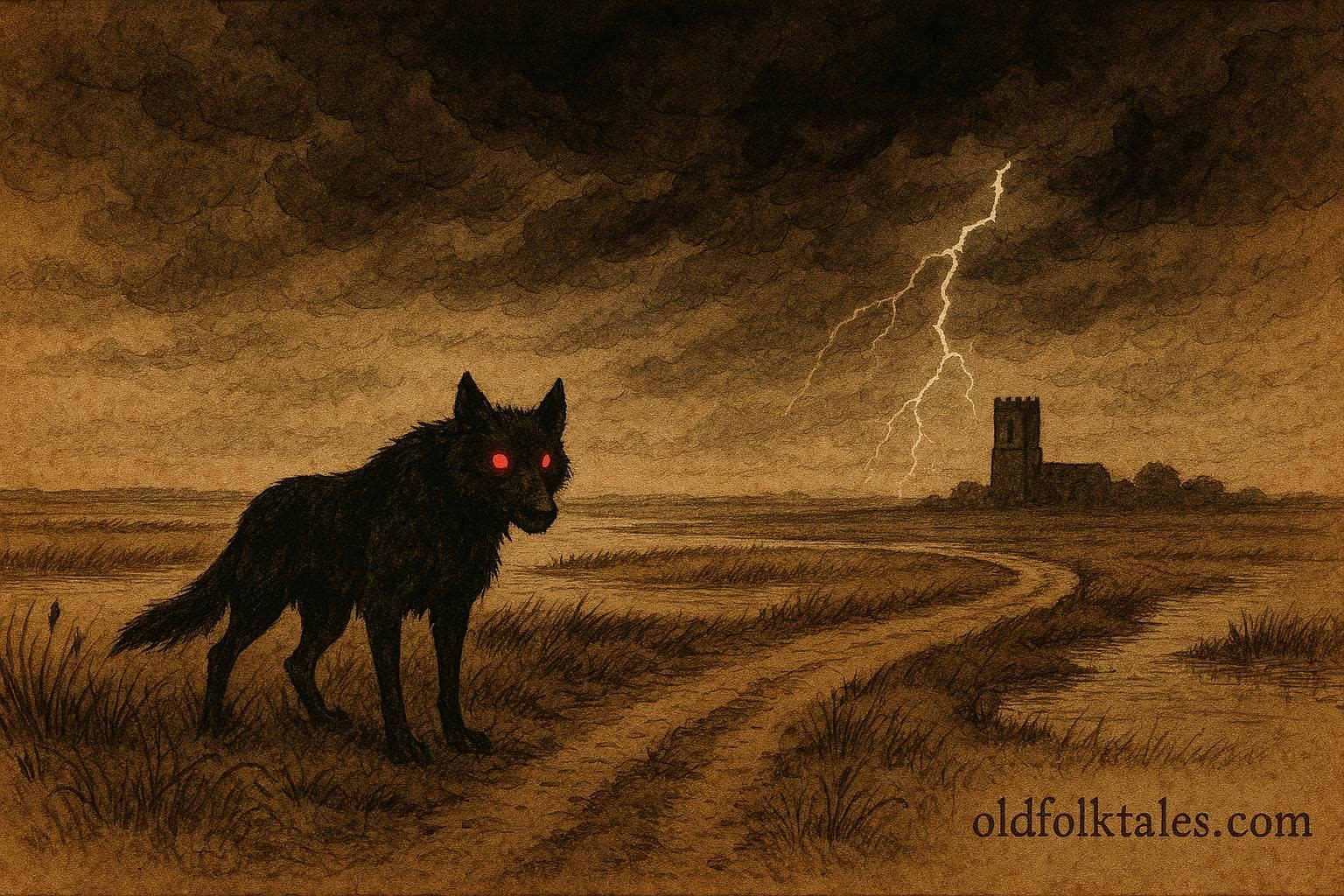
A dog, if dog it could be called, larger than any mastiff, its body cloaked in darkness so complete it seemed to swallow light. But what none could forget were its eyes. They burned like coals in a dying fire, fierce and red, casting an unnatural glow in the night. Some said sparks leapt from them. Others swore that a single glance froze the blood in their veins.
This was the Black Shuck.
Its name was whispered with dread. “Shuck” was thought to mean devil or fiend, and many believed the creature to be a spirit of ill omen. Those who saw it expected misfortune. Some prepared themselves for death.
One account, preserved by Reverend Abraham Fleming in 1577, describes fearful events in Suffolk. A violent storm lashed the region, thunder splitting the sky and lightning striking near sacred ground. Amid this chaos, witnesses claimed that a monstrous black dog burst into a church, its eyes blazing. It ran through the nave, leaving marks of terror in its wake. When it vanished as suddenly as it appeared, several parishioners were said to have perished.
Whether the deaths were caused by lightning or by the panic that followed mattered little to those who survived. The legend took root immediately. The Black Shuck was no ordinary apparition. It was a harbinger.
Yet not all tales spoke of violence.
In many villages of Norfolk and Suffolk, the spectral hound appeared along lonely coastal paths or beside ancient hedgerows. A fisherman returning home at twilight might glimpse it pacing beside him silently. A cart driver might hear the heavy tread of paws behind his wheels, only to find no creature when he turned.
Often, the Black Shuck did nothing more than walk.
It neither growled nor attacked. It simply followed, its presence enough to send a traveler hurrying forward with pounding heart. Some reached their homes safely, shaken but unharmed. Others later reported illness or tragedy in their households, interpreting the sighting as a warning they had not fully understood.
The flat lands of East Anglia seemed especially suited to such a legend. Mist gathered easily across the marshes. Moonlight reflected strangely on tidal waters. Shapes distorted in the half-light. A large stray dog glimpsed at distance could become, in frightened memory, something far greater.
But fear does not depend solely on explanation.
The people of East Anglia lived close to uncertainty. The sea claimed ships without warning. Disease swept through villages. Harvests failed. Death was never distant. In such a world, a creature like the Black Shuck gave form to anxieties too large to name. It became the shadow that accompanied every fragile life.
Some stories even granted the hound a strange neutrality. In certain accounts, it acted not as executioner but as messenger. A traveler who encountered it and survived might take the warning to heart, mending quarrels, confessing sins, or preparing spiritually for what lay ahead. In this way, the Black Shuck served as a reminder of mortality rather than its cause.
Descriptions varied slightly across the region. In some versions, the hound had a single blazing eye. In others, it was headless. A few spoke of chains clanking as it moved, like a restless guardian bound to its route. Yet always the core remained: a large black spectral dog, appearing at night, its fiery gaze impossible to forget.
Churches in Blythburgh and Bungay became especially associated with sightings. Weathered doorways bore scorch marks that locals pointed to as proof of the hound’s passing. Whether lightning or legend carved them mattered little. The marks themselves became relics of belief.
Children grew up hearing warnings: do not wander alone after dark; do not mock what you do not understand; heed the signs that cross your path.
Still, sightings continued.
A shepherd crossing open fields at dawn claimed he saw the creature watching from a rise, its silhouette stark against pale sky. When he blinked, it was gone. A woman returning from market swore it crossed her road silently, vanishing into hedgerow shadows. A sailor, hardened by storms, admitted to trembling when he glimpsed burning eyes along the quay.
Time did not banish the Black Shuck. Even as centuries passed and superstition slowly yielded to reason, the story persisted. Folklorists collected accounts. Antiquarians debated origins. Some suggested the hound descended from older European myths of spectral dogs guarding thresholds between worlds. Others pointed to Norse influences brought by earlier settlers.
But to the people of East Anglia, the explanation mattered less than the experience.
The Black Shuck belonged to their landscape.
It haunted wide skies and low marshes. It lingered where sea met land. It moved through a countryside shaped by wind and tide, places where the horizon feels endless and solitude runs deep.
And though many claimed it foretold death, not all who saw it perished soon after. Some lived long lives. Some never encountered it again. This ambiguity only strengthened the legend. A creature that kills outright can be categorized as monster. A creature that merely appears, unpredictable, silent—becomes something more unsettling.
It becomes possibility.
In the end, whether the Black Shuck was spirit, omen, or imagination given shape by storm and shadow, it accomplished something enduring. It bound communities through shared story. It reminded listeners that life is fragile and that night holds mysteries beyond full understanding.
Even today, along certain coastal paths of East Anglia, walkers speak of a sudden chill when fog thickens. They glance over their shoulders, half-expecting to see a massive dark shape pacing just beyond sight.
And sometimes, in the corner of an eye, there flickers something like red fire.
Moral Lesson
The legend of the Black Shuck teaches that fear often grows from uncertainty, and that mortality is an inescapable part of human life. Whether omen or imagination, the spectral hound reminds us to live thoughtfully and not ignore the fragile boundaries between the known and the unknown.
Knowledge Check
1. What is the Black Shuck in English folklore?
The Black Shuck is a large black spectral dog from East Anglia believed to be a death omen or supernatural warning.
2. Where did the Black Shuck legend originate?
The legend originates in East Anglia, England, particularly Norfolk and Suffolk.
3. Who recorded early accounts of the Black Shuck?
Reverend Abraham Fleming documented sightings in a 1577 pamphlet.
4. What do the fiery eyes of the Black Shuck symbolize?
They symbolize supernatural presence, fear of death, and divine or ominous warning.
5. Did the Black Shuck always harm people?
No. In many tales, it frightened travelers without harming them, serving as a warning rather than an attacker.
6. Why is the Black Shuck associated with rural superstition?
Its legend emerged in isolated countryside communities where natural dangers and uncertainty shaped belief.
Source: Reverend Abraham Fleming, pamphlet account of East Anglian events (1577).
Cultural Origin: East Anglia, England.