In a modest town of old Germany, where timber-framed houses leaned gently over cobbled streets and church bells marked the rhythm of daily life, there lived a tailor whose world was no larger than his workshop window.
He was small in stature, light in build, and rarely taken seriously by those who passed his door. His days were spent bent over cloth, needle flashing in and out of wool and linen, stitching garments for farmers, merchants, and the occasional traveler. It was honest work, but humble.
One summer morning, as sunlight streamed across his worktable, he prepared himself a slice of bread spread generously with jam. Just as he lifted it to eat, flies descended in a buzzing swarm, drawn by the sweetness.
Annoyed, the tailor snatched up a scrap of cloth and struck at them with sudden force.
When he lifted the cloth, seven flies lay still upon the table.
Seven, in a single blow.
He stared in disbelief. His heart beat faster. The world felt different.
“Seven at one stroke!” he whispered.
The words stirred something deep inside him. For the first time, he saw not a tailor, but a man capable of great deeds. It mattered little that his adversaries had been flies. The number was what counted.
Seized by sudden inspiration, he stitched a belt and embroidered upon it in bold letters:
‘Seven at One Stroke.’
He fastened it proudly around his waist.
Why should he remain confined to hems and seams when he possessed such power? The world beyond the town walls called to him.
And so, with little more than bread in his pouch and confidence in his chest, the tailor set out upon the road.
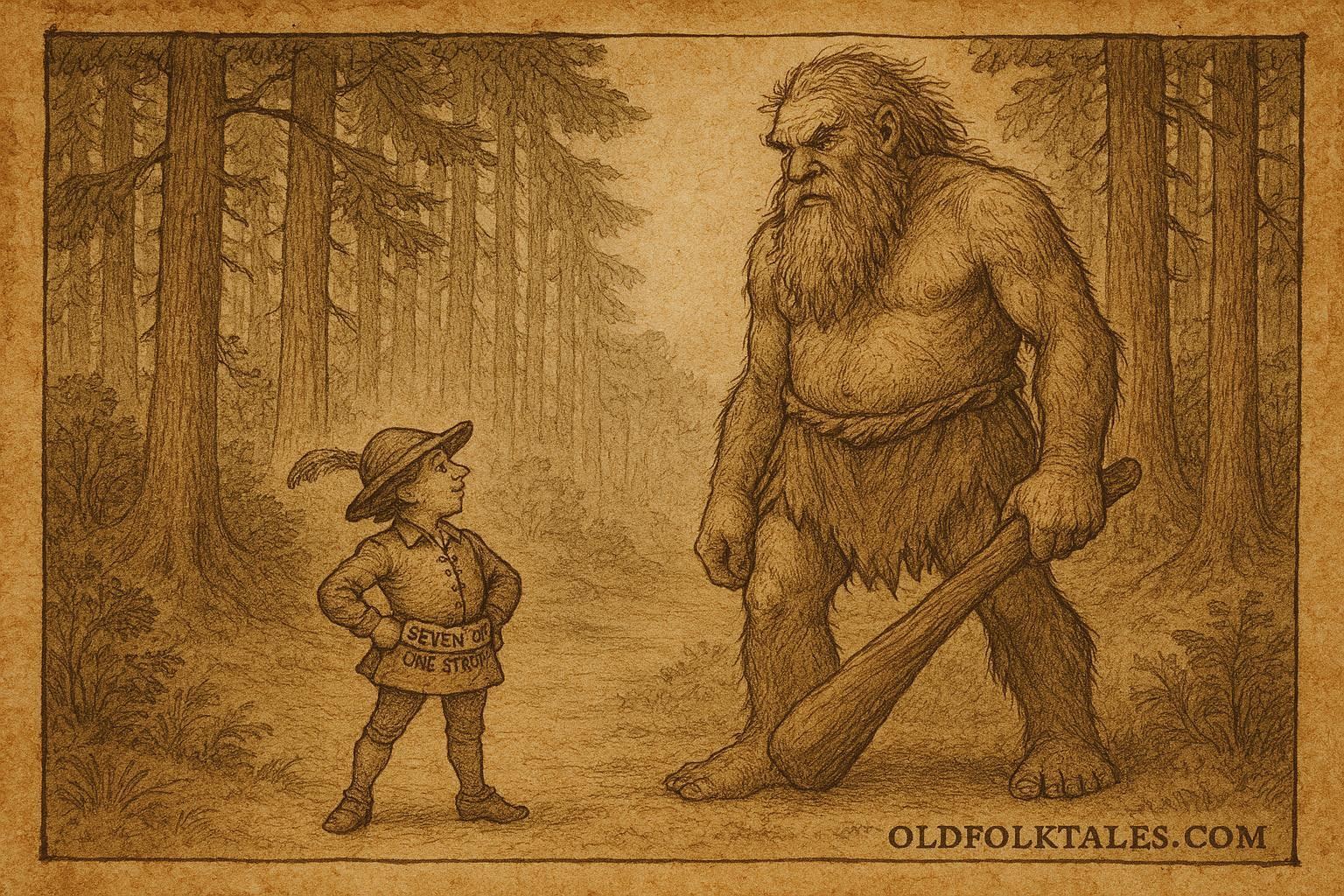
Not far into the forest, he encountered a giant tall as an oak, broad as a barn door, with arms like tree trunks.
The giant looked down at the small man with mild amusement.
“Where are you going, little fellow?”
The tailor straightened and tapped his belt.
“Seven at one stroke.”
The giant’s eyes widened. He assumed the boast referred not to flies, but to men.
Curiosity replaced amusement.
To test him, the giant picked up a stone and squeezed until water dripped from it.
“Can you do that?” the giant asked.
The tailor calmly reached into his pouch and produced a piece of soft cheese. He squeezed, and whey ran down his fingers.
The giant frowned.
Then the giant hurled a stone high into the air.
“It will never return,” he boasted.
The tailor picked up a small bird hidden in his pocket and tossed it upward. The bird flew free into the sky.
“Mine won’t return either,” he said.
The giant’s confidence wavered.
Still uncertain, he led the tailor to a fallen oak tree.
“Carry this to our cave,” the giant commanded.
The tailor agreed but cleverly positioned himself at the top of the trunk, allowing the giant to bear most of the weight while he appeared to assist.
When they reached the cave, the giant, increasingly uneasy, sought to rid himself of the small but alarming man. He offered him a bed, secretly intending to crush him during the night.
The tailor, noticing the scheme, slept in a corner instead. At midnight, the giant struck the bed with an iron bar, convinced he had flattened the little warrior.
At dawn, when the tailor appeared unharmed, the giant fled in terror.
Word of the tailor’s “strength” spread swiftly.
Soon he arrived in a kingdom troubled by two giants who devastated fields and frightened villagers. The king, desperate, promised riches and his daughter’s hand to whoever could rid the land of these monsters.
The tailor volunteered.
Hidden among trees, he cleverly provoked the giants into fighting one another by hurling stones at them from concealment. Each blamed the other. Their anger escalated until, in blind fury, they destroyed each other.
The tailor stepped forward as victor.
But the king, uneasy about giving his daughter to such a small man, devised further tests.
First, the tailor was ordered to capture a wild unicorn terrorizing the forest. Rather than confronting it head-on, he stood before a tree. The unicorn charged. At the last moment, the tailor leapt aside, and the beast’s horn embedded itself in the trunk.
Bound and helpless, the unicorn was delivered to the king.
Next came a savage boar ravaging the countryside. Again, the tailor relied on wit. He lured the beast into a chapel and slipped out swiftly, trapping it within heavy doors.
Each success made the king more anxious.
At last, unwilling to defy his promise openly, he arranged for soldiers to enter the tailor’s chamber at night and kill him in his sleep.
But fate, and habit, intervened.
In his dreams, the tailor muttered aloud:
“Seven at one stroke!”
The soldiers, hearing the words, believed he spoke of men, not flies. Terrified of confronting such a warrior, they fled.
The king, recognizing that neither giants nor beasts nor soldiers could overcome him, accepted what destiny had decreed.
The humble tailor married the princess and rose to royal rank.
And though he remained small in size, his courage and cleverness had carried him farther than brute strength ever could.
Some say he ruled wisely, remembering his modest beginnings. Others say he always kept his belt, “Seven at One Stroke”, as a reminder that confidence can transform even the smallest victory into a path toward greatness.
Moral Lesson
Cleverness and confidence can achieve what brute force cannot. True strength lies not in size, but in wit, courage, and self-belief.
Knowledge Check
1. Why is the tailor called “The Brave Little Tailor”?
Because he boldly proclaims killing seven at one stroke and proves his courage through clever victories.
2. What does “Seven at One Stroke” mean in the Grimm folktale?
It refers to seven flies killed at once, though others mistake it for seven men.
3. How does the tailor defeat the giants?
He tricks them into fighting each other using intelligence instead of strength.
4. What role does wit play in the story?
Wit allows the tailor to overcome giants, wild beasts, and royal tests.
5. Who recorded The Brave Little Tailor?
Jacob and Wilhelm Grimm in Kinder- und Hausmärchen (1812).
6. What theme defines this German folktale?
Intelligence and confidence triumph over brute force.
Source: Jacob and Wilhelm Grimm, Kinder- und Hausmärchen, 1812
Cultural Origin: German folklore