In the emerald hills and misty valleys of ancient Ulster, where rivers gleamed like silver ribbons and the wind carried the scent of heather, there lived a bull unlike any other. His hide was the color of deep autumn earth, gleaming bronze in the sunlight, and his eyes burned with the fierce intelligence of the wild. This was no ordinary bull, for he was the Brown Bull of Cooley, a creature of magic and power, whose presence was both revered and feared by all who dwelled in the lands around Cooley Peninsula.
The bull’s fame spread far and wide, for it was said that his strength could topple trees, shake the ground, and rival the mightiest warriors. In a time when cattle were wealth, status, and the lifeblood of a kingdom, the Brown Bull represented not only raw power but the honor and pride of Ulster itself. Each king and chieftain who heard of the bull’s grandeur felt a mix of awe and envy, and the rumor of his existence stirred ambitions that would change the course of the land.
Explore the wit and wisdom of Western Europe, where humor and virtue often go hand in hand
Among the men who knew the tales was Conchobar mac Nessa, the young king of Ulster. Strong, proud, and clever, he ruled with both wisdom and a temper quick to flare when his authority was challenged. The Brown Bull grazed in the hills of Cooley, under the care of the herders of Connacht, in a region bordering Ulster’s lands. Word reached Conchobar that the bull’s capture would enhance his prestige and provide unmatched wealth and strength to his kingdom. His heart, stirred by ambition and the honor of Ulster, resolved to claim the creature for his own.
The Call to Heroism
To capture the bull, Conchobar summoned the finest warriors of Ulster, among them the young hero Cú Chulainn, famed for his courage, skill, and the divine favor that seemed to accompany him. Cú Chulainn, though still young, had already earned a reputation as a formidable champion, whose prowess in battle and unmatched speed with spear and sword inspired both loyalty and fear. The king charged him with leading the raid to Cooley, warning that only courage, cunning, and strength could succeed against a creature so vast and untamed.
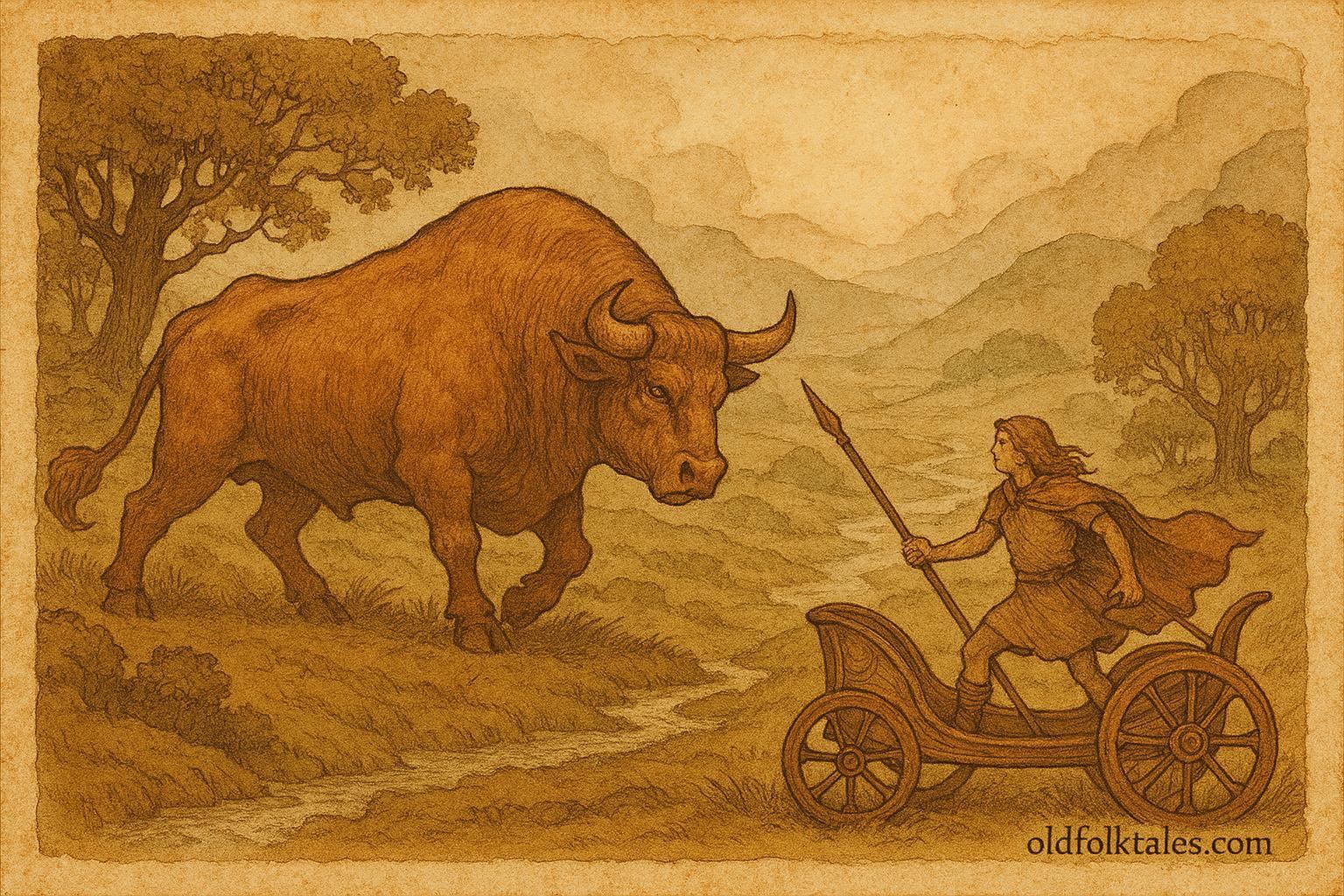
Cú Chulainn accepted the task with solemn determination. He gathered his chariot, weapons, and swift horses, knowing that a force alone might not suffice, the Brown Bull was no ordinary beast. As he rode into the hills of Cooley, the earth trembled beneath the weight of the bull’s hooves, a reminder of the challenge that awaited. Birds scattered from gorse bushes, and wild animals fled as if sensing the tension between human and magical power.
The Encounter with the Bull
At dawn, Cú Chulainn and his warriors reached the valley where the Brown Bull grazed, a lone figure in the misty sunlight. The bull lifted its head, nostrils flaring, eyes gleaming like molten bronze. The earth itself seemed to recognize its master. Warriors held their ground, gripping their spears and swords, yet even the boldest felt the weight of awe. Cú Chulainn, calm and focused, approached alone at first, testing the bull’s reaction.
The Brown Bull pawed the ground, snorted, and charged, not with malice, but with the instinct of a creature aware of its power and freedom. Cú Chulainn sidestepped with the swiftness of a striking hawk, thrusting his spear carefully, testing the beast’s defenses. Hours passed as man and beast circled, each measuring the other. It became clear that only the sharpest strategy and deepest respect for the bull’s strength would ensure survival.
The Challenge of Honor
Cú Chulainn recognized that brute force alone would fail. He recalled the teachings of elders and the sacred respect owed to all living creatures, especially those blessed with strength beyond mortal measure. Using the terrain to his advantage, he led the bull along narrow ridges and shallow streams, guiding it without harm, allowing the creature’s strength to be acknowledged rather than punished.
The bull tested him repeatedly, charging through fields and leaping rocky banks. Yet Cú Chulainn’s skill, patience, and understanding of the animal’s spirit allowed him to gain the bull’s reluctant trust. Slowly, the chase became less of a battle and more of a ritual, one of respect, courage, and mutual acknowledgment. Cú Chulainn’s heart beat steadily, aware that any misstep could bring ruin to himself and his men.
The Capture and the Spark of War
Finally, after days of careful pursuit and daring maneuvering, Cú Chulainn succeeded in restraining the bull, binding it with ropes blessed by druids and the elders of Ulster. Triumph filled the hearts of Ulster’s warriors, yet their victory was shadowed by the tension between kingdoms. The capture of the Brown Bull was seen by the neighboring king of Connacht as an insult and a direct challenge to their honor. Word of the theft traveled quickly, and the drums of war began to beat across the hills, stirring men and animals alike into a frenzy of preparation for battle.
The bull itself, though restrained, remained proud, its eyes reflecting both defiance and recognition of the hero who had bested it with skill rather than cruelty. Its presence in Ulster symbolized not only the wealth and prestige of the kingdom but also the responsibility that came with such power. Cú Chulainn, aware of the impending conflict, prepared the men not just with weapons but with courage, ensuring that honor and strategy guided them more than rage or greed.
The Battle for Honor
The war between Ulster and Connacht erupted across the green hills and river valleys, a clash of swords, spears, and shields, where men fought for kings, pride, and the future of their clans. Yet even in the chaos of battle, the Brown Bull proved its worth. Its strength and presence bolstered the courage of Ulster’s warriors, inspiring acts of heroism that would be sung of for generations. Cú Chulainn led the men with a combination of daring, strategy, and deep respect for the land, ensuring minimal loss and demonstrating that true bravery lies not only in skill but in judgment.
Stories tell that the bull itself sometimes broke free in moments of frenzied energy, charging across battlefields and scattering forces, yet never harming the innocent. Its loyalty, once earned, was absolute, illustrating the bond between human courage and the natural or magical world.
Aftermath and Legacy
When the fighting ceased, the Brown Bull of Cooley remained a symbol of Ulster’s strength, courage, and honor. Cú Chulainn returned to his people, his fame amplified, but he always remembered the lesson of the bull: that power demands respect, that the greatest triumphs combine skill with wisdom, and that honor carries responsibility. The bull was neither tamed nor diminished by its captivity, it remained majestic, a living emblem of the mystical and heroic spirit that animated the land.
In the villages surrounding Cooley, the story of the Brown Bull passed from generation to generation. Parents recounted the heroism of Cú Chulainn and the trials of the bull, teaching children that bravery, loyalty, and honor are as essential as strength. The tale became part of the cultural fabric of Ulster, blending the heroic ideals of men with the sacredness of the land and its magical creatures.
Journey into the charm of British wit and Irish wonder through centuries of folk tradition
Moral Lesson
The legend of the Brown Bull of Cooley teaches that true heroism is not measured solely by strength, but by courage, wisdom, and respect for the natural and mystical worlds. Bravery and honor are intertwined; loyalty to one’s people and ethical action elevate success beyond mere conquest. True power carries responsibility, and the bonds between humans and the extraordinary, whether animal, land, or magic, shape the destiny of kingdoms.
Knowledge Check
-
Who is the Brown Bull of Cooley?
A giant, magical bull whose capture becomes central to the heroism of Cú Chulainn and sparks a war between kingdoms. -
Who leads the capture of the bull?
Cú Chulainn, the young hero of Ulster, renowned for courage, skill, and divine favor. -
What qualities allow Cú Chulainn to succeed?
Bravery, intelligence, patience, respect for the bull, and strategic skill. -
Why does the capture of the bull spark war?
Because the neighboring king of Connacht sees it as an insult and a challenge to honor. -
What themes are central to the story?
Heroism, loyalty, bravery, honor, and human-animal bonds. -
What is the cultural origin of this tale?
Irish folklore, part of the Ulster Cycle, recorded from older oral traditions.
Source: James MacKillop, A Dictionary of Celtic Mythology (1998, citing older oral sources)
Cultural Origin: Irish (Ulster Cycle, Celtic folklore)