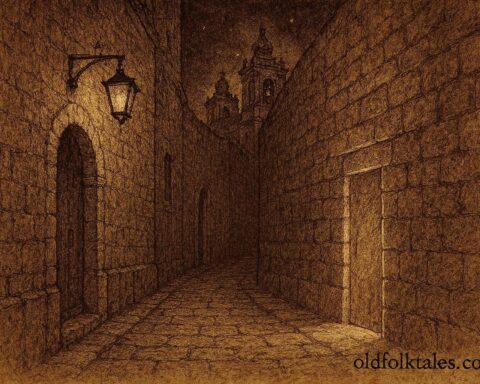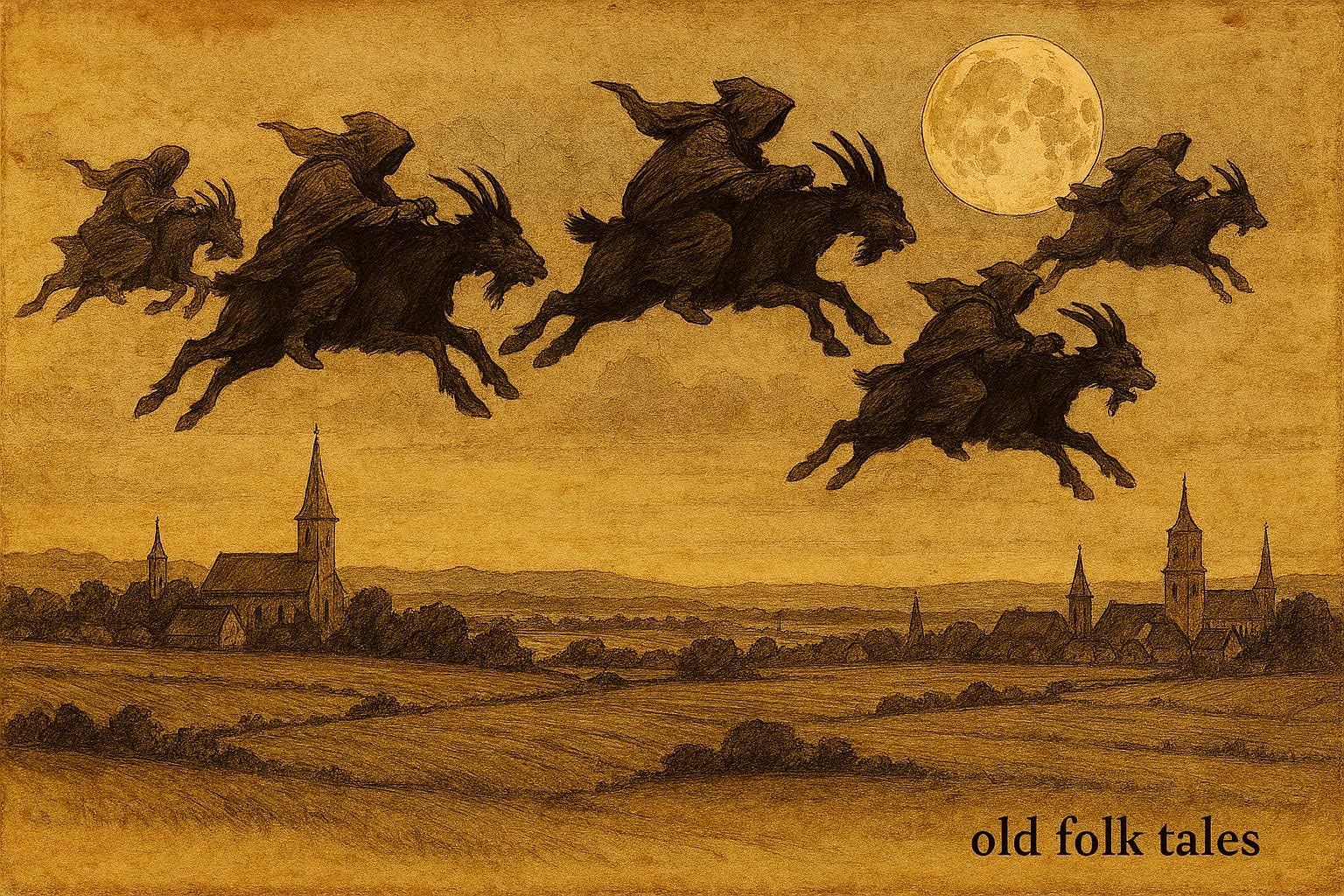
Along the mist-covered fields and wooded hills of Limburg, where the borders of Flemish and Walloon lands blur into one another, villagers once whispered of a terror that rode the night sky. These riders were called the Buckriders, Bokkenrijders, a secret brotherhood said to travel after dark upon flying goats, passing unseen over hedges, rivers, and church towers alike.
By day, Limburg was a land of farms, chapels, and quiet labor. But when night fell, fear crept into every household. Doors were barred, candles burned low, and prayers were spoken with urgency, for no one knew when the Buckriders might appear.
According to rumor, the riders gathered in secrecy, swearing oaths beneath moonless skies. Some claimed they met at crossroads or deep in the forests, where ancient trees hid their gatherings from God’s light. Others insisted they rode through the air itself, mounting goats that leapt from hill to hill and soared across valleys like shadows given form.
The goats were always described the same way, black-haired, red-eyed, unnaturally swift. The riders were said to whisper strange words before mounting them, words that smelled of sulfur and fear. With a sudden bound, man and beast vanished into the darkness, leaving only hoofprints that glowed faintly before fading away.
Villagers believed the Buckriders stole from the wealthy, merchants, landowners, and church treasuries, yet their crimes were never cleanly explained. Some homes were robbed without a lock broken. Others were left untouched despite standing unguarded. No two accounts agreed, and this uncertainty fed the fear.
Church sermons warned that the Buckriders had made pacts with dark forces. Priests spoke of stolen souls and damned men who had traded salvation for power. It was said the riders could not cross consecrated ground, yet others swore they had seen shadows pass over church roofs themselves.
Children were warned to behave, lest the Buckriders carry them off. Mothers pressed holy medals into small hands. Fathers listened intently to the night wind, unsure whether they heard goats bleating, or something worse.
Yet beneath the fear, another story moved quietly through the villages.
Some whispered that the Buckriders were not demons at all, but men driven to desperation. Limburg in those days was marked by heavy taxes, poor harvests, and widening divides between rich and poor. Peasants worked land they did not own, paid debts they could never clear, and faced punishments that spared the powerful while crushing the weak.
In this telling, the Buckriders were not monsters but outlaws, men who had learned that justice would never come to them by daylight. They met in secret not to worship darkness, but to survive. The flying goats, some said, were inventions of fear: fast horses, secret paths, or exaggerations born from panic and rumor.
But truth in Limburg was never simple.
There were stories too precise to dismiss entirely. Witnesses swore they saw riders pass overhead against the moon, cloaks billowing, hooves striking sparks in the air. Dogs howled in terror on nights when no riders were ever caught. Livestock refused to settle, and candles flickered violently without wind.
When authorities finally began investigations, arrests followed swiftly. Men were accused of Buckriding based on rumors alone. Some confessed under pressure, repeating the stories they were expected to tell, of oaths, goats, and dark pacts. Others maintained their innocence to the end.
Executions and punishments followed, and with them, silence.
Yet fear did not fade.
Even after the trials, villagers claimed the Buckriders still rode. Some said the brotherhood had been broken; others believed the true riders were never caught. The legend grew darker, shaped by sermons, trials, and the need to explain suffering.
In time, the Buckriders became something more than men. They became symbols, of rebellion, of terror, of injustice, of survival.
To some, they were proof that evil lurked wherever law and faith were ignored. To others, they were a reminder that when society offers no mercy, people seek power wherever they can find it, even in shadows.
Long after the last trial records were written, people in Limburg still spoke carefully of the night sky. A sudden bleating in the dark could still quiet a room. A fast-moving shadow could still unsettle the brave.
And somewhere between fear and memory, the Buckriders rode on, not always as monsters, not always as heroes, but as echoes of a land where survival often demanded secrecy, and justice was not always found in the light.
Moral Lesson
The legend of the Buckriders teaches that fear and superstition often arise from deep social injustice. When people are pushed to desperation, they may be remembered not for who they were, but for what others feared they became. The story reminds us to question whether monsters are born or made.
Knowledge Check
-
Q: Who were the Buckriders of Limburg?
A: A legendary secret brotherhood said to ride flying goats at night. -
Q: What were the Buckriders accused of doing?
A: Stealing from the wealthy and spreading fear among villagers. -
Q: Why were they believed to be supernatural?
A: They were rumored to fly through the night sky and make dark pacts. -
Q: What alternative explanation exists for the Buckriders?
A: They may have been desperate peasants resisting oppression. -
Q: What themes does the story explore?
A: Fear, superstition, social inequality, morality, and survival. -
Q: Where does the Buckriders legend originate?
A: Limburg, on the Flemish–Walloon border of Belgium.
Source: Traditional oral folklore recorded in regional Belgian chronicles, 18th century (c. 1700s)
Cultural Origin: Limburg (Eastern Belgium, Flemish–Walloon border)