In the windswept hills and misty coastlines of Brittany, where the sea kissed rocky cliffs and forests hid secrets beneath gnarled oaks, there lived a humble peasant named Julien. He was poor, with only the clothes on his back, a small cottage, and a patch of land he tilled to feed his family. Yet for all his modest means, Julien possessed a mind sharp as the scythe he wielded in the fields. He could untangle the most perplexing knots, remember the patterns of the tides, and solve riddles that baffled even the cleverest neighbors.
One day, news spread through the villages that the proud King Renaud of Brittany had grown bored with the ordinary council of courtiers. To amuse himself, he issued a challenge: whoever could solve his series of impossible riddles would win a reward beyond imagination and earn a place of honor in his court. Those who failed, however, would face ridicule in front of the entire kingdom. The riddles were crafted to confound the proud and clever alike, and many a wealthy noble had already attempted and failed, returning home humiliated.
Experience legends where mountains breathe magic and heroes face moral choices that shape destiny
Despite the warnings, Julien felt a spark of opportunity. He knew he had little to lose, and the prospect of testing his wits appealed to him deeply. With a small bundle of provisions, he journeyed along winding roads and muddy tracks toward the grand castle perched atop a cliff overlooking the sea. As he approached, he marveled at its towers and ramparts, the banners snapping in the wind, and the marble courtyards that gleamed beneath the sun. The sight of such wealth and grandeur did not intimidate him; rather, it reminded him that cleverness could sometimes surpass riches.
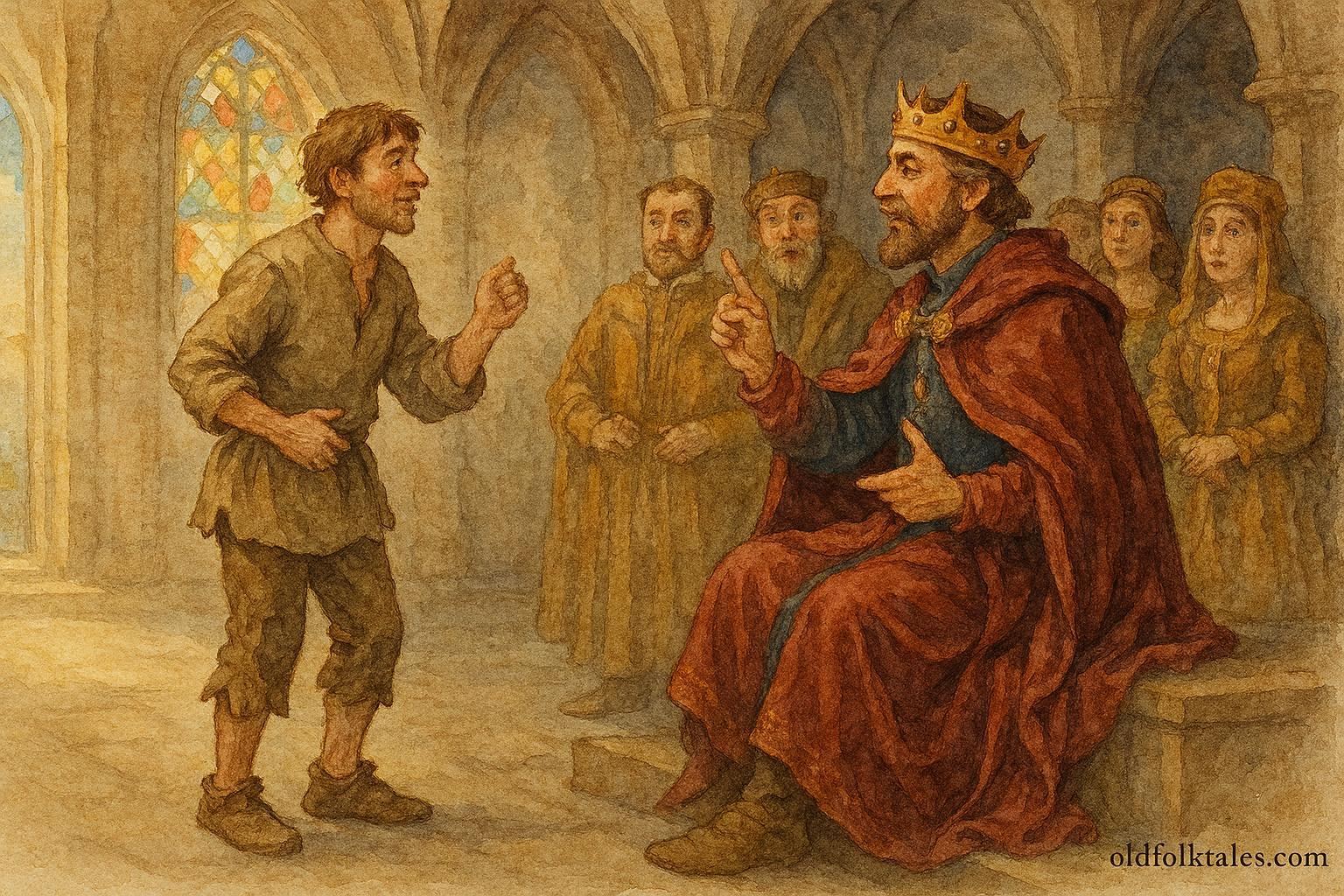
The king’s court buzzed with anticipation when Julien arrived. Courtiers, dressed in velvet and gold, laughed at his simple garments and the calloused hands of a fieldworker. “Who is this rustic fool?” one sneered, whispering behind a fan. “Surely he cannot solve a single riddle.” But Julien met their derision with calm, polite bows, his eyes steady and observant, taking in the layout of the hall, the faces of the courtiers, and even the subtle ways the king’s attendants signaled among themselves.
King Renaud himself, tall and imposing in a cloak of deep blue adorned with silver embroidery, regarded the peasant with mild amusement. “You, little man,” he said, voice echoing across the marble floor, “dare to try what many noble lords have failed? Very well. Answer my riddles, and you may earn your place here. Fail, and you shall be sent away with nothing but your humiliation.”
The first riddle was posed with a flourish:
“I speak without a tongue, I hear without ears, I run without legs. What am I?”
Julien closed his eyes briefly, picturing the natural world he knew, the whispering streams, the echoing cliffs, the way the wind moved through fields. A smile touched his lips. “Your Majesty,” he said, “it is an echo. It speaks without a tongue, hears without ears, and runs without legs.”
A murmur ran through the hall. Some courtiers scoffed, others whispered in astonishment. King Renaud, slightly impressed but masking it with a stern frown, nodded. “Very well,” he said. “Next, then. A harder one.”
“I fly without wings, I cry without eyes, I die without being born. What am I?”
Julien thought of the storms that swept across the Brittany coast, of clouds that darkened the cliffs and brought sudden rains. He saw the lesson in nature, the ephemeral life of things that existed yet were not tangible. “It is the wind, Your Majesty,” he replied. “It flies without wings, cries without eyes, and dies without being born.”
The king’s eyebrows rose. “Hmm,” he muttered. “You are cleverer than I expected. But let us see if you can solve my final and most cunning challenge.”
The hall fell silent. The courtiers leaned forward, eager to witness the humiliation of the peasant, or perhaps to marvel at his success. King Renaud’s final riddle was long and intricate, full of misleading turns and words meant to confound even the most seasoned minds:
“There is a room with no doors, yet everyone enters. It is filled with riches unseen, yet most leave empty-handed. I vanish when you grasp me, yet I am sought by all. What is it?”
Julien paused. He envisioned the patterns of human desire, the fleeting nature of fortune, and the paradoxes of the world. Slowly, he smiled, thinking of the humble life he led, the things that truly mattered, and the illusions of those who prized wealth over wisdom. “Your Majesty,” he said, voice steady, “the answer is opportunity. It is a room with no doors, filled with riches invisible to those unprepared, vanishing when grasped, yet sought by all.”
A hush fell over the hall. The courtiers whispered, their expressions a mixture of disbelief and admiration. King Renaud, for all his pride, could not hide a gleam of respect in his eyes. “Indeed,” he said, rising from his throne. “You, peasant, have solved what the noble and learned have failed. Your wit is sharper than gold, and your intelligence surpasses titles. You have earned my favor.”
The king ordered a feast in Julien’s honor, and the courtiers, once mocking, bowed in recognition. He was given a place at court, not for wealth or lineage, but for the brilliance of his mind. Julien, humble and wise, did not let arrogance enter his heart. He remained a man of the people, offering counsel, solving disputes, and reminding even nobles that intelligence and fairness often mattered more than rank or treasure.
Over time, tales of the clever peasant spread across Brittany and beyond. Parents told children of Julien’s cunning, encouraging them to value cleverness, resourcefulness, and integrity. Scholars and storytellers marveled at his success, noting that wit could outshine wealth and that status alone did not guarantee victory in matters of intellect. Even King Renaud himself, once proud and dismissive, learned to respect the simple wisdom that lay in unexpected places, and he grew more thoughtful and just in his rulings.
The story of Julien, the clever peasant, endured as a testament to human ingenuity. It reminded people that intelligence was a treasure independent of birth or fortune and that courage and insight could overcome even the most formidable challenges. In Brittany’s rolling hills and coastal towns, children and adults alike would recount the tale by firelight, laughing at the courtly folly, admiring the peasant’s cleverness, and learning the enduring lesson that wit and determination can change the course of one’s life.
Explore the wit and wisdom of Western Europe, where humor and virtue often go hand in hand
Moral Lesson
The Clever Peasant and the King’s Challenge teaches that intelligence and resourcefulness are often more powerful than wealth, social status, or brute strength. Cleverness, combined with humility and integrity, can overcome arrogance, elevate the humble, and reshape the course of destiny.
Knowledge Check
- Who is the protagonist of the story?
- Julien, a poor but clever peasant from Brittany.
- What challenges does the peasant face?
- Solving a series of impossible riddles set by the proud King Renaud.
- How does Julien succeed where nobles fail?
- By applying observation, wisdom, and clever thinking rather than relying on status or wealth.
- What themes are highlighted in this French folktale?
- Intelligence over brute power, social mobility, cunning versus arrogance, and justice.
- How does King Renaud respond to Julien’s success?
- He recognizes Julien’s wit, rewards him with favor and a place at court, and learns to respect intelligence over status.
- What cultural elements are featured in the tale?
- Brittany landscapes, medieval court life, social hierarchy, and the folkloric tradition of riddles and clever commoners.
Source: Collected by Paul Sébillot, Contes populaires de la France, 1883, Brittany, France.
Cultural Origin: Brittany, France