In a quiet corner of a Czech village, where fields stretched golden in summer and cottages huddled close against winter winds, there lived a poor man and his daughter. Their home was small, their possessions few, but the girl possessed something far greater than wealth, she had a sharp mind, quick wit, and a way of seeing through problems that others could not.
The villagers often whispered about her cleverness. Though she wore simple clothes and lived humbly, her answers were always thoughtful, her ideas surprising, and her judgments fair.
Discover the timeless charm of French, Dutch, and Belgian stories filled with cleverness and heart
One day, her father became entangled in a dispute that would change both their lives.
The poor man had been traveling with a wealthier neighbor when the two discovered a horse and cart left unattended by the roadside. No owner was in sight, and after waiting a long while, they decided to take the cart along, intending to return it if anyone came forward.
As they journeyed on, something remarkable happened, the horse gave birth to a foal.
Now came the question: who did the foal belong to?
The rich man claimed it immediately. “The cart is mine,” he argued, “and the horse pulled it. Therefore, the foal belongs to me.”
But the poor man protested. “The horse is the mother, not the cart. The foal belongs to the horse, and since we found the horse together, it should be mine.”
Unable to resolve their argument, they took the matter before the king.
The king listened carefully to both sides. He was known for his authority, but also for testing the minds of those who came before him. Instead of giving a direct judgment, he decided to challenge them.
“I will not decide this matter at once,” he said. “Instead, I will give each of you riddles. Whoever answers them correctly shall win the case.”
He turned to the two men and presented four questions:
“What is the strongest and swiftest thing in the world?
What is the fattest thing in the world?
What is the softest thing in the world?
And what is the sweetest thing in the world?”
The rich man returned home confident, surrounded by servants and comfort. He believed the answers would come easily.
The poor man, however, walked back to his humble cottage with a heavy heart.
“My daughter,” he said, “the king has given me riddles I cannot answer. If I fail, I will lose everything.”
The girl listened quietly, her eyes thoughtful.
Then, one by one, she spoke.
“The strongest and swiftest thing in the world is the wind,” she said. “It cannot be caught, yet it moves everything.”
“The fattest thing is the earth itself,” she continued. “It feeds all that lives.”
“The softest thing is the human hand,” she said gently. “For no matter where one rests, they will always place their head upon it.”
“And the sweetest thing in the world is sleep, for it brings rest to both rich and poor.”
Her father stared at her in amazement.
The next day, he returned to the king and gave the answers.
The king was impressed. These were not ordinary responses, they showed depth and understanding.
“Tell me,” the king said, narrowing his eyes, “did you think of these answers yourself?”
The poor man hesitated, then spoke truthfully. “No, Your Majesty. My daughter did.”
The king leaned back, intrigued.
“A girl, you say?” he murmured. “Then let us test her further.”
He sent a message to the girl:
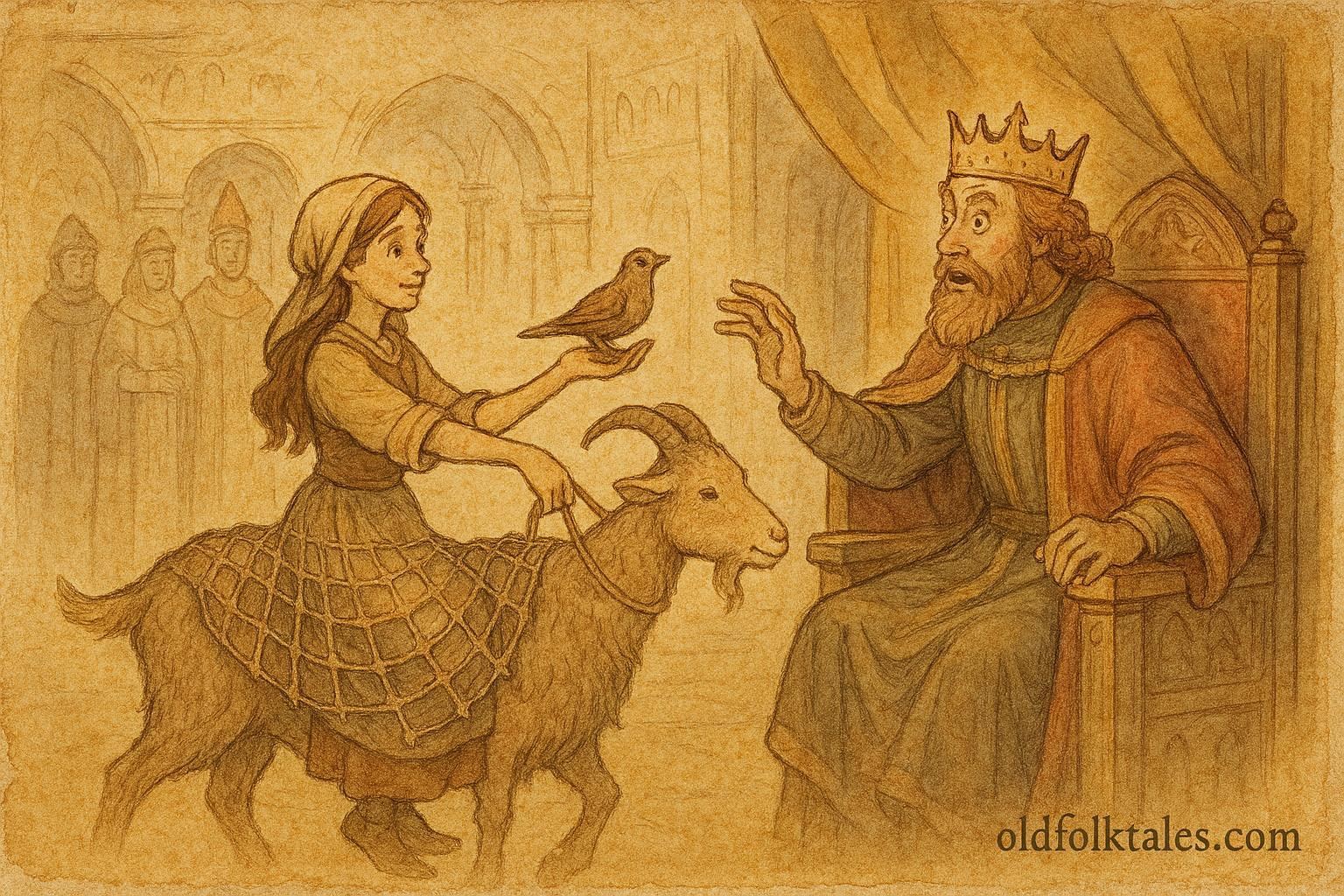
“Come before me, not dressed and not naked, not walking and not riding, not alone and not accompanied. And bring me a gift that is neither rich nor poor.”
The villagers buzzed with confusion when they heard the king’s challenge. It seemed impossible.
But the girl only smiled faintly.
On the appointed day, she set out for the palace.
She wore no proper clothing, but wrapped herself lightly in a fishing net, so she was neither dressed nor naked. She did not walk, but rode astride a goat, with one foot dragging along the ground, so she was neither walking nor riding. She brought along a small bird in her hands.
When she reached the king, she presented her gift, the bird. As he reached out to take it, the bird flew away.
Thus, it was neither a rich gift nor a poor one, it could not even be possessed.
The king could not hide his admiration.
Never had he encountered such intelligence, such precise understanding of words and meaning.
“You are indeed clever,” he said. “And a mind like yours should not be wasted in poverty.”
In time, he took her as his wife, and she became his queen.
As queen, she remained as wise and fair as she had been in her father’s cottage. People came from far and wide seeking justice, and she often saw what others overlooked.
One day, a case was brought before the king, a dispute not unlike the one her father had once faced. The king judged hastily, favoring the wealthier party.
But the queen quietly intervened, offering her insight. With calm reasoning, she revealed the truth and corrected the injustice.
The people praised her wisdom, but the king did not.
He felt his authority challenged.
“You must not interfere in my judgments,” he said sternly. “A queen should not overstep her place.”
Though she meant no harm, the king’s pride had been wounded.
In his anger, he made a harsh decision.
“You may return to your father’s home,” he declared. “But you may take with you only what you love most.”
The court fell silent.
It was a cruel command, yet cleverly worded.
But the queen did not argue. She bowed her head.
“As you wish, Your Majesty,” she said calmly.
That night, she prepared a farewell meal for the king. She served him with care and kindness, just as she always had.
The king, softened by the moment, ate and drank freely.
Soon, he fell into a deep sleep.
Gently, the queen ordered her servants to carry him, still asleep, to her father’s humble cottage.
When the king awoke the next morning, he was no longer in his grand palace. Instead, he lay in a simple room, sunlight streaming through a small window.
Confused, he looked around.
The queen stood nearby, smiling softly.
“What is the meaning of this?” he demanded.
She bowed slightly.
“You told me I could take with me what I love most,” she said. “And so, I have brought you.”
For a long moment, the king said nothing.
Then, slowly, realization dawned.
Her words were true. She had followed his command exactly, without disobedience, without defiance, and yet with perfect cleverness.
The king could not help but laugh.
His anger melted away, replaced by admiration once more.
“You have outwitted me again,” he admitted. “And I see now that your wisdom is not a threat, but a gift.”
He took her hand.
“Come,” he said. “Let us return home, together.”
And so, the clever princess returned to the palace, not in disgrace, but in triumph.
From that day on, the king valued her counsel, and together they ruled with fairness and understanding.
The people prospered, knowing that wisdom, not wealth or pride, guided their kingdom.
Moral Lesson
True wisdom lies in understanding not just words, but their deeper meaning. Intelligence, fairness, and ingenuity can overcome power, pride, and even injustice.
Knowledge Check
- Who is the Clever Princess in Czech folklore?
She is a poor but highly intelligent girl who solves riddles and becomes queen through her wit. - What riddles did the king ask in the story?
He asked about the strongest, fattest, softest, and sweetest things in the world. - How did the girl appear before the king?
She came neither dressed nor naked, neither walking nor riding, fulfilling the king’s impossible conditions cleverly. - Why was the queen banished by the king?
She corrected his judgment, which wounded his pride and made him feel challenged. - What did the queen take when she left the palace?
She took the king himself, as he was what she loved most. - What lesson does The Clever Princess teach?
It teaches that intelligence, fairness, and wit are more powerful than status or authority.
Source: Collected in Prostonárodní české písně a říkadla by Karel Jaromír Erben (1864)
Cultural Origin: Czech