Long ago, among the rolling hills and silver olive groves of Central Italy, there stood a Tuscan kingdom of terracotta towers and narrow stone streets warmed by the sun. The vineyards were generous, the people industrious, and the royal family admired for their wisdom.
But beneath the kingdom’s harmony lay a shadow.
When the queen gave birth to a daughter, joy rang through the hills. Bells echoed from monastery towers, and fountains were adorned with flowers. The child was radiant, with dark curls and bright, curious eyes. She was named Lucia, meaning light.
On the seventh day after her birth, a renowned astrologer was summoned to cast the child’s future. His calculations were slow and precise. As he traced the constellations’ paths, his expression grew troubled.
“Your Majesties,” he said gravely, “your daughter’s destiny is entwined with danger. Before her eighteenth year, she will fall into a death-like sleep brought on by treachery. The kingdom will grieve as though she were lost forever.”
The queen paled. The king clenched his jaw.
“Can this fate be prevented?” the queen whispered.
The astrologer hesitated. “Fate may bend, but it does not vanish. You may delay it. You may attempt to guard against it. But prophecy is rarely defeated by walls.”
The king, unwilling to risk his daughter’s life, made a decision born of fear disguised as protection.
The Crystal Casket
As Lucia grew, she proved gentle and perceptive. She roamed palace gardens, asked thoughtful questions of tutors, and brought warmth to every hall she entered. Yet she was never permitted beyond the palace gates. Her world narrowed with each passing year.
On the eve of her eighteenth birthday, the king enacted his desperate safeguard.
Deep within the palace, artisans had crafted a magnificent crystal casket, clear as mountain water and strong as forged steel. Cushioned in silk and lined with gold, it was both prison and sanctuary.
The king explained with forced calm, “My daughter, this is for your protection. You will rest safely within, beyond harm, until the stars pass their danger.”
Lucia did not protest. She saw fear in her father’s eyes and sorrow in her mother’s silence.
“If this protects the kingdom,” she said softly, “I will endure it.”
At midnight, as candles flickered, Lucia lay within the crystal casket. The lid was sealed. A spell, whispered by court magicians, drew her into enchanted sleep, neither alive in the world nor fully removed from it.
The casket was hidden in a secluded pavilion beyond the city walls, guarded and forgotten by most.
Years passed.
The king aged. The queen wept in private. The kingdom whispered of its vanished princess.
The Prince Who Questioned Silence
Far beyond the Tuscan hills, in another principality, lived a young prince named Alessandro. He had heard fragments of the tale: a hidden princess, a crystal tomb, a prophecy wrapped in secrecy.
Unlike others who dismissed the story as myth, Alessandro felt drawn to it, not by ambition, but by unease.
“Why hide life to escape fate?” he wondered aloud. “Does fear truly conquer destiny?”
Against the advice of his court, he journeyed across valleys and forests, following rumors. In taverns and monasteries, he gathered whispers. Eventually, an old monk spoke plainly.
“The princess is not dead,” the monk said. “She sleeps in crystal, sealed by love twisted into fear.”
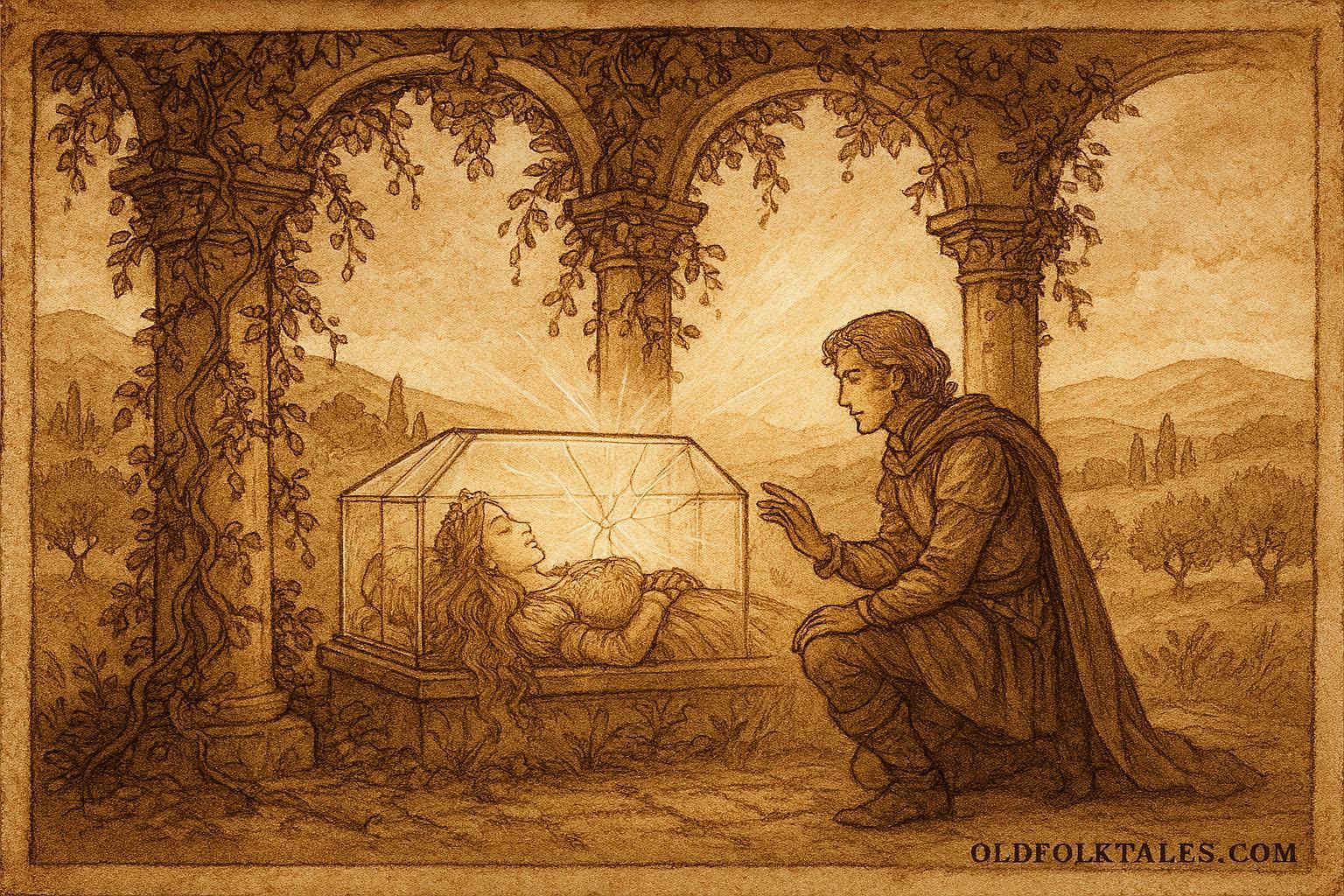
Alessandro pressed on until he reached the overgrown pavilion. Vines coiled around marble columns. Dust lay thick upon forgotten steps.
Inside, bathed in pale afternoon light, stood the crystal casket.
And within it, untouched by time, lay Lucia.
She appeared merely asleep, her face serene, her hands folded lightly upon her chest.
Alessandro felt no triumph, only reverence.
The Breaking of Fear
He circled the casket slowly. There were no locks, no visible hinges—only seamless crystal.
“Protection built from fear becomes its own prison,” he murmured.
He did not strike the glass. He did not call for force.
Instead, he spoke.
“Princess Lucia,” he said gently, “if your sleep is bound by silence, let truth awaken you. If your prison was built from fear, let courage undo it.”
The air shifted.
For years, Lucia’s sleep had been sustained not by magic alone, but by belief, the belief that only confinement ensured safety.
Alessandro placed his hand upon the crystal.
“I do not seek to steal you from destiny,” he continued. “I seek to meet it with you.”
A faint crack shimmered across the surface, like frost melting beneath sun. The crystal softened, dissolving not with violence, but with surrender.
Lucia’s eyes fluttered open.
She inhaled sharply, as though surfacing from deep water.
The pavilion filled with golden light.
Truth Revealed
Lucia rose slowly, supported by Alessandro. Though years had passed, she felt no weakness, only clarity.
“My father tried to seal away prophecy,” she said quietly. “But destiny is not a storm one hides from. It is a path one walks.”
At that moment, messengers arrived from the kingdom: the old king had fallen gravely ill. The realm trembled without leadership.
Lucia returned not as a fragile relic preserved in glass, but as a woman shaped by stillness and insight.
When she entered the city gates, the people gasped, not in fear, but in awe.
The prophecy had spoken of treachery and death-like sleep. It had not spoken of resurrection through courage.
The astrologer, now aged and bent, was summoned once more.
“You see,” he said softly, “fate unfolded. But how it unfolded depended on the hearts involved.”
Lucia forgave her father. She understood his fear.
With Alessandro at her side, she assumed the throne. Their reign was remembered for balance: caution tempered by bravery, protection guided by trust rather than panic.
The crystal casket was not destroyed. Instead, it was placed in the palace gardens as a reminder.
Not of fear.
But of truth.
Moral Lesson
Fate cannot be permanently sealed away. Protection born of fear may delay destiny, but only courage and love can transform it.
Knowledge Check
-
Why was the princess placed inside the crystal casket?
To protect her from a prophecy foretelling enchanted sleep and danger. -
What central theme defines the tale?
Fate and protection, showing that fear cannot permanently prevent destiny. -
How is the spell broken?
Through courage, truth, and the prince’s willingness to confront fate rather than avoid it. -
What does the crystal symbolize?
Protection turned into imprisonment. -
What cultural tradition does this story come from?
Central Italian (Tuscan) folktale tradition. -
Who recorded this version?
It appears in Fiabe italiane by Italo Calvino (1956).
Source: Fiabe italiane by Italo Calvino (1956)
Cultural Origin: Central Italy (Tuscan tradition)