Once upon a time in the gentle hills of Tuscany, there lived a humble herb-gatherer who earned a modest living with his three daughters. When the father passed away, the sisters were left alone in the world, dwelling together and earning what they could by spinning.
One evening the king, who had a habit of walking through the streets at night listening at doors to hear what his people said of him, overheard a heated discussion at their cottage door. The eldest daughter declared: “If I were wife to the royal butler, I would pour water from one glass and quench the whole court, and still some would remain.” The second said: “If I were wife to the keeper of the royal wardrobe, I would with one piece of cloth clothe all his attendants, and a little piece would still be left.” Then the youngest quietly spoke: “Were I the king’s wife, I would bear him three children: two sons holding apples in their hands, and a daughter with a star shining on her brow.”
The very next morning the king sent for the sisters. He asked them to account for their words. The eldest repeated her boast, and the king brought a single glass of water and challenged her to fulfil her promise. She poured and poured, and indeed the court drank until the glass still held a little, so the king exclaimed his admiration and gave her the butler as husband. Next the second sister cut cloth for the attendants, and indeed had some left, and was married to the wardrobe-keeper. Then the king turned to the youngest: she claimed she would bear him those wondrous children. He said: “If it is true, you shall become my queen; if not, you shall die.” Without hesitation he married her.
Time passed, and at last the queen bore those children as she had foretold: two sons, each holding an apple, and a daughter with a star on her forehead. But while the king had gone off to war, the two elder sisters, now the queen’s jealous aunts, conspired against her. They bribed the nurse to swap the newborns for puppies, then sent word to the king that his wife had given birth to dogs. The king, deceived and distant, replied that his wife was to be cared for for two weeks and then placed on the tread mill (a dreadful fate of forced labour). Meanwhile the nurse took the babies into the forest and abandoned them, but there three fairies passed by, discovered the children and said: “How beautiful they are!” One fairy gifted them a deer to nurse them; another gave them a purse that would always have money; the third gave them a ring that would change colour when misfortune came. The deer raised them until they grew strong and well.
When the children were grown they decided to hire a house in the city, and in the counsel of the deer they settled opposite the royal palace. They furnished it richly and lived as though of noble birth. The aunts, peering from the palace windows, discovered the strange sight of youths with apples in their hands and a maiden with a star on her brow, and they trembled. They summoned the nurse and asked what this could mean; the nurse pretended to visit, and told the maiden: “You see how fair your brothers are. But if they love you truly they will bring you the Dancing Water.” Thus she planted the idea.
One brother set out bravely for the Dancing Water. He met strange hermits who directed him: climb the mountain, reach a plain, a gate guarded by four giants with swords, wait until their eyes are open, then enter; then pass a lions’ hall when their eyes are open. At the mountain’s summit he observed the giants’ eyes closed and the gate open, so he waited until the moment their eyes opened and the door shut, then entered. He waited until the lions’ eyes opened and slipped inside, found the dancing water which leapt from basin to basin, filled his flasks, and fled safely. When he returned he presented the water in golden basins, and it danced between them, terrifying his aunts who cried: “How did he accomplish that?” Once more the nurse crept to the sister and whispered: “True, but now the Singing Apple remains to make you complete.”
The second brother rode forth for the Singing Apple. He was instructed: climb the mountain again, beware of giants and lions, then you will find a small door with a pair of shears: if they are open, go in; if closed, turn back. He methodically followed the guidance, entered when the shears were open, found a magnificent tree whose top swayed violently. He waited for stillness, leapt up, plucked the apple, and all the while the apple kept making a sound as he carried it home. On his return the aunts were again distraught, and the nurse whispered once more to her niece: “Lovely, the Dancing Water, the Singing Apple, but unless you see the Speaking Bird, your joy is not full.”
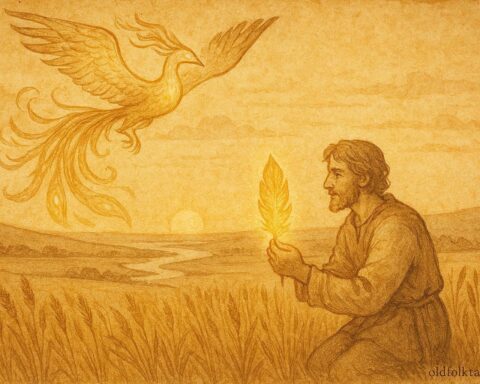
The youngest brother accepted the quest for the Speaking Bird. He reached the palace where statues stood everywhere, a fountain in a garden, and upon its basin perched the bird. The hermits’ final counsel: if it speaks to you, say nothing; pluck one feather, dip it into the jar you will find, anoint all the statues, and proceed. The young man arrived; the bird cried: “What has brought you, noble sir? Your aunts have sent you to your death! Your mother is in the tread-mill.” At once he answered, “What! my mother in the tread-mill?” and immediately turned to stone among the statues. The ring on the sister’s finger changed to blue. The aunts rejoiced. Then the second brother undertook the journey, and met the same fate, the bird announced the mother’s fate and he became stone. The ring now turned clear. Finally the sister, disguised as a page, set out. She met the hermits, listened, and above all remained silent when the bird spoke. The bird said: “Ah, you too? Now you will face the same fate. Do you see them? One, two, and you are the third. Your father is at war, your mother in the tread-mill, your aunts rejoicing.” The sister remained silent. The bird flew down; she snatched a feather, dipped it into the jar, and anointed her brothers’ nostrils. Instantly they regained life. She then anointed all the statues, the lions and the giants; all living beings returned to life. The palace and the hermits vanished, they had been fairies in disguise.
Back in the city the siblings summoned a goldsmith to craft a golden chain, fastened the Speaking Bird to it; opposite the royal palace they displayed the Dancing Water, the Singing Apple, and the Speaking Bird. The aunts looked on in horror. The bird then directed a grand carriage finer than the king’s, with twenty-four attendants, a more lavish palace, better cooks and servants, all executed, so the aunts trembled in fury.
When the king returned from war, his people told him of little else but the curious palace opposite. He looked and saw the youth holding apples, the girl with a star, and could hardly believe his eyes. Then one Sunday the bird invited the king and the siblings to dinner. At the table the king said: “Bird, you promised to speak, what is your word?” The bird recounted everything: how the sisters had deceived, how his wife and children lived in exile and death. At the bird’s signal the king commanded the aunts punishments: the nurse thrown from a window; the sisters cast into a cauldron of boiling oil. The evil ended. The king embraced his queen, the children were restored, and the bird departed. From that day on peace and harmony reigned throughout the land.
Moral Lesson:
True kindness, patience and faith triumph over envy and treachery. The youngest sister’s compassion, courage and obedience to wise counsel lead to justice’s triumph. Even when Fate seems cruel, loyal hearts and right actions restore order and reward the good.
Knowledge Check
- Who originally made the lofty promises at the herb-gatherer’s home?
His three daughters: the eldest about the butler, the second about the wardrobe-keeper, and the youngest about marrying the king and bearing wondrous children.
- What three magical treasures were sought in the tale?
The Dancing Water, the Singing Apple, and the Speaking Bird.
- What symbol on the ring given by the fairy indicated misfortune?
The ring’s stone would change colour when one of the children faced disaster.
- How did the youngest sister succeed where her brothers failed in the quest for the Speaking Bird?
She did not speak when the bird addressed her, followed the hermit’s directions exactly, plucked a feather, dipped it in the jar, anointed the statues and revived them.
- What happened when the bird spoke to the king?
It revealed the truth: how his wife had been wronged, his children sent away, and thereby secured justice against the malicious sisters and nurse.
- What is the cultural origin and tale-type classification of this story?
It is an Italian folktale collected by Thomas Frederick Crane in Italian Popular Tales (1885), and is classified as tale-type ATU 707, “The Three Golden Children.”
Source:
Adapted from the Sinhalese folktale “The Jackal and the Dog” in Village Folk-Tales of Ceylon, Vol. II, collected by H. Parker (1910), London: Luzac & Co.
Cultural Origin:
Italy (Tuscany) – Italian folktale