In the ancient land of Thessaly, where olive trees shimmered under the Mediterranean sun and mountains rose like stone guardians of the horizon, there once ruled a mighty king who had three sons. His palace stood beside a fountain whose clear waters fed the whole kingdom. But peace was troubled by a dreadful creature, a dragon that came each night to drink the fountain dry, leaving nothing for the people when morning came.
The king, tormented by this nightly curse, made a solemn proclamation throughout the realm:
“Whoever slays the dragon shall receive half my kingdom and the honour of my throne.”
The people trembled at the thought, for the dragon was known to breathe fire and smoke, its eyes blazing like molten gold. Yet the king’s eldest son, bold but reckless, declared, “I shall face the beast.” That night, he took his sword and kept watch by the fountain. The moon shone bright, the night was still, but as the hour grew late, sleep overcame him. The dragon came, drank all the water, and vanished into the darkness before dawn.
The next evening, the second son vowed to try. “I will not fail as my brother did,” he said. But when midnight arrived, the soft whisper of the fountain and the hum of crickets lulled him to slumber. Again the dragon came and drank its fill, leaving only a scorched mark on the stones.
Finally, the youngest prince, the bravest and most humble of the three, stepped forward. “Father,” he said, “I will stand guard tonight. If I do not return, pray for my soul, but let fear not rule this kingdom any longer.” His father’s eyes were heavy with worry, but he blessed the boy and sent him forth.
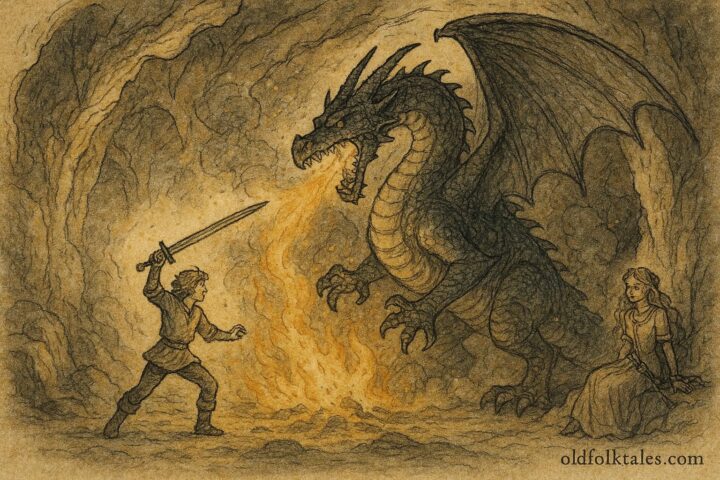
That night, the youngest prince sat by the fountain with his sword drawn, his heart steady and his eyes fixed on the moonlit path. When midnight came, a rumble shook the earth, the dragon emerged, its scales glinting like bronze and its breath curling into black smoke. Its eyes burned like twin embers, and its claws tore at the earth as it slithered forward. The prince, though trembling, stood firm. As the creature bent to drink, he raised his sword high and struck. The dragon roared in pain and fled into the hills, leaving behind a trail of blood that gleamed red beneath the stars.
At sunrise, the prince followed the blood’s path deep into the mountains, until he reached the mouth of a dark cave. There sat an old woman, her hands spinning thread on a wooden wheel.
“Good mother,” he said respectfully, “what lies within this cave?”
The woman looked up, her eyes wise and sorrowful. “Death lies there, my child,” she said. “For that is where the dragon dwells.”
But courage burned brighter in the prince’s heart than fear. He entered the cave, torch in hand, and found within three maidens chained to the walls, pale from captivity, yet graceful as moonlight. He broke their chains, and one of them, the eldest, spoke softly:
“If you wish to kill the dragon, wait until he sleeps. Then cut off his head. But beware, if even one drop of his blood touches the ground, a hundred small dragons will rise.”
The prince hid behind a rock, waiting. When the dragon returned, its breathing grew deep and slow as it drifted into slumber. The prince crept forward and, with a single swift stroke, cut off its head. Yet before he could stop it, a single drop of blood splashed onto the cave floor. Instantly, a hundred tiny dragons burst forth, hissing and writhing in fury. Quick-thinking, the prince seized a handful of ashes from the hearth and threw it upon them. The creatures stiffened, their scales turned grey, and in moments, they were all turned to stone.
When the cave fell silent, the prince led the rescued maidens out into the daylight. Together they returned to the palace. The king wept with pride and joy, calling his youngest son “the saviour of the kingdom.” But envy is a shadow that often follows greatness. The elder brothers, burning with jealousy, whispered among themselves:
“He used witchcraft. No man could do this alone.”
That night, they conspired to kill their brother in secret. Yet the maidens overheard their plot and ran to the king. “Your Majesty,” they said, “your son is innocent and your kingdom owes him its peace.”
Furious at such treachery, the king banished the envious princes and declared the youngest his heir. On the day of his coronation, the prince visited the hill where the ashes had fallen, where the little dragons had turned to stone. There he knelt and prayed that courage and truth would never die in the hearts of men.
From that day forward, the people of Thessaly honoured the brave prince who faced the dragon and the darkness within men’s hearts alike.
Moral Lesson
True courage lies not in strength, but in steadfast heart and noble purpose. Envy destroys, but bravery endures.
Knowledge Check
1. Who were the main characters in the story?
The king, his three sons, the dragon, the old woman, and the three maidens.
2. What challenge did the kingdom face?
A dragon drank all the water from the royal fountain every night.
3. How did the youngest prince defeat the dragon?
He struck while the dragon slept and used ashes to stop the smaller dragons.
4. What did the dragon’s blood symbolize?
It represented the spreading nature of evil and the need for vigilance after victory.
5. Why were the elder brothers banished?
They plotted to kill their younger brother out of jealousy.
6. What is the main moral of this Greek folktale?
Courage and purity of heart triumph over fear, deceit, and envy.
Source
Adapted from The Dragon and the Prince, in Modern Greek Folklore and Ancient Greek Religion by John G. Lawson (Cambridge University Press, 1910), pp. 195–198.
Cultural Origin: Greece (Thessalian folklore)