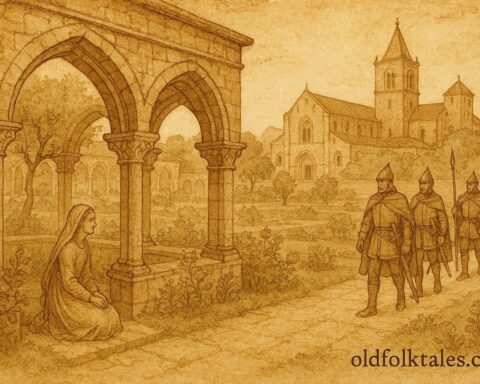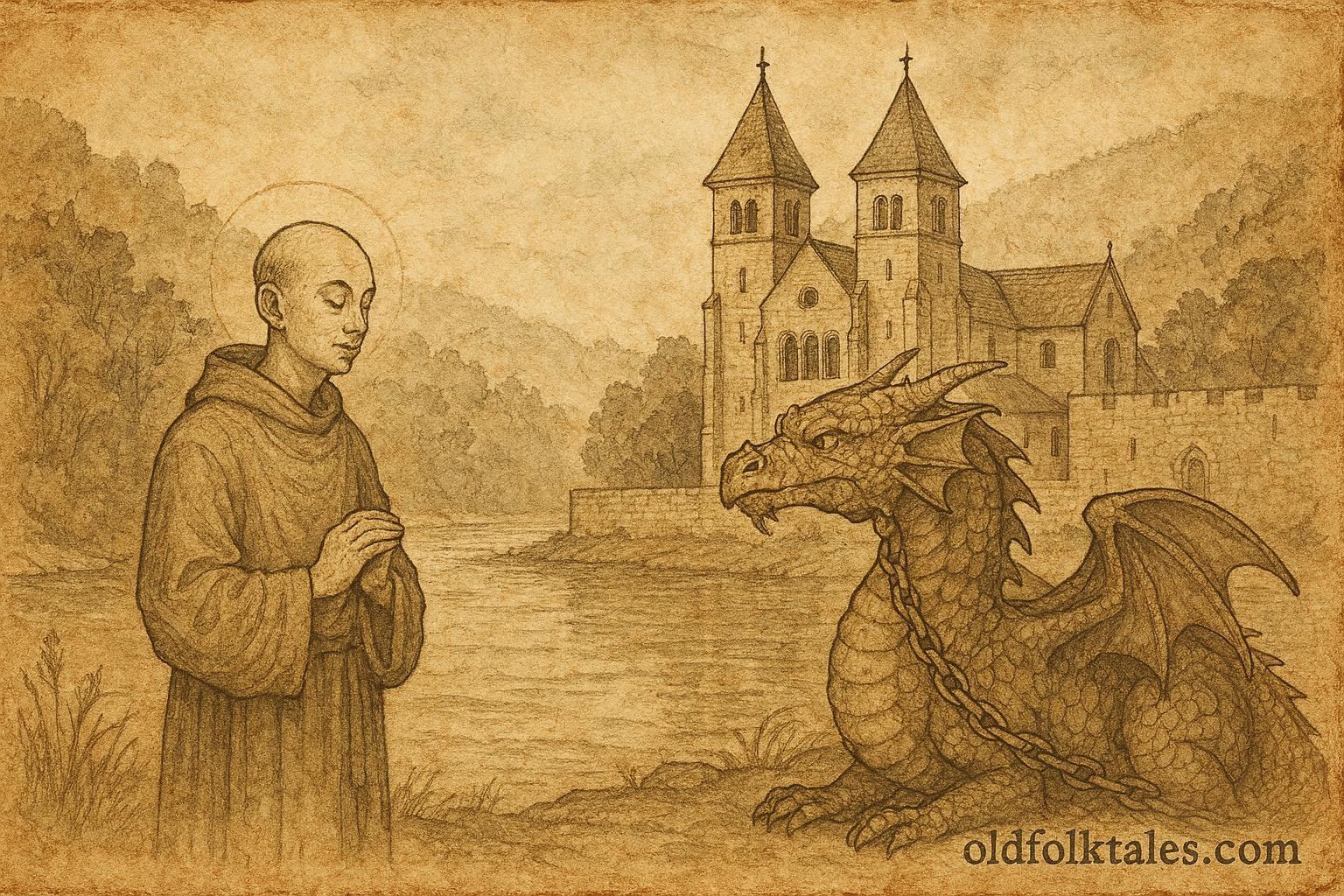
Long ago, in the green and mist-laden valleys of Luxembourg, there stood the venerable Abbey of Echternach, its stone walls rising quietly beside the winding River Sûre. The abbey was a place of prayer, learning, and calm reflection. Bells rang each morning and evening, echoing through nearby forests and fields where villagers labored in peace. Yet beyond the abbey’s tranquil grounds, a shadow of fear crept across the land. In the dense woods and rocky hills near Echternach, a dragon was said to dwell.
No one could remember when the terror first began. Some said the beast had always lived there, hidden in caves and ravines, awakening only when hunger or rage drove it forth. Others believed it appeared suddenly, as if summoned by the fears of men themselves. Whatever its origin, the dragon’s presence soon made itself known in dreadful ways.
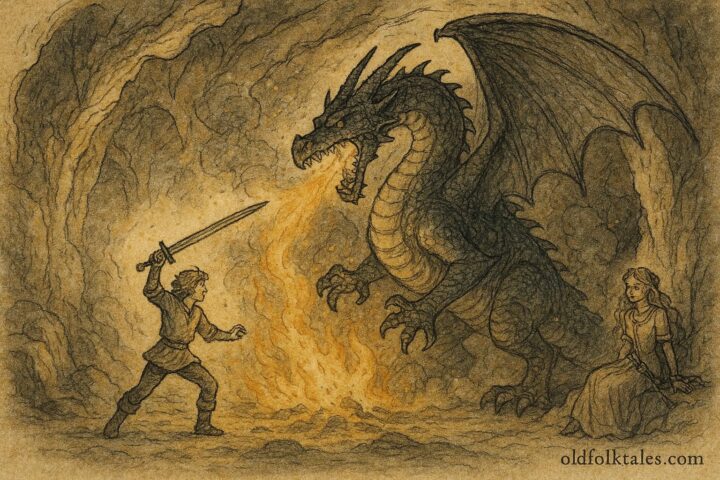
Villagers spoke of a massive, scaled creature whose body gleamed darkly like burnished iron. Its wings beat the air with a sound like thunder, and its breath steamed in the cold mornings as it prowled near paths and pastures. Livestock vanished without a trace. Crops near the forest edge were trampled or scorched. At night, distant roars rolled across the countryside, shaking doors and chilling hearts.
Fear ruled daily life. Parents kept children close. Travelers avoided the roads near Echternach. Even the bravest men hesitated to speak of the dragon aloud, as if naming it might summon the beast itself.
Many believed no human strength could defeat such a creature.
The abbey, too, felt the weight of this dread. Though its walls offered safety, the monks knew that faith could not flourish while terror stalked the people they served. They prayed for guidance, for courage, and for deliverance from the monster that threatened both body and soul.
Among the monks was one whose name has been lost to time, remembered only for his wisdom and resolve. He was not a warrior, nor did he possess unusual strength. He was a man of quiet devotion, known for thoughtful words and steady faith. While others spoke of weapons and guards, he listened carefully, reflecting deeply on the nature of the danger they faced.
He understood something crucial: the dragon fed not only on flesh, but on fear.
Where panic ruled, the beast grew stronger. Where courage and clarity prevailed, its power weakened.
One morning, after long prayer, the monk announced that he would face the dragon himself. Gasps filled the abbey hall. Some tried to stop him, insisting that such a task required swords and armor, not robes and prayers. But the monk remained calm. He did not claim bravery, only trust, trust in divine guidance and in the strength of wisdom over violence.
He carried no weapon. Instead, he brought with him symbols of faith and a plan shaped by careful thought rather than force.
Leaving the safety of the abbey, the monk walked alone toward the dragon’s lair. The path wound through thick forest where sunlight filtered weakly through ancient trees. Every sound—the snap of a twig, the rustle of leaves, seemed magnified. Yet the monk did not turn back.
At last, he reached the place where the dragon was known to dwell: a rocky hollow near the riverbank, scorched and scarred from the beast’s presence. The air was heavy, and the ground bore marks of claws and fire. Summoning his resolve, the monk called out, his voice steady despite the danger.
The dragon emerged in all its terrible majesty. Its size dwarfed the man before it, and its eyes burned with a fierce, knowing intelligence. The earth trembled as it moved, and its breath carried the scent of smoke and decay.
But instead of fleeing, the monk stood firm.
He spoke—not with threats, but with authority drawn from faith and reason. Using calm words and deliberate actions, he lured the dragon closer, guiding its movements rather than challenging its strength. Through cleverness and unwavering focus, he led the beast into a trap prepared with care and foresight.
The dragon struggled, roaring in fury, but its might was useless against the monk’s strategy. Bound and subdued, the creature could no longer terrorize the land.
When the villagers learned what had happened, disbelief turned to awe. They gathered near the abbey, watching as peace returned to paths once feared and fields once abandoned. The dragon, no longer a force of destruction, was rendered powerless through wisdom rather than slaughter.
The monk returned quietly to his life of prayer, seeking no praise. Yet his deed became legend.
From that day forward, Echternach knew peace once more. The story of the dragon and the monk spread from village to village, reminding all who heard it that fear can be defeated, not by brute force alone, but by courage guided by faith and clear thought.
Moral Lesson
The tale of The Dragon of Echternach teaches that true strength lies not in violence or physical power, but in wisdom, faith, and courage. When fear is confronted with calm understanding and moral resolve, even the greatest threats can be overcome for the good of the community.
Knowledge Check
-
Who defeated the Dragon of Echternach?
A wise and faithful monk from Echternach Abbey subdued the dragon using cleverness rather than force. -
Where does the Dragon of Echternach legend originate?
The folktale originates from Echternach, Luxembourg. -
What did the dragon symbolize in the story?
The dragon symbolizes fear, chaos, and threats to communal peace. -
How was the dragon defeated without violence?
The monk used intellect, strategy, and faith to trap and subdue the dragon. -
What role does faith play in the folktale?
Faith provides courage, guidance, and moral authority to overcome fear. -
What is the main lesson of The Dragon of Echternach?
Wisdom and courage can triumph over fear and brute strength.
Source: Nikolaus Gredt, Sagenschatz des Luxemburger Landes (1883)
Cultural Origin: Echternach, Luxembourg