Along the southern edge of the Netherlands, where Zeelandic Flanders once stretched green and prosperous toward the sea, there lay a land known as Saeftinghe. In its time, it was neither wild nor barren, but fertile and ordered, a patchwork of fields, dikes, villages, and grazing meadows shaped by human hands and held in uneasy balance with the waters beyond.
Today, Saeftinghe no longer appears on maps as it once did.
Where ploughs once cut the soil, only tidal marsh remains. Where church bells once marked the hours of labor and prayer, the wind now carries strange echoes across the mudflats. And where people once believed they had mastered the sea, the sea remembers otherwise.
This is the tale of how Saeftinghe was lost, and why it is never forgotten.
A Land Claimed from the Sea
For generations, Saeftinghe stood as proof of human determination. Like much of Zeeland, it had been wrested from water through dikes, drainage canals, and endless labor. Farmers tilled rich soil, harvested grain, and raised cattle. Villages thrived, protected by embankments that rose like walls against the tides.
The people of Saeftinghe knew the sea well. They respected its strength, but they also trusted in their dikes, their skills, and their shared responsibility. Each breach repaired, each storm survived, reinforced the belief that the land would endure as long as human effort remained strong.
Yet over time, that belief slowly changed.
The Erosion of Care
Legends do not agree on a single cause for Saeftinghe’s fall, but they speak with one voice about neglect.
Some say the dikes were allowed to weaken as wealth grew and vigilance waned. Repairs were delayed. Responsibility was shifted from neighbor to neighbor. What had once been a shared duty became an inconvenience.
Others tell of pride, of landowners who believed their prosperity guaranteed safety, of officials who dismissed warnings, of communities that forgot the humility required to live beside the sea.
Still others speak in moral tones, claiming the land was lost because of decay of spirit: greed, indifference to the poor, and disregard for the balance between human ambition and natural limits.
Whatever the cause, the outcome was the same.
The sea waited.
The Night the Water Came
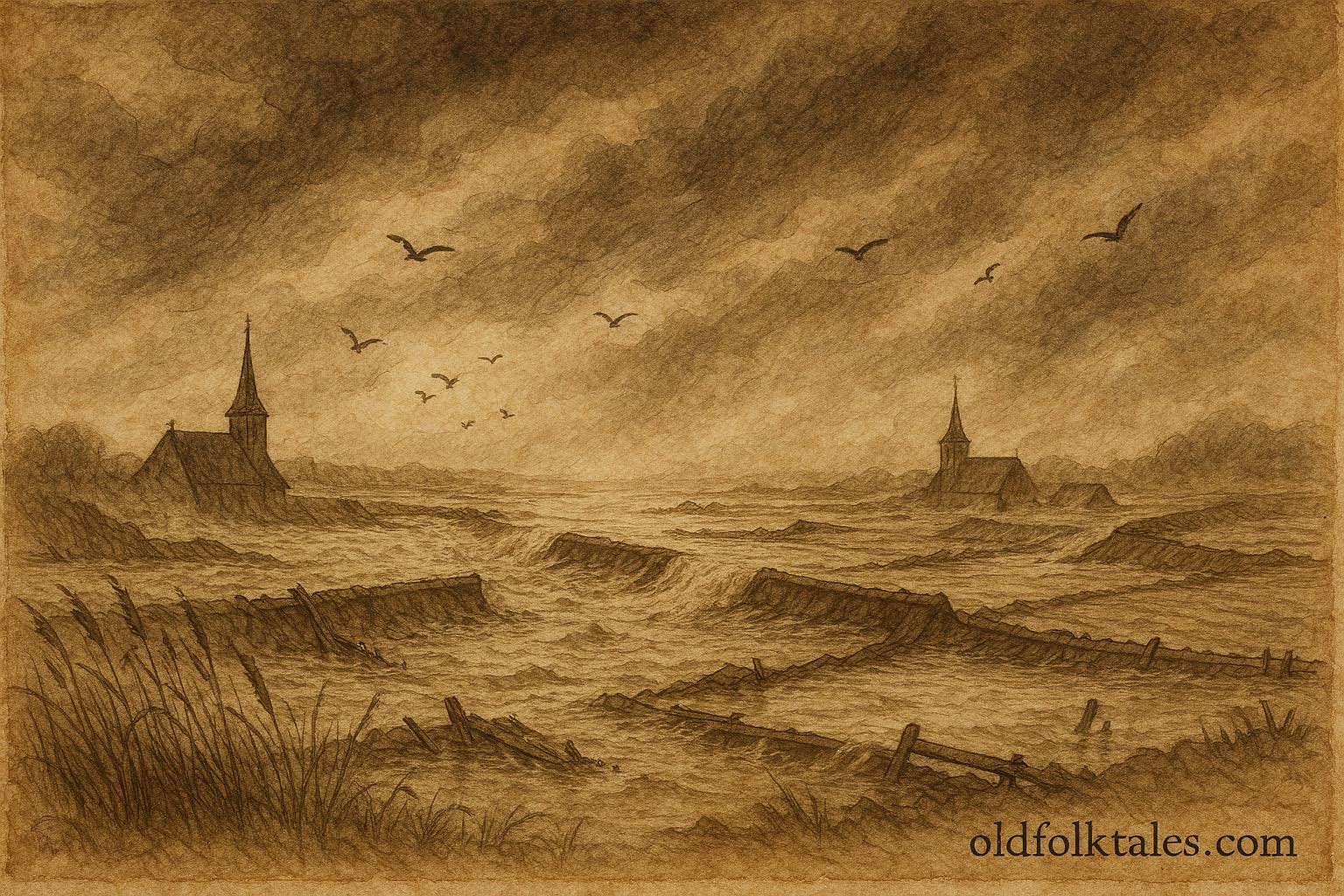
In the year 1584, the North Sea rose with relentless force. Storms battered the coast, tides pressed hard against the dikes, and water found every weakness that had been ignored for too long.
When the embankments failed, they did not fail gently.
Seawater poured inland, overwhelming fields and homes alike. Channels widened into torrents. Roads vanished beneath churning waves. The land that had taken generations to build was undone in hours.
People fled where they could. Some escaped to higher ground. Others were trapped by the speed of the flood. Livestock drowned in their pens. Crops vanished beneath saltwater. Entire villages were swallowed, leaving no trace but memory.
By dawn, Saeftinghe was no longer land.
A Landscape Transformed
In the years that followed, the sea did not retreat.
What remained of Saeftinghe became a vast tidal wilderness—mudflats, creeks, and reeds shaped by the rhythm of the tides. Attempts to reclaim the land failed. The water had claimed it fully, and human hands could not take it back.
Nature moved in where people once lived.
Birds nested where roofs had stood. Fish swam through what had once been lanes and courtyards. Salt marsh grasses replaced crops. The drowned land became both grave and sanctuary.
Yet the memory of Saeftinghe did not sink with it.
Echoes Beneath the Wind
Local tradition holds that on certain days, especially when the tide is low and the air is still, sounds rise from the marsh.
Some say they hear church bells, faint and distant, ringing beneath the wind. Others claim the cries of cattle echo across the flats, or that voices murmur where villages once stood.
Fishermen speak of shadows beneath the water that resemble rooftops or walls. Walkers tell of sudden silences, as if the land itself were listening.
These are not said to be hauntings of terror, but reminders, soft warnings carried by wind and water.
A Moral Landscape
Unlike tales of sudden divine wrath, the legend of Saeftinghe unfolds slowly. Its lesson is not found in a single moment of punishment, but in a long chain of choices: repairs delayed, warnings ignored, responsibilities neglected.
The drowned land does not accuse loudly. It simply exists, visible at low tide and submerged again at high, reminding each generation that nothing reclaimed from nature is permanent.
In Zeeland, this understanding runs deep. Dikes are maintained not merely as structures, but as acts of collective memory. Every repair acknowledges Saeftinghe.
Saeftinghe Today
Today, the Verdronken Land van Saeftinghe is one of the largest tidal marshes in Europe, a protected natural area where land and sea continue their ancient negotiation. Scientists study it. Birds depend on it. Visitors walk its edges with caution and respect.
Yet beneath its ecological value lies its older meaning.
This is not merely a wetland. It is a story written in water.
What Saeftinghe Teaches
The legend endures because it speaks to a universal truth: prosperity does not guarantee permanence, and mastery over nature is always temporary. Where vigilance fades, loss follows, not suddenly, but inevitably.
Saeftinghe was not destroyed by a single storm alone. It was undone by forgetting what had once made it possible.
And so its memory remains, as enduring as the tides themselves.
Moral Lesson
The Drowned Land of Saeftinghe teaches that neglect, pride, and disregard for balance invite ruin. Human achievement survives only through humility, shared responsibility, and respect for the forces that sustain, and surpass, us.
Knowledge Check
1. Where was Saeftinghe located?
In Zeelandic Flanders, in the southwestern Netherlands.
2. What kind of land was Saeftinghe before it was lost?
A fertile, reclaimed agricultural region protected by dikes.
3. What event led to its destruction?
Severe flooding in 1584 after weakened dikes failed.
4. What themes are emphasized in the legend?
Hubris, environmental neglect, impermanence, and remembrance.
5. What remains of Saeftinghe today?
A tidal marshland shaped by sea and nature.
6. Why is Saeftinghe still remembered in folklore?
As a warning about human pride and the power of the sea.
Source: Historical legend and oral tradition, Flood of 1584 CE (legends developed afterward).
Cultural Origin: Zeelandic Flanders, Netherlands