Long ago, in a distant Polish kingdom surrounded by ancient forests and mist-covered mountains, there lived three brothers, the sons of a nobleman. They were known far and wide for their strength and skill, but it was said that only one among them possessed the true heart of a hero.
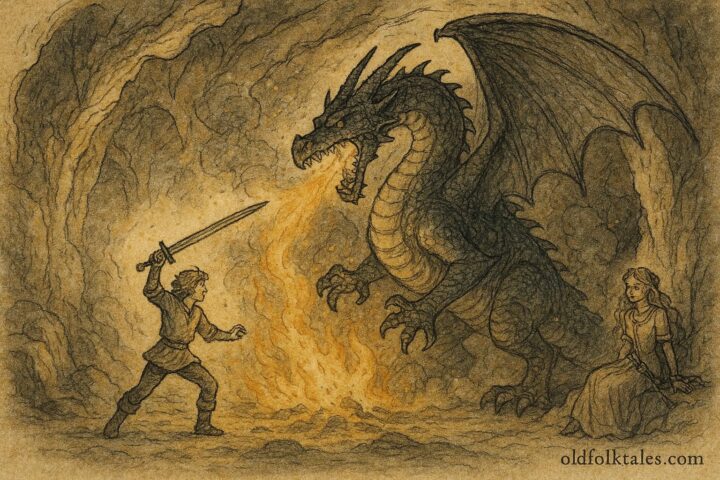
In the royal orchard of their land stood a single, mysterious tree that bore a golden apple, the fruit of fortune and eternal glory. But this wondrous tree was guarded by a terrible dragon, whose fiery breath scorched the earth and whose eyes gleamed like molten gold. Every night, the dragon watched over the apple, and all who sought it perished.
The king proclaimed that whoever brought back the golden apple would be declared the saviour of the land and heir to his throne. Hearing this, the three brothers resolved to seek the treasure, for the glory of their family and the good of their country.
The Journey Begins
Their journey led them through dark forests, where the trees whispered secrets of ancient magic, and over snow-capped mountains, where the winds sang mournful songs. The eldest brother walked proudly at the front, his sword flashing in the sun. The second followed closely, muttering complaints. The youngest, though quieter than the rest, carried himself with steady courage and faith.
As the days passed, hardship began to test their spirits. The elder brothers, weary from the climb, grew impatient and mocked the youngest for his calmness.
“You are slow and simple,” they jeered. “You think the world rewards those who dream instead of fight.”
But the youngest only smiled. “The path is long, brothers. Strength alone may not win the golden apple, perhaps the heart must be pure.”
Their laughter echoed through the valley, but he pressed on.
The Mountain of the Eagles
At last, they came to a towering cliff known as the Mountain of the Eagles, so high that its peak touched the clouds. The dragon’s lair was said to lie beyond it. The climb was perilous, the rocks sharp as blades, and the wind so fierce that it tore at their cloaks.
The eldest brother tried first, but halfway up he trembled and turned back. The second brother fared no better, losing his grip and sliding down in fear. The youngest brother looked up at the sheer height before him. He felt the chill of fear, yet his heart burned with courage. Grasping a jagged stone, he began to climb.
Higher and higher he went, until the mountain vanished below him in a sea of clouds. At the summit, he found the golden apple, glowing softly in the nest of a great eagle. Before he could reach for it, a shadow fell over him, and suddenly the air roared with wings.
The Queen of the Air
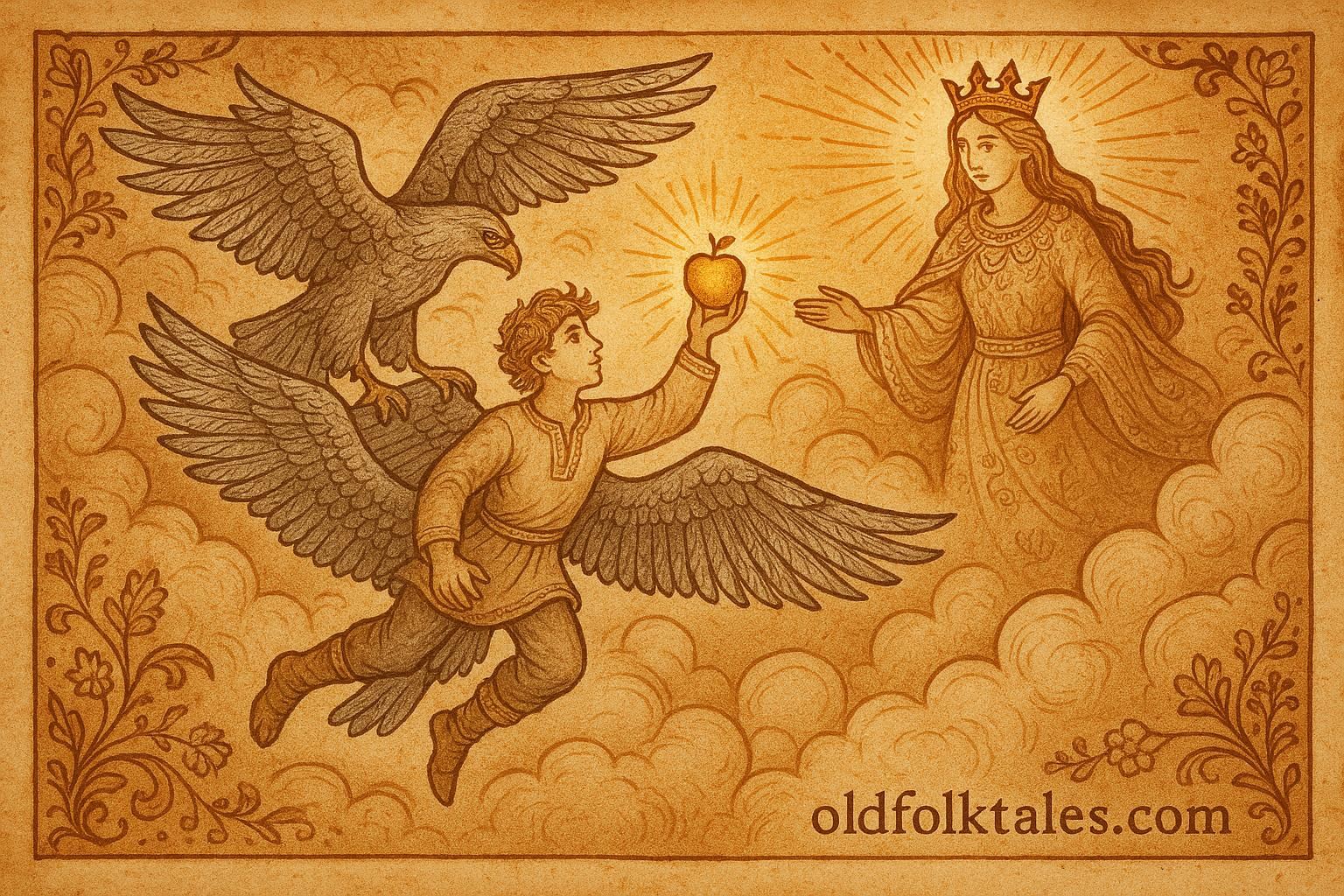
Three mighty eagles descended, their feathers shining with silver light. With a cry, they lifted the young man into the sky and carried him above the clouds to a realm of light and air. There, on a throne of crystal, sat the Queen of the Air, a radiant figure crowned with starlight.
“Brave youth,” she said, her voice like wind over water, “few mortals dare climb to this height. Tell me, why do you seek the golden apple?”
He bowed low and answered, “Not for power or pride, but to bring peace to my land and honour to my father’s name.”
The Queen smiled. “Then your heart is pure.” She tested him with questions of truth and loyalty, and seeing no deceit in him, she handed him the golden apple. Then she plucked a single feather from her own eagle’s wing and gave it to him.
“Keep this feather,” she said. “Should danger ever find you, cast it into the air, and I will come.”
With that, the eagles bore him back to the mountain and set him safely upon the ground.
The Brothers’ Betrayal
When the youngest returned, weary but triumphant, his brothers were waiting at the foot of the mountain. Their eyes widened at the sight of the golden apple. Envy flared in their hearts. As he told them his tale, they plotted against him.
That night, as he slept, the brothers pushed him into a deep ravine and took the apple for themselves. “No one will know,” they whispered. “The glory shall be ours.”
But the youngest was not fated to die. When he awoke, broken and alone, he remembered the Queen’s gift. Taking the feather, he cast it into the wind. At once, the sky darkened with wings, and the eagles descended. Gently, they lifted him from the pit and bore him home.
Truth and Justice
At the royal court, the two brothers had already presented the apple to the king, claiming they had slain the dragon together. But before the reward could be given, the hall trembled as a gust of wind swept through it. The youngest brother appeared, the eagles soaring above him.
He spoke the truth calmly, showing the Queen’s feather as proof of his tale. The king, seeing his honesty and courage, was filled with pride and sorrow. The elder brothers hung their heads in shame.
“Your heart was tested,” said the king, “and it has proven truer than gold.”
The youngest brother was declared heir to the throne. Under his rule, peace and prosperity flourished, and the story of the Eagles and the Golden Apple was told for generations.
Moral Lesson
This Polish folktale teaches that purity of heart and courage shine brighter than envy or deceit. True strength lies not in pride or ambition, but in honesty and faith.
Knowledge Check
-
What guarded the golden apple?
A fierce dragon guarded it near the Mountain of the Eagles. -
Which brother succeeded in the quest?
The youngest brother, who remained brave and pure-hearted. -
Who tested the hero’s courage?
The Queen of the Air tested him before granting the apple. -
What gift did the Queen give the hero?
A magic feather that could summon her aid. -
How did the brothers betray the youngest?
They pushed him into a ravine and stole the golden apple. -
What is the moral of this Polish folktale?
Courage, truth, and purity of heart always overcome envy and deceit.
Source: Adapted from The Eagles in Polish Fairy Tales, collected by Antoni Józef Gliński, translated by Maude Ashurst Biggs (1920), Project Gutenberg eBook #36668.
Cultural Origin: Poland (Eastern provinces; connected with bird-myth motifs)