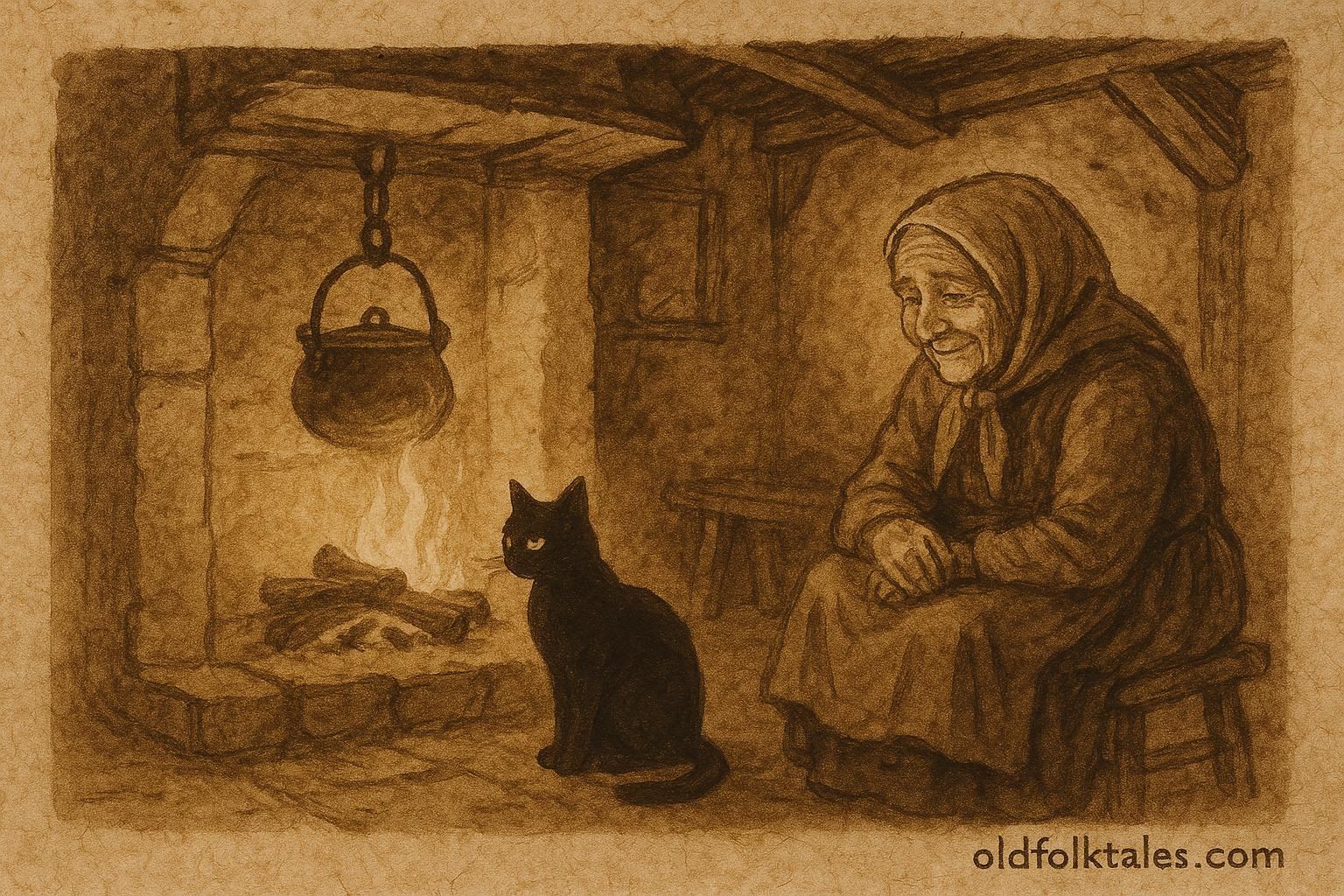
In the heart of old Hungary, where soft mists coil over the meadows and village bells echo across the hills, there once stood a poor peasant’s cottage, small and humble but filled with warmth. Within lived a kind-hearted woman who longed for nothing more than companionship. Her husband had died long ago, and her only child, a bright, loving daughter, had grown up and married, leaving her mother alone.
Each night, as the wind sighed through the chimney, the old woman whispered, “Oh, if only I had someone to talk to, even if it were just a little creature who could share my fire.”
One cold evening, while she sat spinning beside the hearth, she heard a faint mewing outside. Opening the door, she saw a small black cat, its fur glistening like velvet in the firelight, its eyes shining like twin emeralds.
“Poor thing,” said the old woman gently, lifting it into her arms. “You shall stay with me and share my bread.”
From that night on, the cat became her dearest companion. It followed her everywhere, into the garden, to the well, even to church. The villagers laughed softly behind their hands, saying the old woman must have lost her wits, for she treated the cat as her child. But she did not care. The creature brought comfort to her lonely life.
As time passed, something curious began to happen. The old woman noticed that the cat’s eyes seemed to hold a deep, knowing sadness, and sometimes, late at night, when she half-dozed by the fire, she thought she heard the faintest whisper, a human sigh, from the corner where the cat slept.
The Noble Visitor
One spring morning, a grand coach rattled down the muddy road that passed the cottage. Inside sat a noble young lord, richly dressed and handsome, his eyes dark and searching. His horses stamped impatiently, their bridles jingling.
The old woman, startled by such a visitor, hurried to the gate. The young man spoke kindly:
“Good mother, I have ridden far and am weary. Might I rest here for a little while?”
“With all my heart,” she said, bowing. “My home is poor, but what I have, I share gladly.”
She laid out her best cloth and poured him milk and bread. The black cat, as usual, sat beside her on the bench, its green eyes fixed intently on the stranger.
The young man looked at the cat, then back at the old woman. “What a beautiful creature,” he said softly. “Its eyes, how strange they are. They seem almost… human.”
At that moment, the cat gave a low cry and darted from the room.
The Secret Revealed
That night, as the moon rose over the thatched roofs, the cat vanished. The old woman searched and called in vain. Then, near midnight, she heard a voice at her door, a woman’s voice, clear and trembling.
She opened it and gasped. Before her stood a young lady dressed in white, her hair dark as midnight, her eyes the same emerald green as the cat’s.
“Good mother,” said the maiden, kneeling, “forgive me. I am the cat you took in. I was cursed long ago by a wicked witch, doomed to live in this form until someone showed me true kindness without asking reward. Because of your gentle heart, the spell is broken.”
The old woman wept for joy, but the maiden only smiled sadly. “Yet the curse has one more task to end. I must find the man destined to love me for who I am, not for what I seem.”
The next morning, the noble lord returned, saying he could not rest for thinking of the cat’s eyes. When he saw the maiden, he knew her at once. “It is you,” he whispered. “The soul behind the eyes.”
Their love was immediate and pure. Before long, they were married in the village church, and the bells rang brighter than they had in years. The old woman, honored as a mother to the bride, lived with them in comfort and peace until her last days.
And as for the maiden and her lord, they ruled wisely, never forgetting that kindness and compassion can break the strongest enchantment.
Moral Lesson
True kindness, given freely and without judgment, has the power to undo even the deepest curse. Love and empathy reveal what lies beneath the surface, teaching that appearances often hide the purest souls.
Knowledge Check (Q&A)
1. Who wrote the English retelling of “The Enchanted Cat”?
Baroness Orczy, in her 1895 collection “Old Hungarian Fairy Tales.”
2. What is the main theme of “The Enchanted Cat”?
The story highlights kindness, compassion, and the power of love to break enchantments.
3. Why was the maiden transformed into a cat?
She was cursed by a wicked witch and could only regain her human form through an act of selfless kindness.
4. What role does the old woman play in the story?
She represents compassion and humility, her kindness frees the enchanted maiden from her curse.
5. What symbolic meaning does the black cat hold in Hungarian folklore?
In Hungarian tales, animals often symbolize hidden wisdom or spiritual trials, here, the black cat embodies transformation and redemption.
6. What lesson can readers learn from this Hungarian fairy tale?
That true goodness and open-heartedness can bring miracles and unexpected blessings.
Source:
Adapted faithfully from “The Enchanted Cat” in Old Hungarian Fairy Tales by Baroness Orczy (1895), London: Dean & Son Ltd.
Cultural Origin: Hungarian folklore, Hungary