The tale of the Enchanted Stag, Csodaszarvas, has lived for centuries in Magyar lore, appearing again and again in seasonal stories, ancestral legends, and early Hungarian collections. Though simple in structure, it is a powerful symbolic tale: a wondrous stag that appears before hunters or forebears, guiding them across wild landscapes, drawing them toward discovery, transformation, or destiny.
In this retelling, the story remains exactly as tradition presents it, an encounter, a pursuit, and the enduring mystery of a creature that reveals more by what it withholds than by what it offers directly. This version seeks only to enrich the imagery and emotion while preserving every original detail and meaning attached to the motif.
Across the early Magyar lands, long before roads cut through forests or villages grew into towns, there stretched wide hunting grounds draped in mist and ancient silence. These woods were dense with oaks, pines, and thorny undergrowth, and they carried the scent of damp earth and wild herbs. It was a place where wind could move like a whisper across the treetops, a place where the border between the human world and the mythic seemed thin enough to pass through unnoticed.
On such a morning, when dawn had barely broken and a pale gold light lay across the horizon, a group of hunters ventured into the wilderness. The air was cold on their breath, and the dew still clung to the grasses as they moved with practiced steps. These hunters represented not only their own skill but the long line of ancestors whose survival had depended on knowledge of the land, the paths of the animals, the changing seasons, and the signals hidden in birdsong and rustling leaves.
It was then, between the first call of birds and the settling quiet of the forest, that they saw it.
The stag.
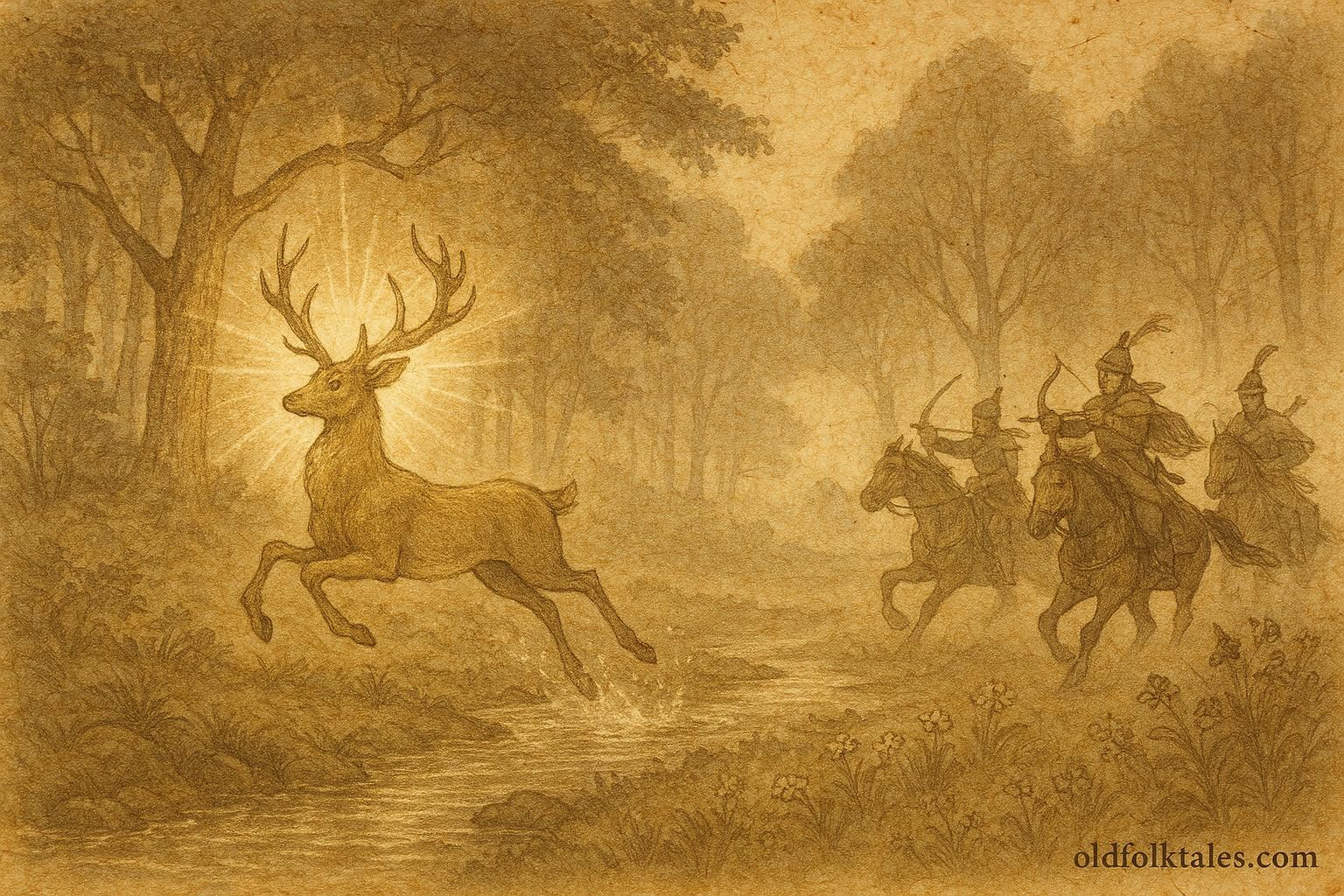
Not an ordinary stag, nor even a particularly large one, but a creature so radiant that the hunters paused as though rooted to the ground. Its coat shimmered, catching the new sunlight in a way that seemed almost unearthly, white and gold at once, luminous without harshness. Its antlers rose like the branches of an old tree, branching into elegant curves touched with a faint inner glow. Even its eyes appeared bright and deep, like pools reflecting a sky too far away to reach.
The hunters recognized immediately what they faced: the Csodaszarvas, the Enchanted Stag of Magyar legend.
It did not flee at once. Instead, it held its ground for a moment longer than any wild creature would, as though acknowledging the hunters, inviting them, perhaps, or testing them. Then, with a single graceful movement, it turned and bounded into the forest, swift and silent.
The hunters gave chase.
They moved through thickets, across clearing after clearing, over small streams that sparkled in the rising light. Every time they thought they were close enough to catch up, the stag would appear again at a distance, always just ahead, always visible, always unreachable. Its presence pulled them forward like a thread, leading them deeper into the wilderness than any of them had planned to go.
Hours passed. The forest changed from sunrise glow to the full brightness of day. The terrain shifted beneath their feet, first soft forest soil, then rocky ground, then rolling meadowland dotted with wildflowers. Through every change, the stag kept its pace: neither frantic nor leisurely, but measured, almost deliberate.
There was no malice in its movement, nor fear. It ran as though fulfilling a purpose long set in motion.
For the hunters, the pursuit stirred something deeper than instinct. Awe mingled with determination. Some felt as though they chased not a creature but a sign, an omen from the natural and the mythic world alike. Others sensed that the stag’s appearance marked a turning point for their people, a moment destined to be remembered long after they themselves returned to dust.
Yet despite their relentless pursuit, they never drew close enough to touch the creature.
When the sun dipped lower and shadows lengthened across the land, the stag finally slowed. It reached the crest of a hill overlooking a vast stretch of untouched land, open fields, distant forests, rivers winding like silver threads. The hunters arrived moments later, breathless and weary.
The Enchanted Stag turned to face them one final time.
Its luminous form glowed in the dusk, and for a moment the entire landscape seemed to shimmer with the same uncanny light. The hunters felt a hush fall over them, not silence, but a presence, a weight of meaning they could sense but not fully grasp. Then, without sound, the stag stepped backward into the shadow of the trees and vanished, as though the forest itself had swallowed it gently.
The hunters stood quietly, understanding that the chase had not been meant to end in capture. The stag had led them to something far greater: a place of new possibilities, a land rich and waiting, a reminder that destiny is not always seized by force but revealed through pursuit.
In Magyar tradition, the Enchanted Stag would continue to appear in many stories, always a guide, never a possession; always a symbol of ancestral movement, seasonal cycles, and the balance between the earthly and the divine. Its legend endured because some truths are too vast to fade: the promise of discovery, the pull of destiny, and the sacredness of the wild.
Moral Lesson
The Enchanted Stag teaches that some paths are not meant to lead to conquest but to understanding. When we pursue with courage and humility, life reveals the destinations we are meant to find, even if they differ from the ones we imagined.
Knowledge Check
1. What is the Csodaszarvas in Hungarian folklore?
The Csodaszarvas is the Enchanted Stag, a recurring Magyar mythic figure symbolizing guidance, destiny, and ancestral movement.
2. Why do hunters pursue the Enchanted Stag?
They follow it because its appearance is seen as a significant sign or omen, guiding them toward discovery and deeper meaning.
3. What does the stag symbolize in Magyar tradition?
It symbolizes divine guidance, transformation, seasonal cycles, and the ancestral journey of the Hungarian people.
4. How does the story portray the hunters’ emotions?
The hunters experience awe, determination, and a growing sense that the stag leads them toward a destiny beyond the hunt.
5. Why does the stag remain unreachable?
Its purpose is not to be captured but to guide, its unattainability reinforces its sacred, symbolic role.
6. What is the main lesson of the Enchanted Stag story?
Destiny often reveals itself through the journey, not the capture, reminding us to follow signs with humility and openness.
Cultural Origin: Based on the Csodaszarvas motif in Magyar/Hungarian folklore.