In a small Hungarian village, where the Danube’s mist touched the fields each morning and the hills shimmered with dew, a young man named Benedek lived with his ailing father. The old man had once been a respected blacksmith, but illness now kept him bedridden, leaving Benedek to care for their modest home. The villagers whispered of remedies and distant cures, but none were potent enough to restore life and vigor to the father’s failing health.
One evening, as the sun dipped behind the western hills, a royal messenger arrived on horseback, his cloak fluttering like the wings of a raven. He carried word from the king himself: the monarch’s daughter had fallen gravely ill, and a magical feather from Hajnal Szép, the Fairy of the Dawn, could heal her. Hearing of this, Benedek’s father grew silent with worry. Though the quest concerned the king, Benedek, filled with courage and filial devotion, resolved to undertake the journey.
At dawn the next day, Benedek set forth. He walked along winding forest paths, over hills crowned with wildflowers, and across streams sparkling with silver light. Each step seemed heavier with responsibility, for he carried not only his father’s hope but also the invisible expectation of honor and virtue.
His first challenge appeared as the sun climbed higher in the sky. A magical horse, gleaming like molten silver, stood in a meadow. Its eyes were deep pools of ancient wisdom. As Benedek approached, the horse spoke in a clear, ringing voice:
“To ride me, young human, you must guard me from the shadows and resist every temptation. Many have tried and failed, seduced by promises of treasure, comfort, or ease.”
Benedek bowed humbly. “I seek only to save my father. No earthly reward can sway my heart.”
The horse nodded and allowed him to mount. Immediately, shadows swirled around him, whispering of riches, glory, and ease. He glimpsed glittering cities, golden coins, and feasts beyond imagination. Yet Benedek clenched his jaw and fixed his mind on the goal: Hajnal Szép’s feather and his father’s health. The shadows, recognizing his resolve, parted, and the horse galloped forward with wind singing through the trees, carrying him swiftly toward the edge of the enchanted forest where the fairy resided.
At the forest’s entrance, Benedek faced trials of cunning and patience. Trees shifted their positions, creating labyrinthine paths, and streams appeared where solid ground should be. Each night, the forest whispered temptations: to turn back, to rest, to abandon the quest. But Benedek relied on his wits, observing patterns, listening to the rustle of leaves, and interpreting the songs of the night birds. Slowly, step by careful step, he navigated deeper into the magical realm.
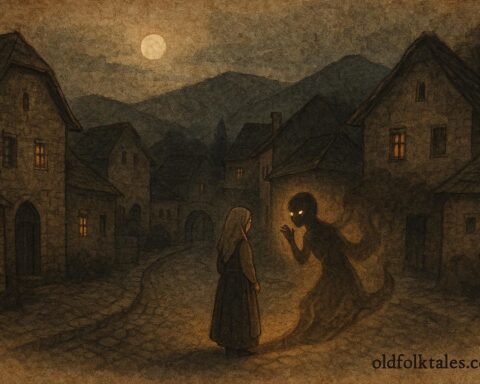
One evening, as twilight bathed the forest in violet and silver, a shadowy figure appeared, a guardian spirit tasked with testing those who sought the fairy. “Why do you enter here, mortal?” it asked, voice echoing like wind through stone.
“To save my father,” Benedek replied without hesitation. “And to fulfill what I must, not for wealth or fame, but for love and duty.”
The spirit’s eyes gleamed. “Then your heart is true. Yet the final test awaits: Hajnal Szép herself. Will you resist distraction, flattery, and fear?”
Benedek nodded. “I will.”
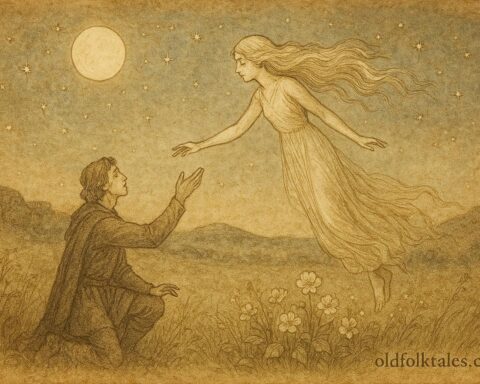
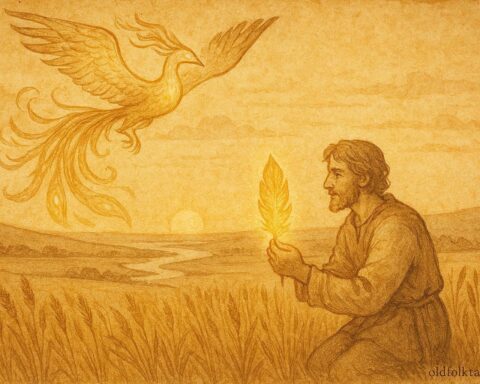
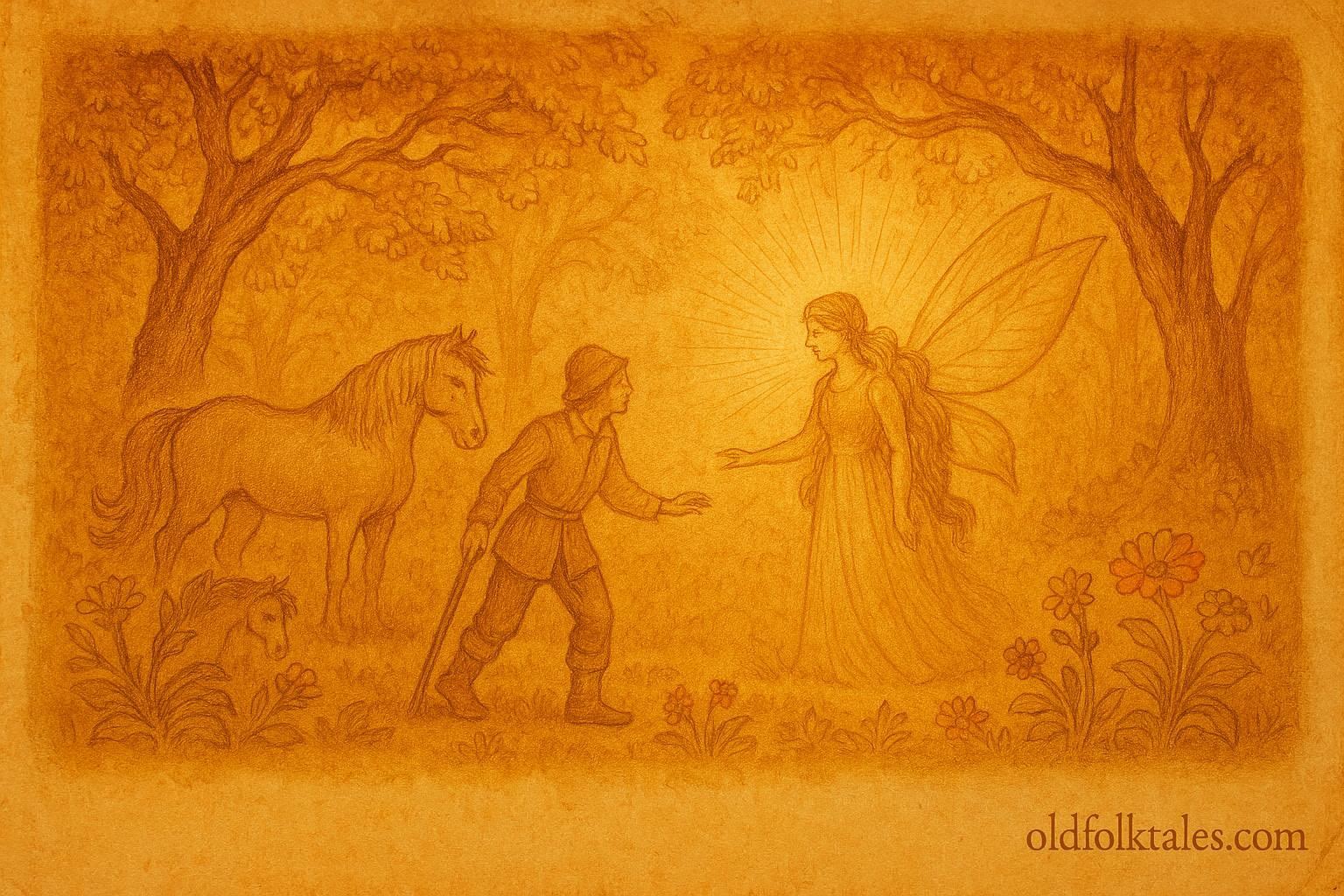
As dawn broke the following day, the forest parted to reveal a glimmering glade, bathed in golden light, where Hajnal Szép, the Fairy of the Dawn, hovered above the ground, radiant and ethereal. Her wings shimmered with every color of sunrise, and her gaze was both kind and commanding.
“Who dares enter my realm?” she asked, her voice like wind chimes over water.
“I am Benedek of the village near the Danube,” he said. “I seek your feather, for it can heal my father, whose life wanes. I beg your mercy and guidance.”
Hajnal Szép studied him for a long moment, her sevenfold eyes reflecting both curiosity and wisdom. Then she spoke: “Many seek my gift, but few endure the trials of heart, mind, and spirit. To earn it, you must complete three tasks, one of loyalty, one of perseverance, and one of insight.”
The first task required him to tend a magical garden for seven days and nights without rest, tending each plant and flower that responded only to honesty and care. Benedek worked tirelessly, singing lullabies to the blooms, speaking kindly, and observing their needs. At the end, each flower glowed, signaling that his loyalty and patience were pure.
The second task involved crossing a bridge of crystal over a river of fire, where illusions of past failures and fears sprang from the flames. Benedek’s resolve was tested, but he remembered the lessons of the magical horse and forest spirits: focus, clarity, and courage guide the heart. He stepped carefully, each movement deliberate, until he reached the other side unscathed.
The final task tested his insight and compassion. Hajnal Szép conjured visions of his father, his village, and himself, sometimes in peril, sometimes corrupted by pride or greed. Benedek’s decisions determined whether the illusions strengthened or dissolved. He chose patience over anger, generosity over self-interest, and understanding over fear. Each choice reinforced the purity of his intentions.
At last, Hajnal Szép descended, the sunlight of dawn bending around her like a halo. “You have succeeded, Benedek,” she said softly. “Your courage, loyalty, and insight have proven that the gift of life is earned not through force, but through heart, mind, and spirit.”
She plucked a single radiant feather from her wing and handed it to him. Its warmth spread through Benedek’s hands like the first sun of spring. “Return to your father,” she said. “Your journey has taught you much, but your wisdom will serve you at every turn of life.”
Benedek mounted the magical horse and journeyed home. Upon arriving, he placed the feather near his father’s chest. Slowly, color returned to his father’s cheeks, his eyes brightened, and his strength grew until he rose from his bed, healthy and renewed. The villagers, witnessing this miraculous recovery, praised Benedek’s courage and the blessings of Hajnal Szép.
From that day forward, Benedek was known not only as a brave and clever youth but as a man whose perseverance, loyalty, and insight brought healing, peace, and respect to his home and community. The story of Hajnal Szép and Benedek became a cherished tale in the village, retold to each new generation as a lesson in virtue, patience, and the power of selfless courage.
Moral Lesson
The tale of Hajnal Szép teaches that true heroism combines perseverance, loyalty, and insight. Trials may tempt, frighten, or mislead, but steadfastness of heart and clarity of purpose ensure that goodness and transformation triumph over adversity.
Knowledge Check
-
Who is Benedek?
A young Hungarian hero who seeks Hajnal Szép’s feather to heal his ailing father. -
Who is Hajnal Szép?
The beautiful Fairy of the Dawn, whose feather possesses magical healing power. -
What magical trials does Benedek face?
Guarding a magical horse, navigating a shifting forest, tending an enchanted garden, crossing a river of fire, and resisting illusions and temptations. -
What are the key themes of the story?
Perseverance, loyalty, transformation, courage, and self-growth. -
What is the cultural origin of the tale?
Hungarian rural oral tradition, collected in the late 1800s. -
What is the story’s moral lesson?
True courage and success are achieved through selflessness, insight, perseverance, and moral integrity.
Source: Collected by Hungarian folktale anthologists in the late 1800s, influenced by Grimm-style recordings
Cultural Origin: Hungary, Hungarian rural oral tradition