In a quiet French village surrounded by green meadows and whispering woods, there lived a humble couple who longed for a child. Their prayers were finally answered when a son was born to them, a bright, healthy baby with eyes like morning dew and a smile that melted every heart. His parents named him Jean.
The household was filled with laughter, songs, and the sweet fragrance of freshly baked bread. Neighbors often came by to admire the child, saying he would surely bring honor to his family. Yet, deep in the forest, unseen eyes watched the happy home. Among the ancient oaks and tangled roots dwelled a wicked spirit, one of the fae folk, jealous of human joy and always seeking to sow sorrow where love bloomed.
One misty night, as the mother dozed beside her infant, the spirit slipped into the cottage. With a hiss and swirl of cold air, it snatched the baby from the cradle and left behind a changeling, an impish creature with sunken eyes and a mocking grin. When dawn came, the mother stirred and reached for her son. The sight that met her eyes froze her heart.
The child before her looked like Jean, but not quite. His laughter sounded hollow, and his eyes held no warmth. Still, a mother’s hope is stronger than reason, and she told herself that her baby was merely unwell. Days turned into weeks, and her fear grew as the child’s strange nature revealed itself. He refused her milk, spoke words no infant should know, and mocked her in a voice far too old. The father, seeing his wife’s despair, went to the village priest for counsel.
The priest, wise in matters of both heaven and the unseen world, listened solemnly. “There are dark powers that steal the innocent,” he said. “Take the child to the crossroads at midnight. There, the truth will show itself.”
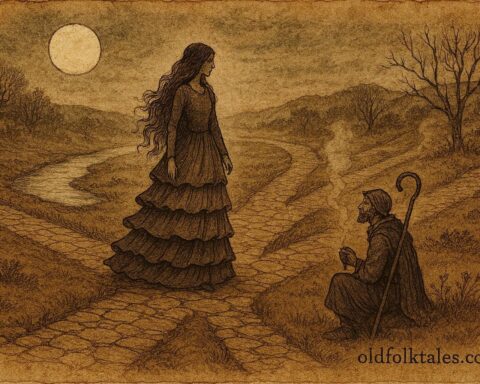
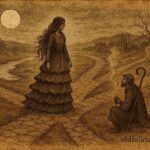
With trembling hearts, the couple obeyed. Under the silver light of the moon, they carried the child wrapped in a shawl. When they reached the crossroads, the mother whispered a prayer. The moment the words left her lips, the changeling let out a shriek that echoed through the night. Its form twisted and shrank, revealing a creature neither fully man nor beast. With a final curse, it vanished into the shadows, leaving behind an empty cradle.
The mother collapsed in tears, thinking her true child lost forever. But just as the church bell struck midnight, a soft cry rose from the woods. Rushing toward the sound, she found a small bundle lying in the grass, her real son, unharmed and smiling, as though no harm had ever touched him.
From that day on, peace returned to the household. The child grew into a fine young man, strong and kind, beloved by all. Yet the story of his strange disappearance spread far and wide, a reminder to all who heard it that not every blessing is without peril.
Years later, when Jean came of age, he learned the truth of his early life. Rather than fear the past, he dedicated himself to helping others protect their homes from evil. He became known as “Jean the True,” a man whose very presence seemed to drive away deceit. In every act of kindness, he carried the quiet memory of a mother’s love and the night when darkness was undone by faith.
Moral Lesson
“The False Child” teaches that love and faith can pierce through even the darkest deceit. True identity, no matter how deeply hidden, will always reveal itself when light and truth are sought with courage.
Knowledge Check
- What is the central theme of “The False Child”?
The story centers on the triumph of truth and love over deception, symbolized by a child’s restoration after being replaced by a false one. - Who replaces the real child in the story?
A malicious spirit or fairy changeling takes the baby’s place to deceive the parents and spread sorrow. - How do the parents discover the truth about their child?
They follow the priest’s advice to bring the child to the crossroads at midnight, where the changeling reveals its true nature. - What is the symbolic role of the crossroads in the folktale?
The crossroads represents a meeting point between the natural and supernatural realms—a place of revelation and choice. - What moral does the story convey about faith?
It shows that faith and courage, even in fear, can uncover truth and restore what was lost. - How does the tale reflect French folklore traditions?
It features common French folkloric elements such as changelings, spiritual guidance from the Church, and moral triumph through steadfast belief.
Cultural Origin: French folktale, France
Source: Adapted from Pourrat’s French Folktales