High in the Carpathian Mountains, where the forests grew thick and ancient and the air carried the scent of pine and stone, there lived a poor hunter who made his living from the land.
His home was a simple wooden hut perched on the edge of a steep valley. Each morning, he set out with bow in hand, moving quietly through the forest, guided by patience rather than haste. He was not the strongest of men, nor the boldest, but he possessed something that served him well in the mountains, he paid attention.
He knew the habits of animals, the patterns of the wind, and the subtle signs that others often missed.
Yet even with such knowledge, his life was not easy.
Game was scarce, winters were harsh, and each day’s success was uncertain.
One evening, as the sun sank low and the forest darkened into shadow, the hunter ventured deeper than usual. He had followed faint tracks, hoping they would lead him to something worth bringing home.
But what he found was not what he expected.
In a quiet clearing, where the trees opened just enough to let the last light of day filter through, something shimmered.
At first, he thought it was a reflection, perhaps sunlight caught in water.
But there was no stream.
He stepped closer.
And then he saw it.
A feather.
It lay upon the ground, glowing faintly, as though holding within it the warmth of the sun itself. Its colors shifted, gold, amber, and a deep, fiery red that seemed almost alive.
The hunter hesitated.
He had heard stories.
Tales passed from one generation to another, of a creature that could not be easily found, and never easily kept.
The Firebird.
He knelt slowly and reached out, his fingers brushing the feather.
It was warm.
Not as fire burns, but as light might feel if it could be touched.
The moment he lifted it, the clearing brightened.
And from above, a movement.
The hunter looked up.
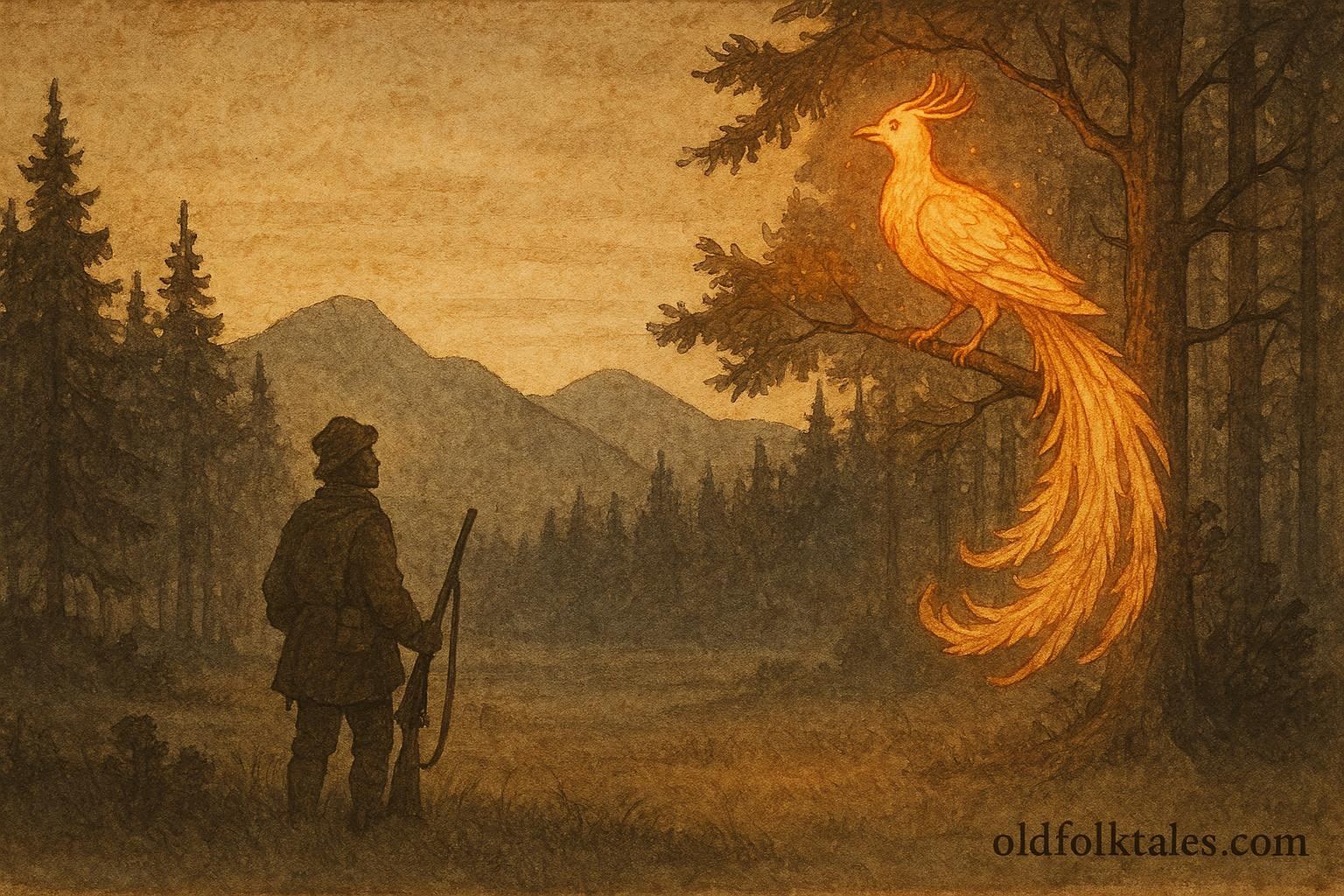
There, among the branches, was the bird itself.
Its feathers burned with color, each one catching the fading light and reflecting it in a way that made the entire forest seem to glow. Its eyes were sharp, aware, and unafraid.
The hunter remained still.
He did not raise his bow.
He did not move closer.
He simply watched.
The Firebird tilted its head, as though studying him in return.
For a long moment, they remained like that, man and creature, neither acting, neither retreating.
Then, with a powerful motion, the bird spread its wings and rose into the sky, its light fading as it disappeared into the darkening forest.
The hunter stood alone once more.
But now, he held the feather.
He returned home with it, uncertain of what he had found, yet unable to dismiss its significance.
The next day, word spread.
Such things did not remain hidden for long.
By the time the hunter reached the village, whispers had already begun.
“A Firebird feather,” they said.
“It brings both fortune and danger.”
Soon, the news reached beyond the village.
It reached the ears of the king.
The king, who ruled the lands below the mountains, was a man who valued possession above all else. He surrounded himself with riches, collected rare objects, and sought always to add more to what he already had.
When he heard of the feather, his interest was immediate.
“Bring the hunter to me,” he commanded.
The hunter was summoned to the court.
He entered the grand hall, where polished floors and towering walls reflected the wealth of the king. The feather, still in his possession, seemed almost out of place among such man-made splendor.
The king leaned forward.
“You have found something rare,” he said.
“Yes,” the hunter replied simply.
“I want the bird,” the king continued. “You will go back into the mountains and bring it to me.”
The hunter remained silent for a moment.
“It is not easily taken,” he said.
The king’s expression hardened slightly.
“Then you will find a way,” he replied. “If you succeed, you will be rewarded. If you fail…”
He did not finish the sentence.
The meaning was clear.
The hunter bowed his head.
“I will go,” he said.
And so, he returned to the mountains.
The forest welcomed him as it always had, but now, there was a difference. He walked not as a man seeking food, but as one sent on a task that carried weight far beyond himself.
He searched for the clearing again.
Days passed before he found it.
When he did, it was unchanged.
He stood at its edge, remembering the moment he had first seen the feather.
This time, he did not act immediately.
He waited.
As the sun lowered, the light softened, and the forest grew still.
Then, once again, the Firebird appeared.
It descended quietly, its presence illuminating the space around it.
The hunter watched carefully.
He remembered the king’s command.
But he also remembered the stillness of their first meeting.
He did not rush forward.
Instead, he placed the feather gently on the ground.
The Firebird moved closer.
Its gaze shifted between the feather and the man.
The hunter lowered his eyes slightly, not in fear, but in respect.
“I was told to capture you,” he said softly.
The bird did not move.
“But I will not take what does not wish to be taken.”
The forest seemed to hold its breath.
The Firebird stepped forward.
For a moment, it stood close enough that the hunter could see every detail, the shifting light, the steady gaze, the quiet strength.
Then, in a movement both swift and gentle, it allowed him to reach out.
The hunter did not grasp or trap.
He simply touched its wing.
And in that moment, he understood something.
This was not a creature to be owned.
It was something to be honored.
When he returned to the king, he did not bring the bird.
He brought only the feather.
The king’s anger was immediate.
“You disobeyed me,” he said.
“I chose not to betray what I did not understand,” the hunter replied.
The court fell silent.
The king studied him, his expression unreadable.
“You had the chance to bring me what I desired,” he said.
“And you refused.”
The hunter did not look away.
“There are things that cannot be taken by force,” he said.
For a long moment, nothing moved.
Then, slowly, the king leaned back.
“You are either a fool,” he said, “or wiser than most.”
He paused.
“And I will not punish a man who returns with truth.”
The feather remained in the court, its light a quiet reminder of what had been sought, and what had not been taken.
The hunter returned to his life in the mountains.
He did not speak often of what had happened.
But those who heard the story understood something more than the tale itself.
That not all treasures are meant to be captured.
And that sometimes, the greatest victory lies in knowing when not to take.
Discover Polish, Russian, Ukrainian, and Belarusian folktales where magic and morality meet
Moral Lesson
True wisdom lies in knowing the limits of power. Greed seeks to possess, but respect understands that some things are meant to remain free.
Knowledge Check
1. What did the hunter find in the forest?
He discovered a glowing feather belonging to the legendary Firebird.
2. Why did the king summon the hunter?
The king wanted the hunter to capture the Firebird for him.
3. What made capturing the Firebird difficult?
The bird was a magical creature that could not be easily taken by force.
4. Why did the hunter choose not to capture the Firebird?
He realized it was a being that deserved respect, not possession.
5. How did the king react to the hunter’s decision?
Though initially angry, he ultimately respected the hunter’s honesty.
6. What is the central theme of the story?
The story highlights the dangers of greed and the importance of wisdom and respect.
Source: Oral folklore of the Carpathian Mountains, recorded in 1902
Cultural Origin: Western Ukrainian highland traditions with Slavic mythological elements