In the deep forests of Greater Poland and the rolling plains of Masovia, when summer reaches its fullest breath and twilight stretches long and golden across the fields, villagers speak in hushed anticipation of a miracle that blooms only once each year. It is said that on Midsummer’s Eve, Kupala Night, the fern, a plant that never flowers, reveals a single radiant blossom.
The Kwiat Paproci.
And whoever finds it will gain wealth beyond measure, wisdom beyond kings, and knowledge of hidden things.
But not without cost.
The Night of Fire and Water
Kupala Night arrives when the sun stands longest in the sky. By day, girls gather wildflowers to weave wreaths, poppies, cornflowers, chamomile, while boys stack wood for the great bonfire.
At dusk, the village gathers by the riverbank. Flames leap high into the violet air. Couples clasp hands and leap the fire, believing that if they land together, their love will endure.
Wreaths are set afloat upon the water, carrying candles that flicker like drifting stars. The river carries secrets downstream.
But as laughter echoes and songs rise, some slip away.
For beyond the fields and rivers lies the forest.
And within the forest waits the fern.
The Poor Young Man
In one such village lived a poor young man, the youngest son of a widowed mother. His family owned little beyond a patch of land and a cottage with a sagging roof.
He worked faithfully from dawn until dusk, but each harvest seemed thinner than the last. When he watched the village elders counting coins at market or saw fine horses tethered before grand homes, he felt the weight of poverty pressing against his chest.
On the eve of Kupala, as others sang, he listened to an old tale spoken by a grey-bearded man near the fire.
“The fern flower blooms at midnight,” the elder murmured. “But only for the brave, or the desperate.”
The young man felt something stir inside him.
That night, while the bonfire crackled and wreaths drifted downriver, he slipped silently toward the forest.
Into the Forest
The forest was thick with summer scent, pine sap, damp earth, crushed leaves. Fireflies blinked between trunks like scattered embers.
The deeper he walked, the quieter it became.
No birds sang.
No wind stirred.
Only his own heartbeat.
The moon climbed high. Shadows stretched long. He reached a clearing where ferns grew dense and tall, their fronds arching like green fountains.
He waited.
Midnight approached.
And then it happened.
The Blooming
For one breathless moment, the forest held still.
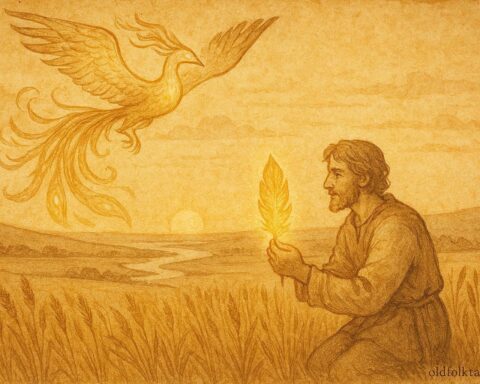
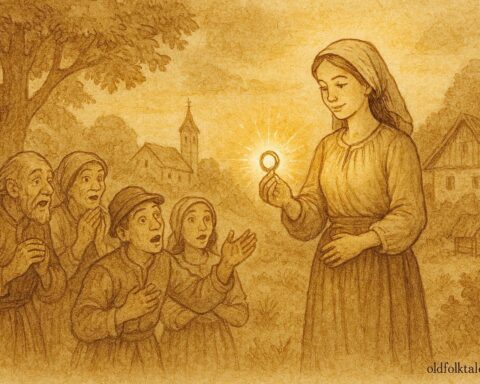
Then, at the center of the clearing, a single fern trembled. From its heart burst a small, blazing flower, bright as a coal, radiant as a fallen star.
It pulsed with crimson-gold light.
The young man stepped forward, scarcely daring to breathe.
Voices whispered from the dark.
Promises.
“Riches.”
“Power.”
“Knowledge.”
He reached out and plucked the flower.
The clearing exploded with sound, rustling, hissing, distant laughter. The earth seemed to groan beneath him.
But when he looked at his hand, the flower lay quiet and glowing in his palm.
And suddenly, he understood.
He knew where hidden treasure lay buried beneath fields. He understood the language of birds. He saw in his mind the paths to fortune others could not see.
The whispers ceased.
The forest returned to silence.
He hurried home before dawn.
Wealth Without Joy
In the weeks that followed, fortune favored him in every endeavor.
He discovered coins hidden beneath an old oak root. His crops flourished beyond expectation. Livestock multiplied. Traders sought his counsel, for he seemed to know market changes before they occurred.
His cottage was rebuilt into a fine house. His clothes were tailored in rich fabrics.
Villagers stared in awe.
But something subtle had shifted.
He no longer laughed at the bonfire.
He no longer joined the wreath-floating by the river.
When others spoke, he often answered before they finished, as if their thoughts were open books.
And though he possessed gold and wisdom, sleep eluded him.
For at night, he heard faint whispering.
The forest calling.
The Isolation
Wealth drew admiration, but also distance.
Friends grew cautious in his presence. Some whispered that he had trafficked with dark spirits. Others envied him.
Even his mother, once warm and cheerful, watched him with unease.
“You have gained much,” she said gently one evening. “But what have you lost?”
He could not answer.
For though he now possessed knowledge of hidden treasures, he felt strangely cut off from simple things, the warmth of shared bread, the comfort of laughter, the peace of ignorance.
The flower still burned faintly where he had hidden it beneath his floorboards.
It pulsed softly at night.
And with each pulse, he felt himself drift further from the life he once knew.
The Unrest
One year later, Kupala Night returned.
The bonfires burned once more. Wreaths floated. Songs rose.
But he did not go.
Instead, he sat alone, staring at the glow beneath his floor.
The whispers grew louder.
He understood then what the elders had never needed to say aloud:
The flower grants wealth.
It grants wisdom.
But it binds the soul to secrets too heavy to bear alone.
He rose before midnight.
Carrying the fern flower, he walked once more into the forest.
Return to the Clearing
The clearing looked unchanged.
Ferns swayed gently in summer air.
He knelt at the place where he had plucked the blossom a year before.
“I asked for fortune,” he said softly. “I did not understand the price.”
The flower burned brighter in his palm, as if resisting release.
But with steady breath, he laid it back among the ferns.
At once, its light dissolved into earth.
The forest exhaled.
Birds stirred in distant branches.
The oppressive weight lifted from his chest.
He felt poorer, and freer.
When he returned to the village, he found that some of his wealth had faded. Crops grew normally, not miraculously. Traders no longer sought him urgently.
But he slept peacefully for the first time in a year.
And on the next Kupala Night, he stood beside the bonfire, laughing as sparks rose into the dark.
The Meaning of the Fern Flower
In Polish folklore, the fern flower remains a paradox.
It symbolizes hidden knowledge and prosperity, but also temptation.
It blooms only once, and only for those bold enough to seek it.
But fortune without balance leads to unrest.
The forest keeps its secrets carefully.
And Kupala Night reminds the faithful that blessings must be honored, not exploited.
Step into the enchanted forests and mystical realms of the Slavic imagination
Moral Lesson
Great wealth and secret knowledge may promise happiness, but when gained without balance or gratitude, they isolate the soul. True contentment lies not in hidden treasure, but in harmony with community and nature.
Knowledge Check
1. What is the Kwiat Paproci in Polish folklore?
A magical fern flower said to bloom on Kupala Night, granting wealth and wisdom.
2. When does the fern flower appear?
On Midsummer’s Eve (Kupala Night) at midnight.
3. Why does the young man return the flower?
Because wealth and knowledge brought loneliness and spiritual unrest.
4. What does the fern flower symbolize?
Temptation, hidden knowledge, and the moral cost of greed.
5. Where does this legend originate?
Greater Poland and Masovia, rooted in Slavic Kupala traditions.
6. What is the central theme of the tale?
Prosperity without balance leads to isolation and loss of peace.
Source: Oskar Kolberg, regional folklore volumes (1857–1890).
Cultural Origin: Greater Poland and Masovia, Polish Kupala Night traditions.