In the quiet valleys of old Ukraine, where fields met the misty edges of deep forests, there lived an old man and his wife. They had forty sons, strong, tall, and proud men who worked the land and ventured into the woods each morning to earn their bread. Yet, their youngest child, the forty-first brother, was still seen as a boy. Though small in stature, his heart brimmed with courage, a quality that would soon test the threads of destiny, his fated path, and the strength of his spirit.
One bright morning, as his brothers prepared their axes and ropes to cut wood, the boy pleaded, “Let me go with you, for I am strong enough now to do a man’s work.” But they only laughed.
“Stay home, child,” they said kindly but dismissively. “You are not yet a man.”
The boy sat by the doorway, his heart heavy with shame. Tears rolled down his cheeks until an old man, with silver hair and eyes bright as dawn, appeared upon the road.
“Why do you weep, my son?” he asked gently.
The boy told him everything, his longing to prove his worth, his brothers’ laughter, his sorrow. The old man smiled and said, “Do not weep. Go and seek thy fortune. Here, take this bow and arrow. Shoot it, and where it lands, there will you find your destiny.”
The boy took the bow, drew it tight, and released the arrow. It soared beyond the hills and vanished into the far forest. With hope rising in his chest, the forty-first brother followed its path.
He journeyed through dark groves, across rivers, and over stones, until he reached a towering mountain. There, glimmering in the sunlight, his arrow stood fast in the rock. As he grasped it, the stone opened like a door, revealing a wondrous palace gleaming with gold and silver light. Inside sat a maiden, beautiful as morning, her eyes bright as starlight.
“Welcome, my dear one,” she said softly. “I have long awaited you. I am your fate, your destiny. Stay, and we shall live in happiness together.”
The boy stayed. Days turned to months, and their love grew deep and pure. But one day, longing filled his heart. “I must return to see my father and brothers,” he told her.
Tears filled her eyes. “Go if you must,” she said, “but take this golden ring. Look upon it, and wherever you are, you will see me. Yet beware, the Black Serpent, my eternal enemy, seeks to destroy you.”
He promised to be cautious and departed.
His brothers rejoiced at his return, for they had thought him lost forever. But one day, while hunting in the forest, he met a dark stranger dressed all in black.
“Good day, friend. Whither do you go?” asked the stranger.
“I hunt,” replied the youth.
“Then let me join thee,” said the man, and so they went together.
That night, as they camped under the stars, the forty-first brother, forgetting his wife’s warning, showed the stranger the golden ring and spoke of the fair maiden who lived in the mountain palace. The man’s eyes gleamed with envy, for he was none other than the Black Serpent in disguise.
When the youth slept, the Black Serpent stole the ring and flew to the mountain. He blew upon the rock, and the door opened. The maiden, thinking her beloved had returned, ran to greet him but when she saw the Serpent’s true form, she screamed and fell lifeless with terror. The Serpent turned her to stone and carried her away to his dark cave.
When the young man awoke and found the ring gone, he knew his beloved was in peril. He raced back to the mountain, but the door would no longer open. There he wept until the old man appeared once more.
“You have disobeyed your wife,” said the wise elder. “But you may still save her. Go to the farthest end of the world, and there you will find the horse Wind-Swift. Serve him faithfully for one year and one day, and he will carry you to your destiny.”
The youth obeyed. For a year and a day, he tended Wind-Swift, feeding him, grooming him, and standing guard by night. When the time was done, the horse spoke:
“Mount me, brave one, and hold fast.”
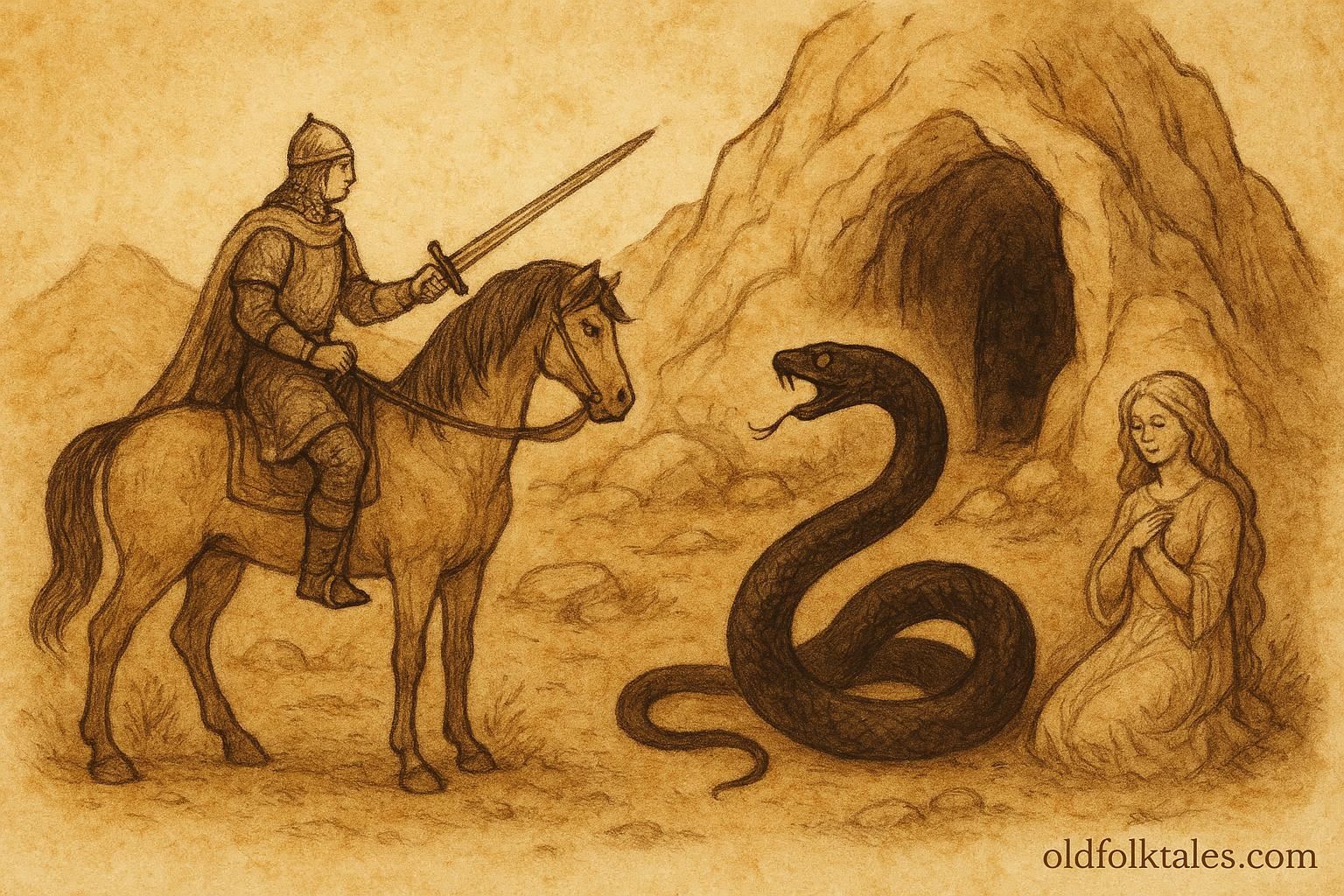
Together they flew faster than wind, crossing forests, rivers, and mountains until they reached the Black Serpent’s cave. Inside, the youth found his beloved, cold and still, turned to stone. He wept over her, and when his tears touched her cheek, she came back to life.
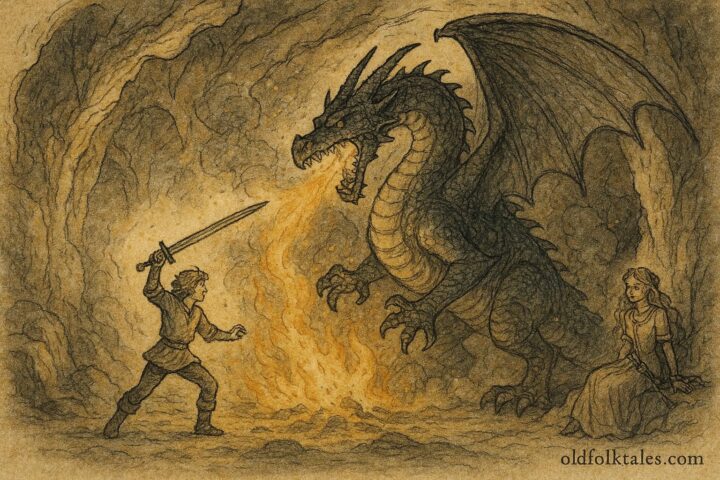
At that moment, the Black Serpent appeared, hissing with fury. The youth drew his sword and fought bravely. The battle raged, but at last he struck off the Serpent’s head and sprinkled its blood upon the stone maiden, restoring her fully.
Mounted once more upon Wind-Swift, they soared homeward. When they reached his village, his forty brothers greeted him with wonder. “Truly,” they said, “thou art now our elder, for thou hast conquered evil.” Together they built a grand home and lived in peace and joy all their days.
Moral Lesson
True destiny is shaped by courage, loyalty, and repentance. The tale teaches that wisdom and bravery can redeem one’s mistakes and overcome the darkest trials.
Knowledge Check
1. Who is the main character in “The Forty-First Brother”?
The story centres on the youngest of forty-one brothers who proves his courage and fulfills his destiny.
2. What symbolizes destiny in the story?
The arrow represents the beginning of the hero’s destined journey toward love and wisdom.
3. What is the moral of this Ukrainian folktale?
That courage, repentance, and loyalty can defeat evil and restore harmony.
4. Who helps the hero on his journey?
A wise old man and the magical horse Wind-Swift guide the hero to redemption.
5. What does the Black Serpent represent?
It symbolizes deception, envy, and the destructive power of disobedience.
6. From which region does this folktale originate?
It originates from Ukraine, specifically the Podolia region.
Source: Adapted from the Ukrainian folktale “The Story of the Forty-First Brother” in Cossack Fairy Tales and Folk Tales by Robert Nisbet Bain (1916), London: G. G. Harrap & Co.
Cultural Origin: Ukraine (Podolia Region Folklore)