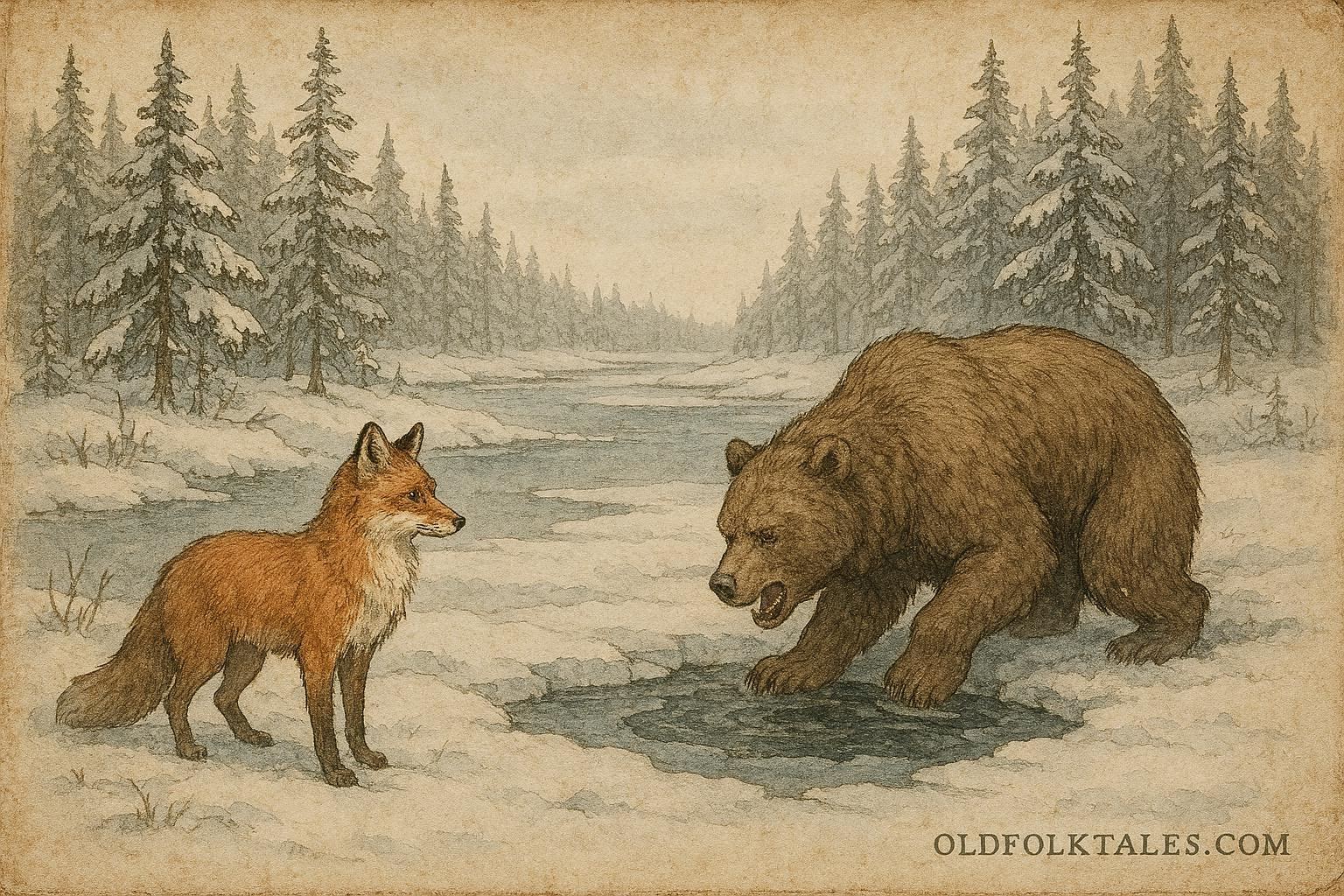
In the forests of Finland, where spruce and pine rise dark and tall and the ground is carpeted with moss and fallen needles, animals have long lived by rules older than memory. Winter there is not merely a season but a test, and hunger sharpens both claws and minds.
Among all creatures of the forest, none was stronger than the bear. His paws could split rotten logs, his shoulders shook saplings, and his growl alone could silence the undergrowth. He believed the forest belonged to him by right of strength. Where he wished to walk, others stepped aside. Where he wished to eat, others went hungry.
Living in the same forest was the fox, small, red-coated, light of step, and always watchful. He did not command the forest, nor did he try. Instead, he studied it. He watched where food was hidden, where danger slept, and how larger creatures behaved when they believed themselves unchallenged.
From the beginning, the fox understood something the bear did not:
that survival in the forest depended not on power alone, but on judgment.
Winter Hunger
When winter came and the rivers froze thick beneath the sky, food grew scarce. Berries vanished. Small animals hid deep beneath roots and snow. Even the bear, great as he was, felt hunger gnawing at him.
The fox, too, was hungry, but hunger made him careful, not reckless.
Seeing the bear wandering restlessly near a frozen river, the fox approached him with respectful words.
“Brother Bear,” said the fox, lowering his head, “you are strong, but even strength grows weary in winter. I know a way to catch fish beneath the ice.”
The bear, who trusted his size more than his senses, listened.
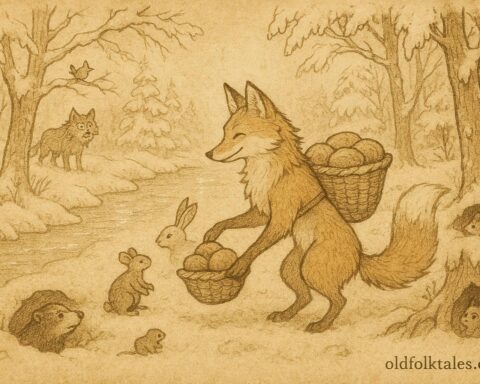
The fox led him to a frozen river and pointed to a narrow hole in the ice where dark water moved below.
“Lower your tail into the water,” the fox said. “The fish will mistake it for food and bite. When you feel their weight, pull them out.”
The bear laughed. “If this works,” he said, “you may have your share.”
He lowered his tail into the water and waited.
The cold deepened. The river stilled. Ice formed around his tail, slowly and silently. When the bear tried to rise, pain tore through him as the ice held fast. He roared and struggled until the ice broke, tearing his tail free and leaving blood on the snow.
The fox was already gone.
Pride and Blindness
The bear was furious, not only at the fox, but at the forest itself. He blamed trickery, bad luck, and winter’s cruelty. He did not blame his own pride.
This was the bear’s flaw:
he believed strength excused thoughtlessness.
The fox, meanwhile, did not linger near the river. He moved lightly, feeding where he could, always alert. He knew that outwitting a stronger creature once was dangerous, but that strength blinded by anger was even more dangerous.
The Farmer’s Storehouse
One day, the bear found a farmer’s storehouse near the edge of the forest. The scent of grain and smoked meat drifted through the air. He forced his way inside and ate until he could barely move.
Full and confident, he fell asleep among the sacks.
That night, the fox crept quietly inside. He took what he could carry and smeared the bear’s muzzle with food scraps. Then he slipped away.
At dawn, the farmer discovered the theft. All signs pointed to the bear.
Shouting and armed with stones, the villagers chased the bear back into the forest. The fox watched from cover, chewing stolen meat.
The Nature of the Fox
The fox was not cruel for cruelty’s sake. He did not deceive out of pleasure alone. In Finnish folklore, the fox is a mirror, reflecting the consequences of arrogance and the rewards of attentiveness.
He understood that strength takes food by force, but wit takes it by timing.
A Pattern Repeats
Again and again, the fox benefited while the bear suffered, not because the fox was stronger, but because he learned. The bear, by contrast, repeated the same mistakes, expecting different outcomes.
He believed the world should submit to him.
The forest did not.
The Final Confrontation
At last, the bear cornered the fox near a clearing.
“Enough,” the bear growled. “Face me openly.”
The fox stood calmly, tail low, eyes bright.
“Brother Bear,” he said, “if strength were enough, you would already have won.”
Before the bear could answer, the fox slipped away, into brush too thick, paths too narrow, spaces the bear could not enter.
The bear was left alone, powerful and frustrated.
The Forest’s Judgment
The forest did not punish the bear with death. Instead, it punished him with repetition, with the same failures, again and again, until he learned or faded into obscurity.
The fox endured.
Moral Lesson
This Finnish folktale teaches that power without wisdom leads to downfall, while intelligence guided by restraint ensures survival. Strength may dominate briefly, but cleverness adapts, and adaptation endures.
Knowledge Check
-
Who are the main characters in “The Fox and the Bear”?
The main characters are a clever fox and a physically powerful but foolish bear. -
What does the bear symbolize in Finnish folklore?
The bear symbolizes strength, authority, and pride without reflection. -
Why does the fox succeed against the bear?
The fox succeeds through intelligence, observation, and adaptability rather than force. -
What lesson does the frozen river scene teach?
It teaches the danger of blind trust and arrogance. -
Is the fox portrayed as evil?
No, the fox represents survival through wit in an unforgiving environment. -
What cultural value does this folktale reflect?
It reflects Finnish respect for balance, humility, and harmony with nature.
Source: Suomalaisia Kansansatuja, collected by Eero Salmelainen, 1852
Cultural Origin: Finland, rural folk storytelling tradition