Along the northern edge of the Low Countries, where land and water have wrestled for centuries, there once lay the Zuiderzee, a wide, restless inland sea connected to the North Sea by shifting tides and shallow channels. Its waters were never gentle. They changed color with the sky, rose suddenly with the wind, and swallowed ships as easily as they carried them home. Generations of Dutch and Frisian sailors learned to read its moods as one reads a face, for survival depended on respect, patience, and humility.
It was among these sailors that the legend of the Ghost Ship of the Zuiderzee took root.
Journey into the charm of British wit and Irish wonder through centuries of folk tradition
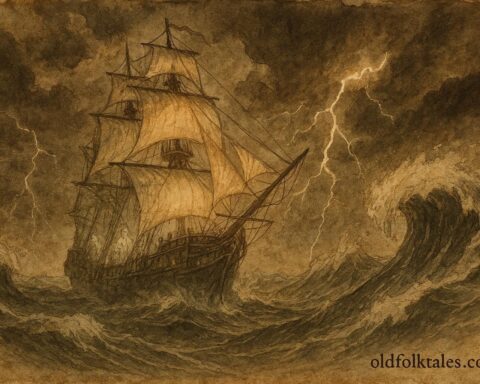
On nights when storms gathered without warning, when clouds pressed low and the wind came sharp from the northwest, men at sea spoke in hushed voices. They reefed their sails early, checked their ropes twice, and whispered prayers taught by fathers and grandfathers long dead. For they knew that on such nights, when lightning fractured the sky and the waves struck like fists, the Ghost Ship might appear.
The first sighting was always the same.
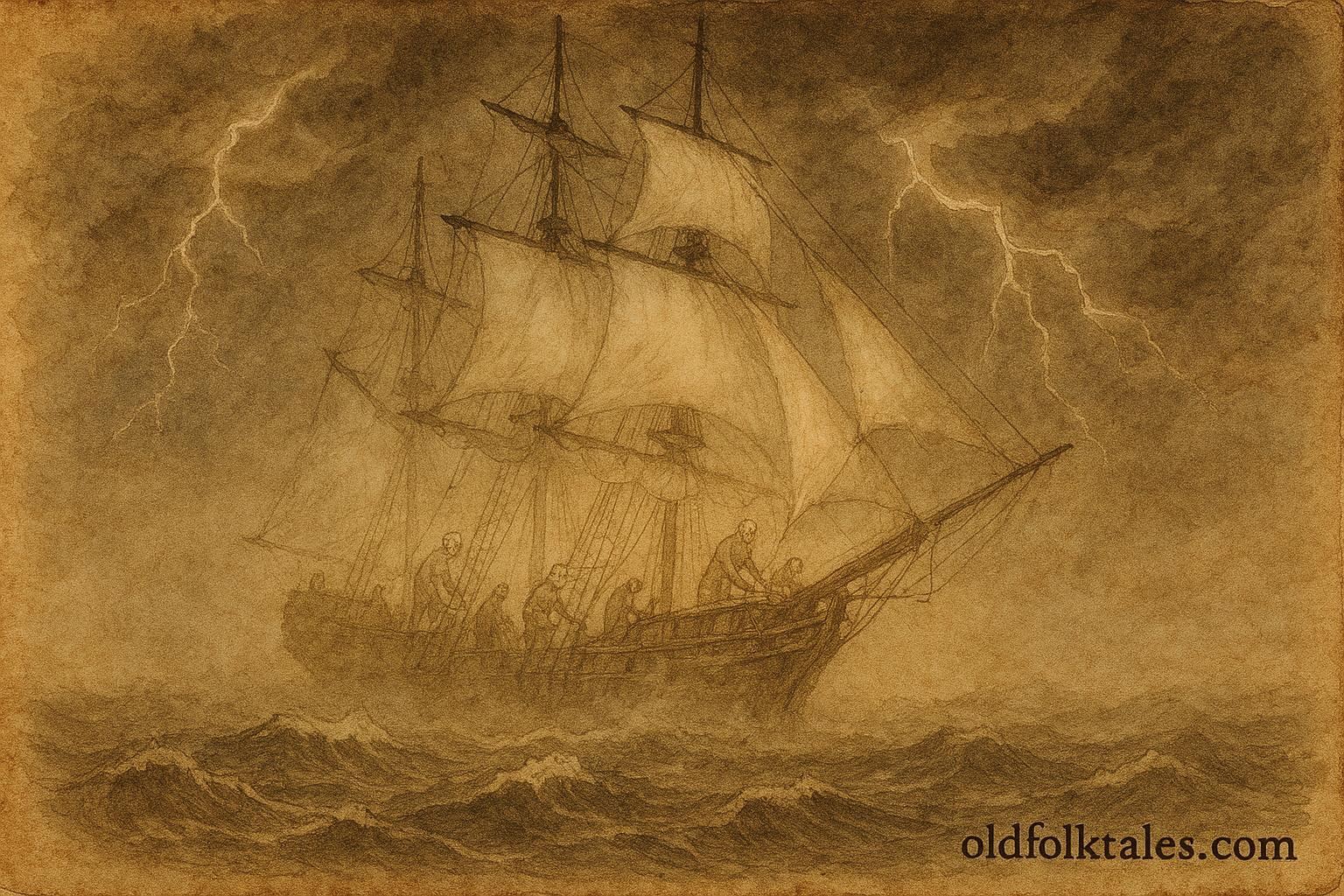
Out of the mist would emerge a vessel larger than any fishing boat, its dark hull cutting through the water without sound. Its sails were torn and patched, yet they billowed as if filled by a wind no living sailor could feel. Lanterns glowed faintly along its deck, casting a pale, unnatural light that did not flicker, even in the strongest gusts.
Those who saw it swore the ship moved against the wind, steady and deliberate, as though guided by an unseen hand.
At a distance, it looked almost ordinary. But as it drew nearer, dread settled into the bones of those watching. The deck was crowded with figures, men in old-fashioned seafaring clothes, their movements stiff and endless. They hauled ropes that led nowhere, scrubbed decks already clean, and climbed rigging that vanished into shadow. Their faces were colorless, their eyes hollow, and though their mouths sometimes moved, no sound came forth.
No living man ever claimed to hear their voices.
Old sailors said the ship carried the damned, souls of men who had mocked the sea, broken sacred oaths, or ignored warnings given by wind and wave. Some were said to have sailed on holy days, others to have cursed God in the face of storms, and still others to have chased profit beyond prudence, loading their vessels too heavy for safe passage.
Whatever their sins, they were bound forever to the waters that claimed them.
The Ghost Ship did not attack. It did not fire cannon or ram hulls. Its power lay in what followed its appearance. Those who witnessed it often met disaster soon after. Nets tore beyond repair. Sudden squalls capsized boats in familiar waters. Men fell ill without cause, or ships vanished entirely, leaving only broken planks drifting ashore.
Because of this, sailors believed the Ghost Ship was not a cause, but a warning.
One tale, told and retold along the harbors of Volendam and Enkhuizen, speaks of a young sailor named Pieter Janszoon. He was strong, ambitious, and eager to prove himself, dismissing the fears of older men as superstition. When warned not to sail during a brewing storm, Pieter laughed and pushed off anyway, boasting that skill mattered more than signs and stories.
That night, as rain slashed the sea and thunder rolled across the sky, Pieter saw the Ghost Ship emerge from the fog. Its lanterns burned steadily, and its silent crew labored on. For a moment, awe overcame fear. Then Pieter noticed something else: among the faces on the deck was one he recognized, an uncle lost years earlier in a sudden storm.
Pieter never returned. His boat was found days later, splintered along the shore.
Stories like this were not told to frighten children, but to instruct sailors. The Zuiderzee fed villages and sustained families, but it demanded humility in return. To forget that balance was to invite ruin.
Even on land, the legend lingered. On stormy nights, villagers claimed they could hear distant creaking, like wood straining underweight, carried inland by the wind. Some said it was only imagination. Others crossed themselves and closed their shutters tight.
As centuries passed and the Zuiderzee was eventually tamed, dammed, drained, and reshaped into the Ijsselmeer, the legend did not fade. Fishermen still spoke of strange lights on the water. And when storms battered the reclaimed land, elders reminded the young that water never forgets its paths, nor the lives it once claimed.
The Ghost Ship of the Zuiderzee remained what it had always been: a floating memory, a moral carved into mist and wave, warning those who worked the sea to do so with reverence, restraint, and respect.
The Ghost Ship of the Zuiderzee teaches that nature cannot be conquered without consequence. Pride, greed, and disregard for warnings lead to ruin, while humility and respect offer the only true protection against forces greater than humankind.
Explore the wit and wisdom of Western Europe, where humor and virtue often go hand in hand
Moral Lesson
The Ghost Ship of the Zuiderzee teaches that nature cannot be conquered without consequence. Pride, greed, and disregard for warnings lead to ruin, while humility and respect offer the only true protection against forces greater than humankind.
Knowledge Check
1. What is the Ghost Ship of the Zuiderzee believed to represent?
It represents a supernatural warning and the restless souls of sailors who disrespected the sea.
2. Where does this folktale originate?
The story originates from Dutch and Frisian maritime communities around the Zuiderzee.
3. Why is the Ghost Ship considered an omen rather than an attacker?
Because it does not cause harm directly but signals impending disaster or misfortune.
4. What moral values are emphasized in the story?
Humility, respect for nature, and obedience to traditional wisdom.
5. How did sailors traditionally respond to the legend?
By avoiding risky voyages, honoring taboos, and respecting storm warnings.
6. Why did the legend survive even after the Zuiderzee was dammed?
Because it symbolizes enduring cultural memory and humanity’s fragile control over nature.
Source: Dutch sailors’ oral tradition, preserved in early modern maritime folklore and coastal chronicles, c. 16th–17th century CE
Cultural Origin: Zuiderzee region (present-day Ijsselmeer), Netherlands