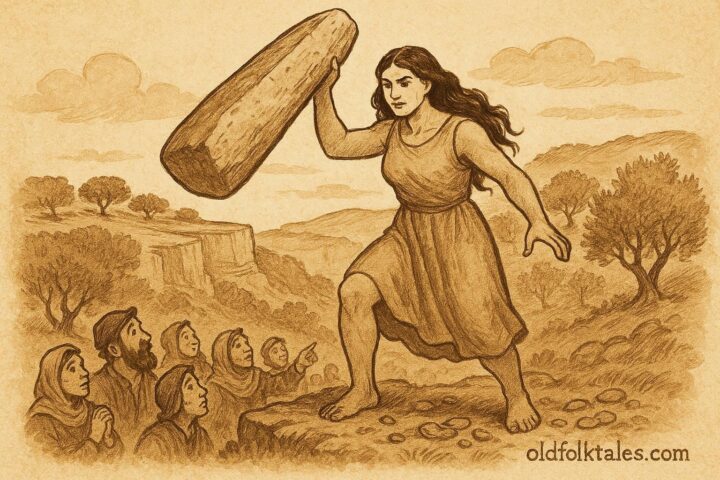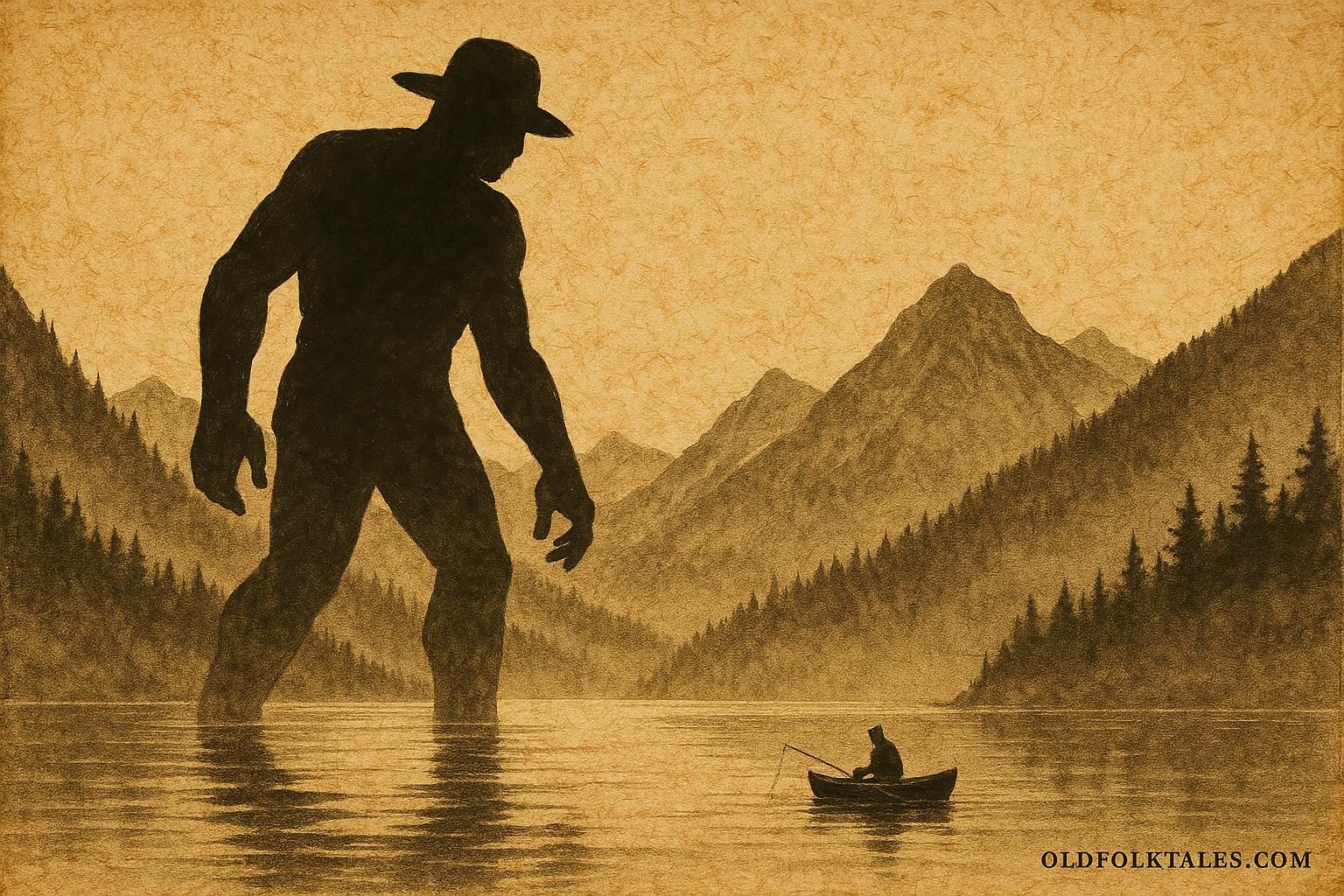
High in the mist-covered mountains of the Tyrol, near the shadowed caves of Eggerskeller, there once lived a fearsome being known as Jordan the Giant. His name alone was enough to send shivers through every shepherd’s heart and make the bravest hunters turn pale. With shoulders broad as boulders and hands that could uproot a pine tree in a single wrench, Jordan was the terror of the valley.
Beside him dwelled his wife, Fangga, whose presence was as strange as her husband’s strength. Though smaller than Jordan, she possessed a wild, unearthly beauty that seemed part mountain mist, part moonlight. The villagers whispered that she was born of the fairy race, one of the Bergleute, the hidden folk of the Alps, yet she had chosen a life bound to the monstrous giant. Some said she stayed out of love; others, out of fear.
The Giant’s Domain
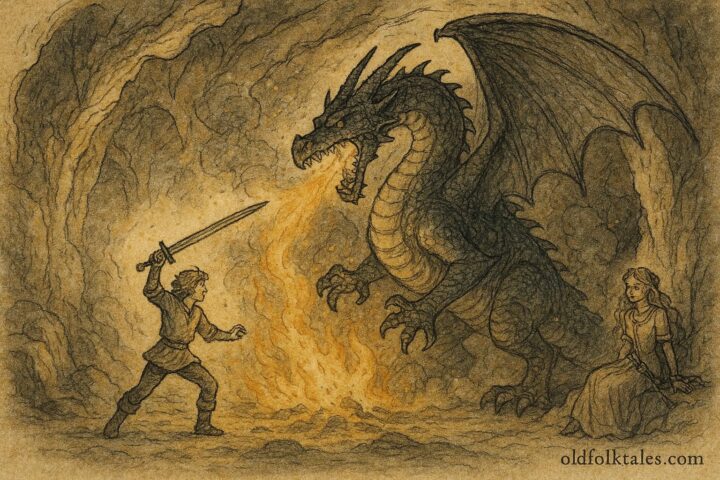
The caverns of Eggerskeller echoed with roars and the clatter of chains. There, Jordan kept the trophies of his cruelty, beasts, travelers, and even children who had wandered too close to his lair. He was said to roam the steep ridges at dusk, his club dragging behind him, hunting by moonlight. Those who crossed him rarely returned.
Jordan’s wickedness extended beyond humans. He despised the fairies who lived in the valleys below. The fair folk, who guarded springs and flowers, would sometimes appear on moonlit nights, dancing across the Alpine meadows. When Jordan found them, he drove them away with thunderous laughter, capturing their kin and locking them in the cold caves beneath the earth.
The people of the valley prayed often, for protection from the storms, from the avalanches, and from Jordan himself. They hung charms of rowan and iron above their doors and avoided the mountains at night. Still, every few seasons, a sheep, a hiker, or a child would vanish, and their names were whispered in church as offerings were laid for their souls.
The Fisherman of Graun-See
One autumn evening, when the wind blew sharp from the glaciers and the lake shimmered dark beneath the moon, a humble fisherman set out upon Graun-See. His small boat rocked softly as he cast his nets, humming a prayer to keep the spirits of the water at bay.
Hours passed quietly. The peaks around him glowed faintly silver under starlight. Then, just as he began to draw in his nets, the air shifted. A faint sound rose across the still water, a melody, light and unearthly, carried on the breeze.
He froze. The sound deepened into a chorus, bells from distant monasteries mingling with voices pure and bright. He looked up and saw, through the drifting mists, shimmering figures dancing along the mountain ridge. Their forms glowed with pale fire. The fairies had come, their song rising like prayer over the sleeping land.
The Song of the Fair Folk
The fisherman’s heart trembled. He knew the old stories, how mortals who lingered too long in fairy music lost their sense of time, or their souls altogether. Yet the beauty was unbearable to resist. The tune grew clearer: a melody of sorrow and longing, of freedom lost and vengeance waiting beneath the mountains.
Some say it was Fangga, the giant’s wife, who led that song. Perhaps she sang for the imprisoned fairies, or for her own fading spirit, bound to Jordan’s cruelty. The fisherman leaned forward, straining to hear more. His oars slipped from his grasp. The current drifted his boat closer to the source of the sound.
The night deepened. The mountains loomed black and vast. Bells echoed from faraway chapels. The music twined with the wind—and then, suddenly, all was still.
The Morning After
At dawn, villagers found the fisherman’s boat adrift upon Graun-See. He sat slumped within it, his eyes open toward the mountain, his face pale and peaceful. The nets lay empty, untouched. Around him hung a faint scent of alpine flowers, though the meadows were already withered by frost.
They buried him by the shore, near where the water lapped softly against the stones. From that day, no man dared to fish the lake after sunset. And when the bells from distant monasteries ring faintly through the valley air, the villagers cross themselves and whisper, “The fairies sing for Fangga.”
Jordan the Giant was never seen again. Some say the fairies’ vengeance fell upon him, that the mountain opened and swallowed his cavern whole. Others say his shadow still walks in storms, seen between lightning strikes high over Eggerskeller.
Moral Lesson
This ancient Tyrolean tale teaches lessons on the dangers of cruelty, the limits of human greed, and the enduring justice of nature’s spirits. Even the mightiest fall before the quiet power of the unseen world. Respect for nature and compassion toward all living beings preserve harmony where strength alone cannot.
Knowledge Check
1. Who was the Giant Jordan in Tyrolean folklore?
A fearsome mountain giant known for cruelty toward humans and fairies alike.
2. What was Fangga’s role in the legend?
She was Jordan’s wife, believed to be part fairy, whose sorrow connects her to the fairies’ song.
3. What lesson does the fisherman’s fate teach?
That human curiosity and enchantment can lead to spiritual danger when facing the supernatural.
4. How does nature respond to cruelty in this tale?
The mountains, fairies, and storms themselves serve as agents of moral balance and justice.
5. Why is the legend set near Eggerskeller in the Tyrol?
The rugged alpine setting reflects the harsh beauty and spiritual depth of Austrian mountain folklore.
6. What moral values does the story emphasize?
Respect for nature, humility, compassion, and the danger of cruelty or greed.
Source: Adapted from Tales and Legends of the Tyrol – Austrian folklore (Tyrol region).
Source Origin: Austrian folklore, Austria.