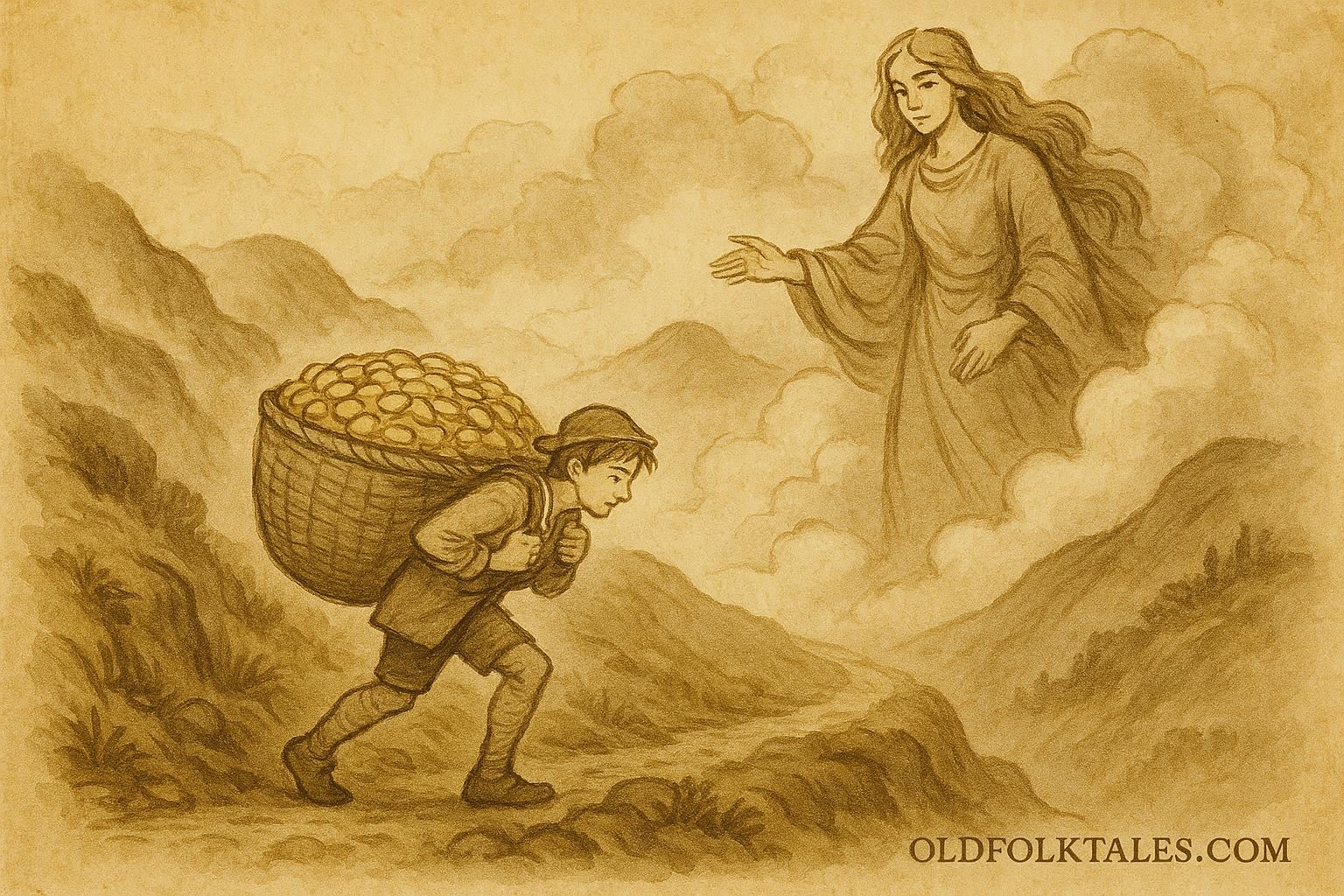
High upon the misty slopes of the Welsh highlands, where the valleys rolled like waves beneath the heathered hills, there lived a humble youth named Iolo. He was known throughout his village for his tireless work and good nature, though his family was poor and their cottage small. Life in the uplands was harsh, but the people believed that those who labored honestly would be rewarded, if not by man, then by fate itself.
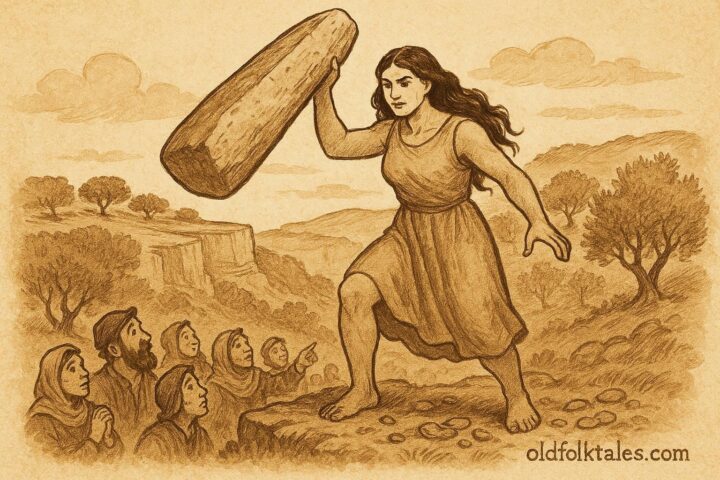
One evening, while Iolo was gathering peat near the mountain pass of Cwm Ddu, he saw a shadow moving among the stones. It was no sheep or shepherd. From the fog emerged a giantess, tall as a beech tree, her hair flowing like dark riverweed, and her eyes gleaming like the moon through storm clouds. Yet her expression was not cruel. She carried an apron filled with rocks and gold, and her voice rolled like thunder softened by distance.
“You there, lad,” she called. “I need a hand with this burden. Will you earn your keep by morning’s light?”
Iolo, though startled, bowed politely. “I will, my lady. Tell me what to do.”
The giantess smiled faintly. “Take this basket,” she said, handing him one woven of twisted roots and reeds, large enough to cradle a pony. “At dawn, you must carry it up the pass to my cairn. Do not delay, and do not look back before the sun touches the ridge. If you keep your promise, the basket’s weight will be your fortune.”
Iolo agreed, though he wondered what task could mean such reward. When dawn broke pale and gold across the peaks, he set out. The basket was heavy, impossibly heavy, but his determination was stronger. He climbed until his feet bled, the path cutting sharp through mist and thorn. Behind him, he thought he heard faint laughter and the clatter of unseen stones. Still, he pressed on without turning.
When the first rays of sunlight touched the cairn, he placed the basket upon it. To his astonishment, the rocks inside had become gold coins, each shining brighter than morning dew. The giantess appeared beside him once more, her eyes soft with approval.
“You’ve done well, Iolo,” she said. “The honest worker earns what he bears. Take what you can carry, and no more.”
She vanished into the mist, leaving him to gather the coins into his cloak. When he returned to the village, the people stared in wonder. His family, once poor, now had enough to mend their home and share with neighbors. Iolo became a figure of quiet admiration, until curiosity and greed began to whisper among his friends.
“You say she filled that basket with gold?” one asked. “If so, why not go again? There’s enough for us all.”
At first, Iolo refused. He remembered the giantess’s warning. But the promise of more, just one more load, gnawed at him like hunger. At last, he gave in. “We’ll go tomorrow,” he said. “But we must climb by dawn, as before.”
Yet morning came late, and his companions lingered, laughing at his caution. By the time they reached the pass, the sun had already risen high. Iolo’s heart pounded as he approached the cairn, calling out, “Lady of the hills! I’ve come again for your blessing!”
From the fog, a shadow moved, not kindly this time. The giantess stood before them, her apron full once more, but her eyes burned like embers.
“You broke your word,” she thundered. “Greed blinds even the good-hearted. Did I not warn you of the hour?”
She flung her apron wide, and a gale rushed down the slopes. Mist turned thick as wool, and the ground trembled. Stones tumbled from the cliffs, scattering the coins he had gathered. The hillside groaned as if alive, and strange lights, blue and green like dancing fire, flickered through the fog.
Terrified, Iolo dropped to his knees. “Forgive me! I meant no harm!”
The storm ceased as suddenly as it began. The giantess’s voice echoed faintly through the mist: “Take what remains, and remember, the mountain gives only to the humble.”
When the clouds lifted, half the gold was gone. Iolo and his friends returned in silence, each carrying only a handful of coins. Though his family lived comfortably thereafter, he never sought the mountain’s fortune again. Often, he would gaze toward the misty ridge and whisper thanks, not for the gold, but for the lesson that saved his soul from folly.
Moral Lesson
True fortune comes not from taking more, but from knowing when to stop. Greed clouds gratitude, and even the greatest gifts can turn to loss when we forget humility.
Knowledge Check
1. Who was the main character in “The Giantess’s Apron-Full”?
The tale centers on Iolo, a humble Welsh youth who learns the cost of greed.
2. What did the giantess ask Iolo to do?
She asked him to carry a heavy basket to her cairn at dawn without delay or looking back.
3. What lesson does the story teach about greed and humility?
It warns that overreaching and greed lead to loss, while honest effort and moderation bring lasting reward.
4. What supernatural element appears in the story?
The giantess herself, a mythic being linked to Welsh mountain lore and natural forces.
5. Why did Iolo lose half his gold?
He broke his promise by returning at the wrong time, showing greed and disobedience.
6. How does the story reflect Welsh folklore traditions?
It reflects the Welsh belief in moral reciprocity, that nature and spirit beings reward honesty and punish excess.
Cultural Origin: Welsh folktale, Wales
Source: Adapted from Welsh Fairy-Tales and Other Stories by P. H. Emerson (1894)