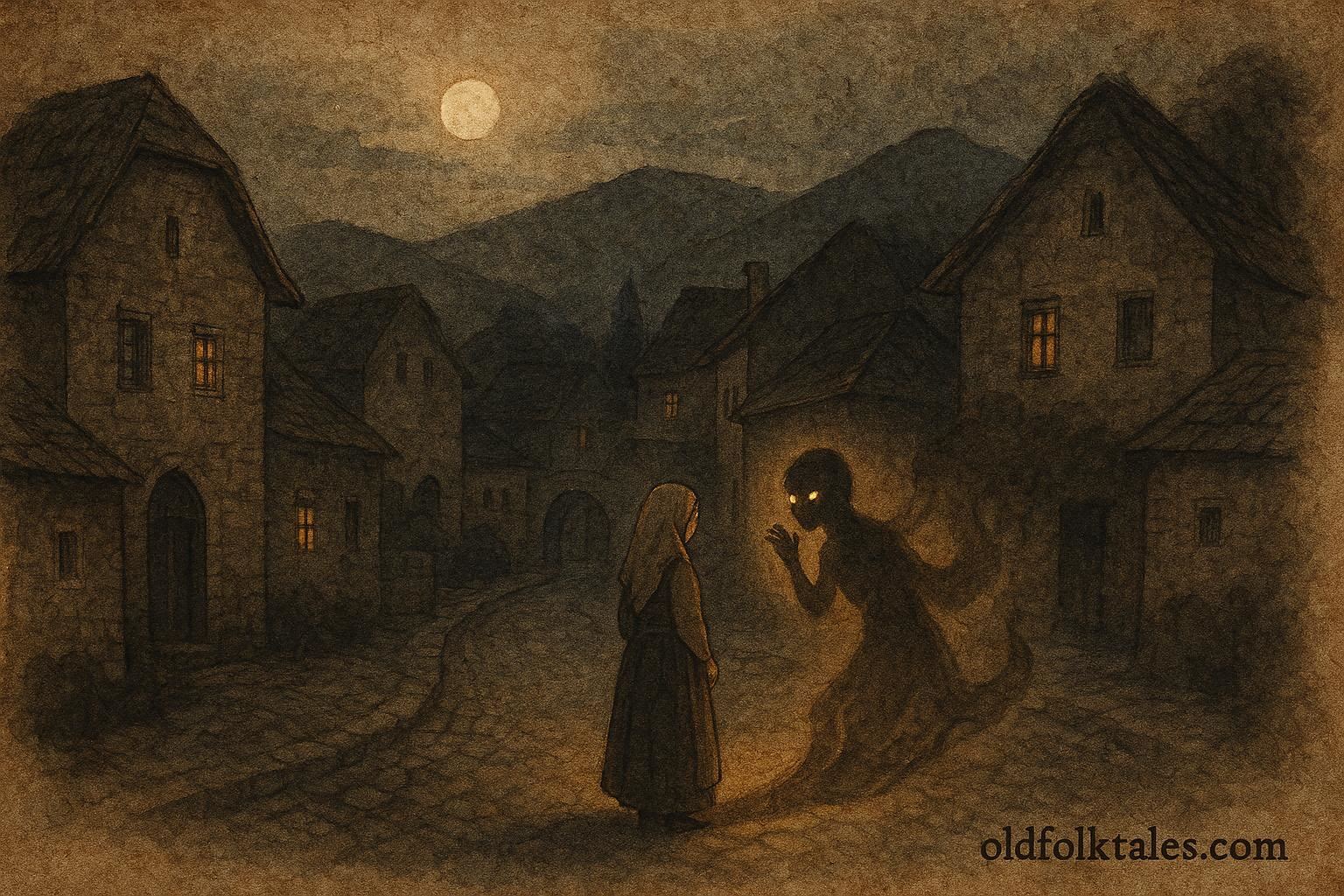
In the quiet heart of Bosnia, nestled between rolling hills and dense forests, lay a village where stone houses huddled close together, their chimneys puffing thin streams of smoke into the crisp mountain air. Here, life moved slowly, guided by the rhythms of the seasons, the ringing of the church bell, and the whispers of the wind through the narrow cobbled streets. Among the villagers, a young girl named Lejka lived with her parents in a modest home near the village square. She was thoughtful and observant, always listening more than speaking, and her eyes held a quiet curiosity that often drew her to the strange and unseen.
From her earliest memory, Lejka had noticed that shadows were not always what they seemed. A tree’s shadow might linger after the sun had set, bending oddly over the cobblestones. A flickering lamp in the window might cast shadows that moved independently of their source. And sometimes, late at night, when the village slept under a pale moon, these shadows whispered. Their voices were faint, soft murmurs that seemed carried on the wind, unintelligible to anyone but her.
One night, as she knelt by the hearth, warming her hands over the glowing embers, her own shadow on the wall shifted strangely. It lengthened, stretched, and then seemed to lean toward her. A whisper brushed her ear: “Seek the truth, child.”
Lejka blinked. “Who is there?” she asked, her voice barely above a whisper. The shadow quivered, but no answer came, only the soft echo of the words in her mind. At first, she thought she was dreaming, yet the feeling lingered: the shadows were trying to tell her something.
The days that followed confirmed her suspicion. Whenever Lejka walked through the village or lingered near the forest, the shadows would murmur fragments of events long past. They showed her visions of quarrels among villagers, hidden acts of kindness, and secrets that had been buried to preserve appearances. The shadows were neither cruel nor benevolent; they were impartial observers, keeping silent watch over human deeds.
As Lejka grew, so did her understanding of the gift. She learned to approach the shadows with respect, never demanding answers or prying too forcefully. She discovered that they spoke only when she was patient, attentive, and sincere, and that careless or greedy attempts to force knowledge could result in confusion, dizziness, or sleepless nights.
One cold winter evening, Lejka wandered near the old mill on the outskirts of the village, drawn by a whisper that seemed urgent and fearful. The wind carried the faint sound of murmurs, and the snow beneath her boots crunched unevenly, as though someone, or something, had recently passed that way. Her shadow stretched beside her, quivering as it pointed toward the forest.
“What is it?” Lejka asked softly, placing her hand on the cold stone of the mill wall. The shadow flickered and then whispered in a low, urgent tone: “Danger. Old wrongs. Unseen harm.”
Following the shadow’s guidance, Lejka discovered a crime that had been carefully concealed for years. A respected villager, whom many trusted, had committed an act of theft and betrayal, taking advantage of the community’s goodwill. Though the incident had occurred long ago, the consequences lingered. Some families suffered quietly, their trust shaken, yet the truth had been buried to protect reputations.
Lejka’s heart ached. She understood the risk: revealing this secret could inflame old tensions and anger those who wished it forgotten. But she also knew that justice and peace required truth. She returned home, thinking deeply about the right course of action. That night, as she sat by the flickering hearth, her shadow danced across the wall, glowing faintly in the firelight.
“Use your voice with care,” it whispered. “Do not accuse recklessly, but guide toward truth.”
The next day, Lejka approached the village elders, humble and respectful. She did not demand attention or make bold proclamations. Instead, she recounted the facts as they had been revealed to her by the shadows, careful to emphasize fairness and caution. She spoke of the evidence, the observed events, and the lingering consequences, letting her words lead the elders to the truth rather than forcing it upon them.
The elders listened, at first skeptical, but as Lejka recounted the intricate details, details no ordinary villager could know, they began to see the pattern. The shadows’ whispers had guided her carefully, and she delivered the story with wisdom, never exaggerating or overstepping. Gradually, other villagers remembered incidents they had long dismissed, filling in the gaps of the story.
Eventually, the guilty party was confronted. With no escape from the truth, he confessed, admitting the wrongs he had done and offering restitution to those affected. The village, once tense and burdened by unspoken fears, felt a sense of relief and healing. Lejka had restored moral balance, not through force or intimidation, but through careful listening, patience, and courage.
From that day forward, Lejka’s gift was no longer seen as strange or threatening. Villagers came to respect her ability to communicate with shadows, seeking her counsel in delicate matters where the truth was hidden or disputed. But Lejka never took her power lightly. She understood that shadows were not servants; they were guardians of memory, impartial observers of life’s complexities. They revealed secrets to those patient and pure-hearted enough to handle them responsibly.
Over time, Lejka became a quiet guardian of her community. She watched, listened, and only spoke when necessary, ensuring that justice, peace, and moral balance were maintained. Children who played near her home often whispered about the girl who could hear the voices of shadows, and even the adults came to respect the mystical boundary she navigated, between the visible and the unseen, the spoken and the secret, the present and the memory of the past.
Through her experiences, Lejka learned an essential truth: knowledge was a responsibility, not a privilege. Courage alone was not enough; wisdom, patience, and respect for both human hearts and supernatural forces were required to wield the gifts she had been given. And in honoring this principle, she became not just a messenger of shadows, but a symbol of how one person could protect a community by seeing what others could not, and by acting with care and compassion.
Moral Lesson
Knowledge and insight are gifts that demand responsibility. Courage, when combined with wisdom and respect for unseen forces, allows one to protect others, restore justice, and guide a community toward balance.
Knowledge Check
1. Who is Lejka in the story?
Lejka is a young Bosnian girl who can communicate with shadows and uncover hidden truths in her village.
2. What do the shadows symbolize?
The shadows represent memory, hidden truths, moral guidance, and the consequences of how knowledge is used.
3. How does Lejka use her gift responsibly?
She listens carefully, reports facts with fairness, and ensures her knowledge serves justice without inciting harm.
4. What themes are central to the folktale?
Responsibility of knowledge, courage in revealing truth, respect for supernatural forces, and justice in community life.
5. What is the outcome of revealing the hidden crime?
The guilty party confesses, restitution is made, and the village regains peace and moral balance.
6. From which cultural tradition does the story originate?
It comes from Bosnian Muslim and Slavic oral traditions.
Source: Collected in Bosnian Folk Tales by Muhamed Hadžiefendić (1972)
Cultural Origin: Bosnian Muslim and Slavic oral tradition