In a remote Austrian valley, where mist clings to the mountains and pine forests sway with the wind, there lived a princess of unparalleled kindness and beauty. Her life, however, was shadowed by misfortune. Her father had passed when she was young, and her mother, equally tender and wise, soon followed her to the stars. Left in the care of a stepmother, the princess found herself living in a house of polished oak and marble, yet her days were filled with the harsh commands and envy of a woman who could not bear another’s goodness.
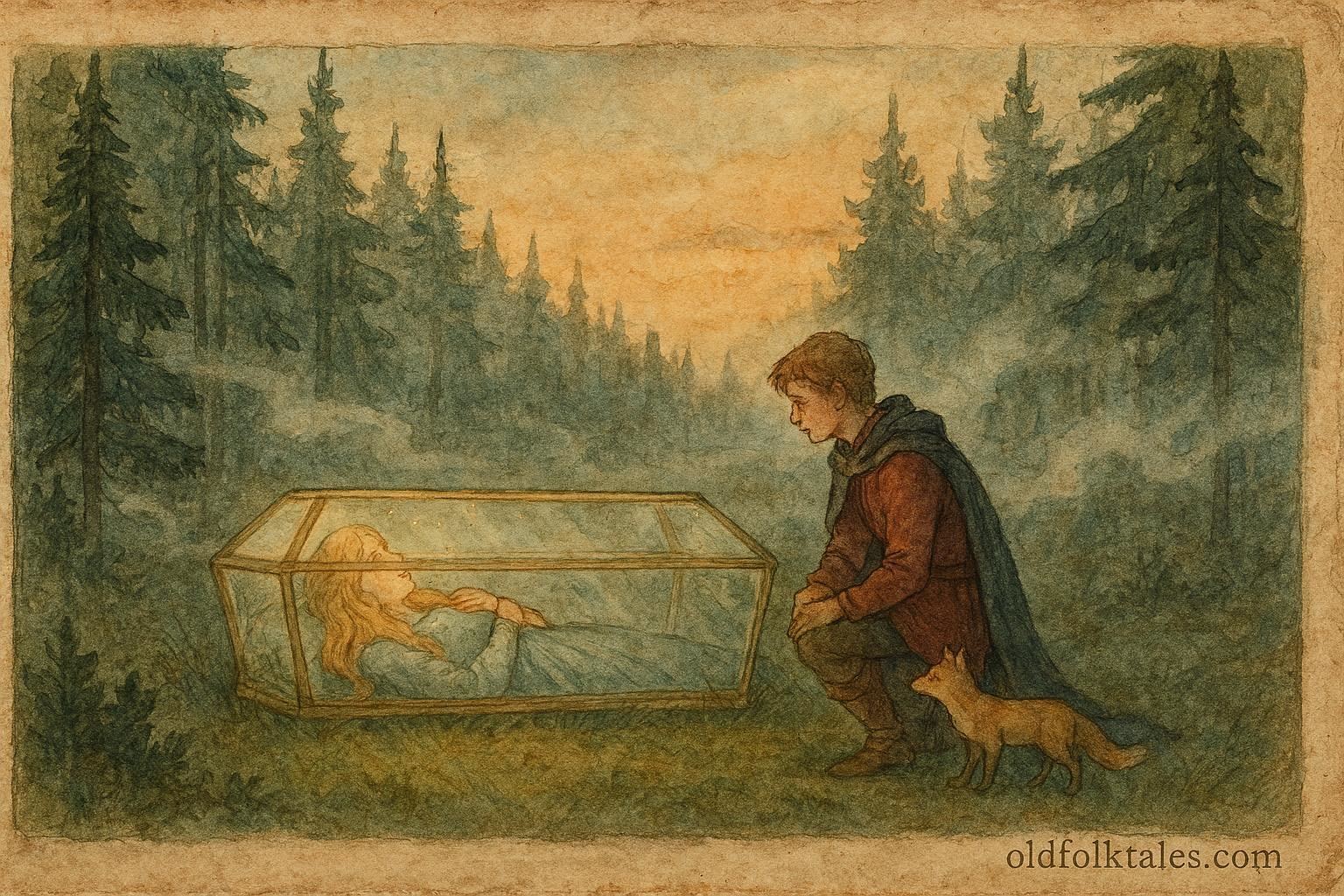
The stepmother, consumed by jealousy of the princess’s beauty and virtue, plotted to remove her entirely. She consulted dark magic, seeking a spell that would trap the princess where no mortal could reach her. At last, with whispered incantations and a curse cast over a rare crystal, she imprisoned the girl within a transparent coffin of shimmering glass. Placed deep within a hidden grove, the coffin sparkled like ice under the sun and reflected the moonlight with ghostly radiance. There, the princess lay in silence, neither aging nor decaying, her fate suspended between life and death.
Years passed. The village below the valley spoke in hushed tones of the missing princess and of a strange light that glimmered in the forest. Many had wandered too close, but none could enter the grove; the spell was strong, and those with ill intent fell into confusion or fled in fear. Yet the valley was not entirely without hope, for legends whispered that a pure-hearted hero, guided by magic and virtue, could find and awaken the princess.
It was during this time that a young prince, traveling across the mountains in search of knowledge and adventure, came upon an elderly hermit at the edge of a glade. The hermit, who had once glimpsed the magic of the forest, spoke of the glass coffin, cautioning that it could not be approached with greed or impatience. Instead, only a heart free of envy and full of courage might reach the princess without falling victim to the spell.
The prince, whose spirit was kind and unwavering, ventured forth into the forest. As twilight fell, a soft rustling of leaves revealed a small, golden animal—a fox with eyes like molten amber. The fox, which some said was a magical messenger of the forest, approached the prince and seemed to beckon him forward. Trusting the creature, the prince followed, moving with quiet reverence through the twisting paths of pine and birch.
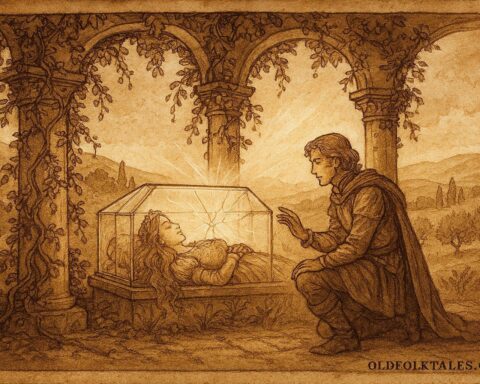
At last, the grove opened before him. Moonlight streamed through the trees, illuminating the glass coffin that lay at its center. The princess inside seemed almost to glow, her hair like spun sunlight and her eyes closed in patient slumber. The prince’s heart ached at the sight of her imprisoned beauty, and he approached with the utmost care. The fox circled the coffin, its tail flicking in a way that seemed to trace invisible protective wards, guiding the prince to stand in the right place.
Recalling the hermit’s words, the prince touched the coffin gently and spoke softly, declaring his intention to free the princess out of respect and compassion. A faint tremor ran through the glass, and the air shimmered as if time itself paused to witness the moment. Then, with a flash of light and a soft chime like distant bells, the glass cracked. Carefully, the prince lifted the lid, revealing the princess’s radiant face.
She awoke, startled but unafraid, sensing the purity of his heart. “You have come for me?” she asked, her voice like a melody.
“I have,” the prince replied, bowing respectfully. “I seek to free you, guided by the magic of this forest and the courage in my heart.”
Together, they returned through the grove, the magical fox leading the way. The forest seemed to part for them, as though recognizing the triumph of virtue over malice. But the stepmother’s shadow still lingered, for she had sensed that the princess might escape. Using the remaining threads of her dark power, she attempted to strike at the pair, conjuring a storm of wind and thunder.
The prince, however, held the princess’s hand and stepped forward, speaking words of truth and loyalty. The magic protecting the princess, strengthened by her own patience and goodness, repelled the stepmother’s malice. In the sudden stillness that followed, the stepmother’s power faltered, and the forest itself seemed to push her from the grove, leaving her to wander lost and powerless. The spell was broken forever.
The princess and the prince returned to the valley, where the villagers rejoiced at her safe return. Her virtue, her patience, and the heroism of the prince were celebrated in song and story. The glass coffin, once a symbol of malice and imprisonment, remained in the grove, now empty, a reminder of the triumph of courage, kindness, and loyalty.
In time, the princess and the prince married, ruling the valley with wisdom and fairness. Their story spread across Austria, told in hearths and castles alike, inspiring generations to believe that virtue, patience, and true-hearted courage can overcome even the darkest of schemes.
Even today, storytellers recount the tale of the glass coffin, emphasizing that no matter how insurmountable a curse or a spell may seem, goodness and perseverance, coupled with magical guidance, can restore justice and bring freedom to those unjustly trapped.
Moral Lesson
The Glass Coffin teaches that patience, virtue, and loyalty can overcome envy and malice. Goodness, aided by courage and respect for magic, triumphs over evil, rewarding the steadfast and punishing the wicked.
Knowledge Check
1. Who imprisoned the princess in the glass coffin?
Her evil stepmother, motivated by jealousy and malice.
2. How was the princess discovered?
A prince, guided by a magical animal (the golden fox) and his pure heart, found the glass coffin.
3. What magical protections surrounded the coffin?
The coffin was enchanted, impervious to greed and impatience, and the forest itself contained protective wards.
4. Where does this story originate?
Austrian fairy tale tradition, recorded by the Brothers Grimm from southern Austrian oral accounts (1819).
5. What themes are explored in the story?
Virtue and patience rewarded, magical intervention, loyalty, true courage, triumph over malice.
6. How is the stepmother punished?
Her powers fail, and she is left powerless and lost, never able to harm the princess again.
Source: Brothers Grimm, Kinder- und Hausmärchen, 1819 (Austrian oral variant)
Cultural Origin: Austria (southern Austrian fairy tale tradition)