Once upon a time, in the heart of Hungary’s wide and gently rolling plain, in the region of Nagykőrös, there lived a noble kingly man who was growing old. He loved his only son dearly, and when his strength began to wane he summoned his queen and made her promise: “Take care of our boy, my love. Do not marry again after I pass. Devote your life to him, that he may follow in my steps.” The queen bowed and promised faithfully.
Not long thereafter the king died, and the young prince remained under his mother’s care. But alas, though she had indeed vowed to abandon marriage, she broke that vow. Soon she married again, this time to a rigid and corpulent man of power, and crowned him king in place of her own son. The prince, though the rightful heir, was pushed aside and treated coldly by his stepfather. His days became shadows of what once might have been.
Nearby the royal castle flowed a curious little brook, its waters not silvery blue, but creamy white, as though the stream ran with milk rather than water. Everyone knew it, yet none dared drink from it: for the new king decreed that no one should take of that milk. Guards stood vigil, forbidding the villagers and the castle folk alike.
Morning after morning the king’s guards noticed something strange. Before the dawn, someone, not any castle‑troop or villager they knew, would quietly draw buckets of milk from the brook. Then this person vanished as mysteriously as they had come. On one such dawn the guard captain rode out and spied a figure hidden by the reeds: a tall wild man, his beard gleaming like fine gold, his hair tangled with leaves. The guards raised their spears, but the golden‑bearded man vanished into thin air as though swallowed by the plain itself.
The king, enraged and curious, demanded that his soldiers capture this mysterious figure. Many attempts were made: ambushes in the reeds, nets set by moonlight, traps strewn by the brook’s edge, but always, the gold‑bearded man slipped away. It seemed the land itself aided his escape.
One night, an old soldier of the king’s guard mapped out a plan. He said, “Let us leave bread and bacon where the brook empties, and pour a cup of wine, drugged with a soporific herb. When the golden‑bearded man comes to drink, he will fall asleep, and we shall seize him.” The king agreed, and the trap was set.
At the turning of the moon, the golden‑bearded man came silently; he ate the bread, tasted the bacon, drained the wine, and lay down, heavy‑eyed. At once the guards sprang forward, bound him in strong chains, and placed him in a cage crafted of iron and wood, right inside the castle grounds.
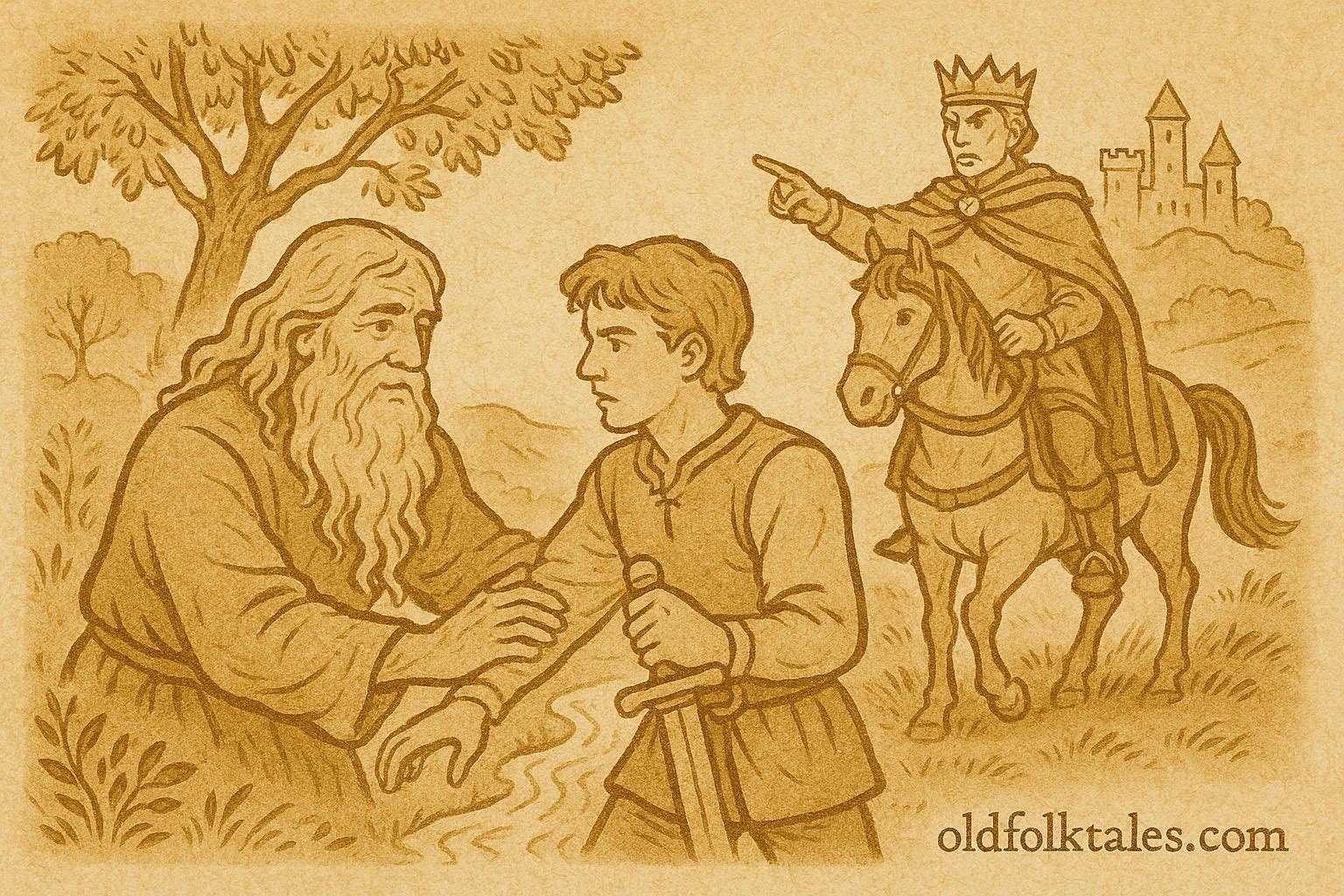
When the young prince heard of this capture, he watched from a hidden balcony. He felt a strange stirring of compassion for this strange captive. Late that night, he slipped to the cage and spoke: “Strange man with beard of gold, why draw the milk of the brook? I beg you, tell me why you take what the king forbids.” The golden‑bearded man looked up, his golden beard glinting under torch‑light, and said: “I draw this milk because I guard the land’s old magic. But it was the king’s decree which dishonoured the stream. If you will release me, I will serve you faithfully.”
The prince’s heart beat fast. He felt a surge of courage and whispered, “I will free you, but only if you swear to become my helper, and guard the land rightly.” The wild man nodded, golden beard brushing iron bars.
On a moonlit night, the prince waited until the guards slumbered, then slipped the lock and opened the cage. The golden‑bearded figure stood tall, his beard shining under the stars of the plain. “Come,” he said quietly. “I will lead you to your rightful place.” Together they ascended the old castle hill, past the silent watch‑towers, into the king’s chamber.
When the new king awoke and found his step‑son and the freed wild man standing before him, he stammered with rage. But the golden‑bearded man raised his voice: “This boy is the rightful heir. For you took his place unjustly, you banished him and forbade the land the milk of its stream. Restore him.” At that instant, the land seemed to stir, a gale whispering in the fields, the brook’s milk‑white water glinting like moon‑silver through the windows.
Moved and terrified, the king knelt before the prince and begged forgiveness. The young man, nobler than his birth could demand, said simply: “My father would want the land to thrive, his people to live in peace.” So the king renounced his crown, pushing it gently into the young prince’s hands. The people cheered across the plain, the brook bubbled with milk again, free at last.
The queen, weeping for her misdeeds, withdrew into prayer and service, devoting herself to the prince’s welfare. The golden‑bearded man vanished into the tall grasses of Nagykőrös, his task complete, leaving behind only the flicker of his beard in memory and the land at peace.
And so the young prince ascended as rightful ruler. Under his gentle hand the fields flourished, the milk‑brook ran freely, and the people lived with hearts light and eyes bright, ever mindful of the strange helper who came when justice seemed beyond reach.
Moral Lesson:
True power lies not in title or decree but in justice, compassion, and the willingness to honour the land and its hidden magic. When oppression silences the simple gifts of nature, a steadfast ally may rise, even in the wild. Guard what is rightfully yours with humility, and you may awaken helpers you never expected.
Knowledge Check
-
Who is the main helper in the story and what is his distinctive feature?
The main helper is the wild man with the golden beard, the “Gold‑Bearded Man”, whose beard shines like gold and who draws the milk from the brook. -
What decree does the king make about the brook by the castle?
The king forbids everyone from taking the milk‑white water of the brook, though the stream naturally flows for all. -
How does the young prince help secure justice and rightful rule?
The prince frees the gold‑bearded man, makes a pact with him, and stands up to the unjust king, restoring himself as rightful heir and restoring the land’s balance. -
What region and country does this folktale originate from?
The tale comes from the Nagykőrös region in Hungary. -
What is the symbolic significance of the milk‑stream and the golden‑bearded man?
The milk‑stream symbolizes the land’s natural bounty and purity; the golden‑bearded man symbolizes the wild, ancient power of the land, allied with the rightful ruler and justice. -
What lesson about rulership and nature does the story teach?
The story teaches that true rulership honours the land and its people, not just by commands, and that nature’s gifts must not be hoarded or forbidden unjustly; when they are, hidden powers may intervene to restore balance.
Source: Adapted from the Hungarian folktale “The Gold‑Bearded Man (Az aranyszakállú embör)”.
Cultural Origin: Nagykőrös region, Hungary.