In the mist-laden hills of the Scottish Highlands, where lochs mirror the gray skies and wind moans through the heather, there stood an ancient castle upon a lonely rise. Its stone walls were thick with moss, its towers scarred by centuries of weather and war. Though time had dimmed its splendor, its halls still echoed with the pride of its lineage, and the whispers of a guardian spirit known to all as the Green Lady.
Every child in the nearby glen had heard the tales. They said that on moonlit nights, a woman clothed in flowing green silk wandered the corridors, her face pale but kind, her eyes luminous as stars seen through mist. She was neither vengeful nor cruel, unlike many spirits in Highland lore, but a silent sentinel, appearing only when danger loomed.
The current laird, a young nobleman newly come into his inheritance, paid little heed to such stories. Brave to the point of arrogance, he believed no ghost could sway his mind. “Let the peasants dream,” he would say with a laugh. “If a lady in green wishes to appear, I shall offer her a dance.”
But the castle had a way of humbling even the proud.
One cold autumn evening, a storm swept over the Highlands, fierce enough to rattle the shutters and stir the ancient tapestries. The laird sat in his hall beside a roaring fire, a goblet of wine in hand, when the great hound by his feet began to growl low and steady. The flames flickered; the air turned chill.
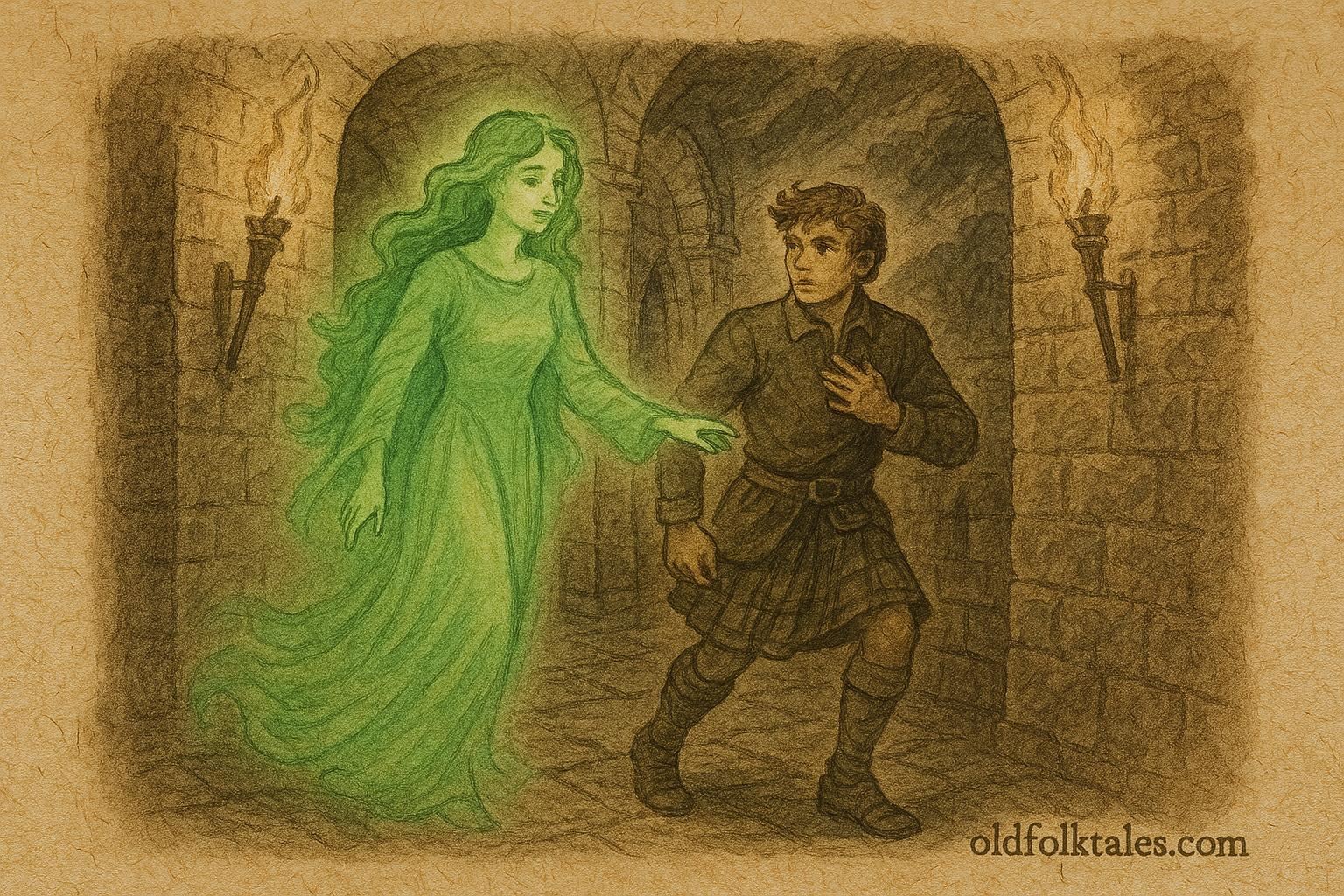
From the far end of the hall, through the wavering light, he saw her. The Green Lady stood there, radiant yet sorrowful, her gown shimmering as if spun from moonlight and emeralds. She raised one hand, pointing toward the door.
“Who dares enter my hall unbidden?” the laird demanded, though his voice trembled. The figure did not speak. Instead, she turned and glided toward the stairwell, vanishing into shadow.
The laird, half in anger and half in awe, seized his torch and followed. Her green glow flickered faintly ahead, leading him through winding corridors seldom used. At last, she paused before a heavy oaken door that led to the cellars, then disappeared.
He hesitated, but curiosity overcame him. Pushing open the door, he descended into the gloom. There, beneath the stone vaults, he heard the faint crackle of something unnatural, a spark, a hiss, and the scent of smoke. By the dim light, he saw it: a torch had fallen from the wall and caught the dry hay that lined the stables below. Fire was spreading fast.
Summoning his servants, the laird ordered buckets brought from the well. They fought through the night, and when the flames were finally quenched, the stables and horses were saved. Only then did he realize what might have happened had he ignored the ghostly warning.
The next morning, he stood again in the great hall, gazing up at the soot-streaked ceiling. There, faint as dew in dawn light, he saw a handprint upon the stone, slender, delicate, and green-tinted, as if pressed by the spirit herself.
From that night onward, the laird’s laughter softened. He listened more closely to his people and respected the unseen forces that guarded his home. And whenever storms rose over the moors, he ordered candles lit in every window to honor the Green Lady, protector of the castle.
Others in the generations that followed spoke of seeing her too, sometimes in times of fire, sometimes before war, or even during sorrow. She never brought fear but a silent, watchful care, a symbol of enduring protection and ancestral love.
For the Highlanders, whose faith in kinship and courage runs deep, the tale of the Green Lady reminds them that guidance can come from beyond the mortal world, if only one chooses to listen.
Moral Lesson
The story of The Green Lady of the Castle teaches that humility, respect for wisdom, and openness to guidance, whether from the living or the unseen, can prevent harm and lead to protection. Ignoring warnings born of care often brings regret, while those who heed them walk safely through life’s unseen dangers.
Knowledge Check
1. Who is the Green Lady in Scottish folklore?
The Green Lady is a protective ancestral spirit believed to guard castles and noble families in the Scottish Highlands.
2. What lesson does The Green Lady of the Castle teach?
The story teaches respect for guidance, humility before the unknown, and gratitude for unseen protection.
3. What does the color green symbolize in this Scottish folktale?
Green represents nature, life, and spiritual guardianship, linking the Lady to ancestral and earth-bound protection.
4. How does the laird change after seeing the Green Lady?
He becomes humbler, wiser, and more respectful toward both his people and the mysterious forces of his land.
5. Why is The Green Lady of the Castle important in Scottish folklore?
It embodies Highland beliefs that the past and present coexist, with spirits watching over their descendants.
6. Where did the story of the Green Lady originate?
It originates from the Scottish Highlands and was recorded in Popular Tales of the West Highlands by John Francis Campbell (1860).
Source: Adapted from Popular Tales of the West Highlands, collected by John Francis Campbell (1860).
Cultural Origin: Scotland (Highland folklore)