Deep within England’s ancient woodlands, where oak and ash trees have stood since time beyond memory, there dwelt a presence older than villages and quieter than prayer. The country folk called him the Green Man. Some knew him only as a carved face peering from church stonework, leaves spilling from his mouth and eyes. Others whispered of him as a living spirit, bound to bark and root, watching over the forest and all who entered it.
The forest itself was a place of shifting light and deep shadow. Sunbeams filtered through tangled branches, moss softened the ground beneath one’s feet, and birdsong echoed like a hymn. Travelers who strayed into these woods often felt watched, not with menace, but with patient attention, as though the land itself were breathing beside them.
Those who respected the forest were seldom harmed. A lost child might find a deer pausing long enough to guide them back to the path. A weary traveler could discover shelter where none had been before. Such kindness was said to be the Green Man’s doing, for he favored those who took only what they needed and honored the living land.
But not all hearts were humble.
In a village at the forest’s edge lived a woodcutter known for his strength and skill. For years, he had taken timber carefully, felling old trees only when necessary and offering a quiet word of thanks before his axe fell. Over time, however, his needs grew. Coin was scarce, and merchants paid well for fresh wood. What began as careful labor turned into restless hunger.
He ventured deeper into the forest than ever before, cutting young trees alongside old ones, ignoring the cries of birds startled from their nests. When the wind rustled the leaves in warning, he laughed and swung his axe harder. The forest, he believed, was endless.
One evening, as twilight thickened and shadows stretched long between the trunks, the woodcutter felt the air change. The forest grew unnaturally still. His axe struck a great oak, and at once the ground trembled. Leaves spiraled upward, though there was no wind, and the bark of nearby trees darkened, twisting into shapes that resembled eyes and mouths.
From the heart of the wood stepped the Green Man.
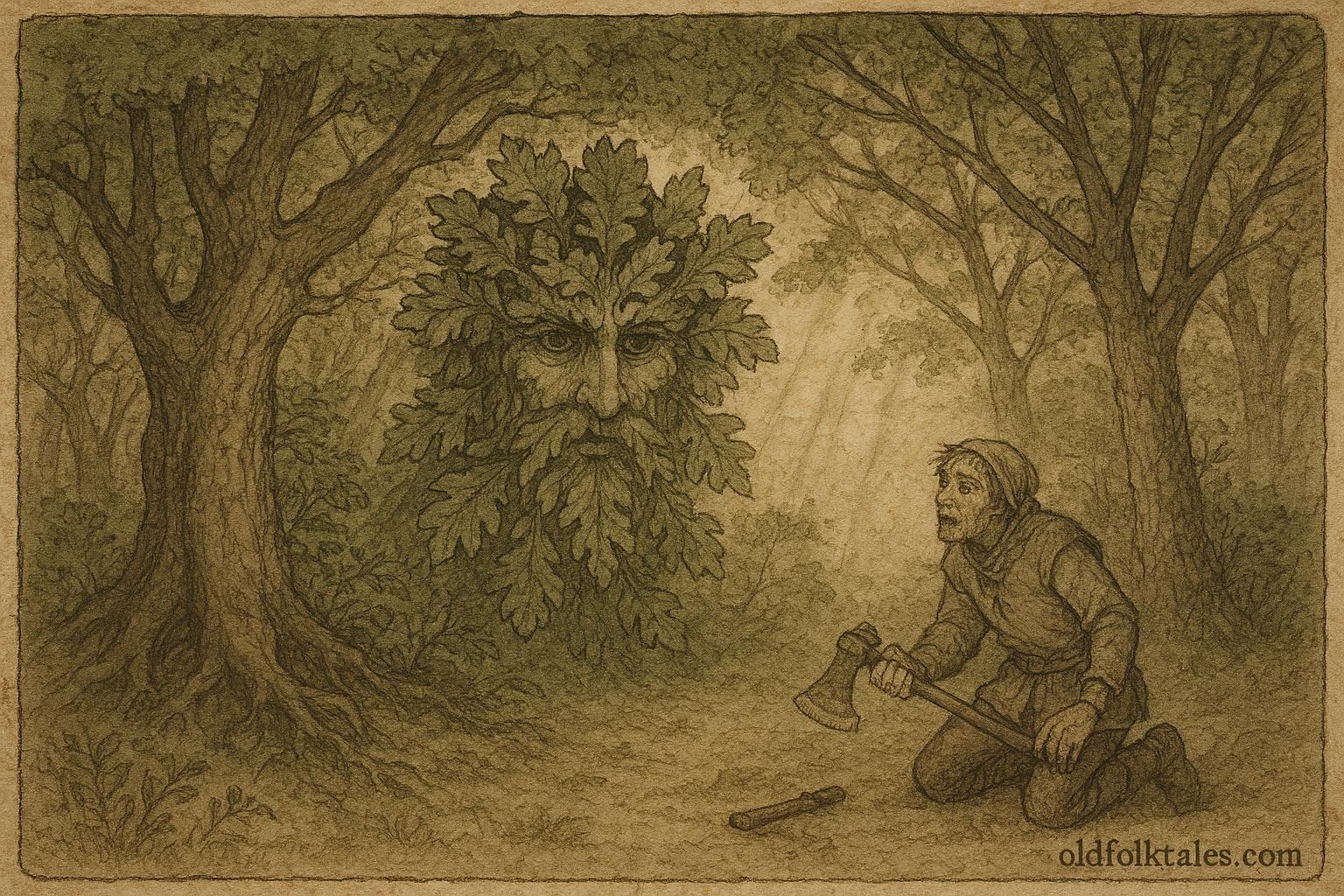
He was neither wholly tree nor wholly man. Ivy wound through his hair, and his skin bore the texture of bark. Leaves unfurled where his beard should have been, and his eyes shone green as new growth after rain. He spoke not with a voice, but with the creak of branches and the sigh of wind through leaves.
The woodcutter fell to his knees, terror rooting him in place. Around them, trees leaned inward, their branches groaning like ancient doors. Roots rose from the soil, coiling like sleeping serpents stirred too soon.
The Green Man showed him visions without words: saplings crushed before they could grow, animals driven from their homes, the forest thinning into silence. Then came another vision, of balance restored, trees standing tall, humans living alongside the land rather than above it.
When the woodcutter awoke, dawn had broken. His axe lay split in two, rusted as though centuries had passed in a single night. Around him, his stacked timber had crumbled into leaf-mold and soil. The forest stood whole once more, but the path behind him had vanished.
He wandered for hours, until hunger and fear humbled him completely. At last, he emerged at the forest’s edge, changed. From that day on, he never took more than fallen branches and deadwood. He warned others of the forest’s living heart, though many dismissed his words as superstition.
Yet the villagers noticed something. Those who listened prospered quietly. Their fields remained fertile, their journeys safe. Those who mocked and took too much found paths lost, tools broken, and fortunes slowly turning against them, as gently and inevitably as seasons change.
And still, in old churches and hidden groves, the Green Man watches, silent, patient, and enduring as the land itself.
Moral Lesson
The tale of the Green Man teaches that nature is not an endless resource, but a living partner. Respect preserves balance, while greed invites quiet but certain consequence.
Knowledge Check
1. Who is the Green Man in English folklore?
The Green Man is a nature spirit symbolizing the living spirit of forests and natural balance.
2. What role does the forest play in the story?
The forest acts as a living entity that responds to human respect or exploitation.
3. Why is the woodcutter punished?
He becomes greedy and takes more than needed, disrupting the natural balance.
4. How does the Green Man communicate?
Through natural signs, visions, and the movements of the forest itself.
5. What lesson does the woodcutter learn?
That humility and respect for nature ensure harmony and survival.
6. Where does the Green Man symbol historically appear?
In medieval English church carvings and architectural decorations.
Source: English folklore motifs recorded in medieval church carvings and later folkloric studies.(c. 1100–1400 CE)
Cultural Origin: England (Medieval rural England)