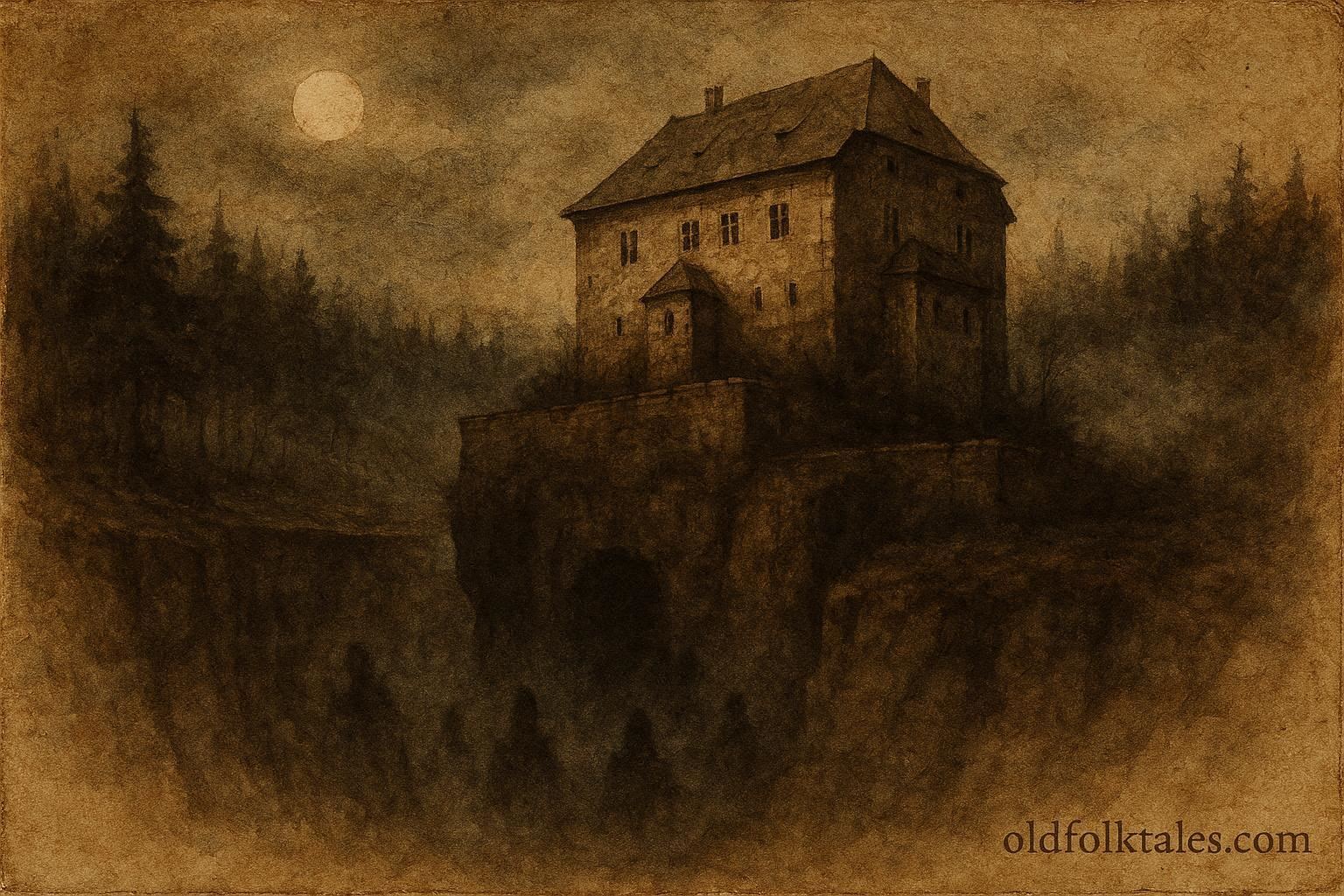
In the deep forests of what is now the Czech lands, far from the comfort of bustling towns and well-traveled roads, there stands a castle unlike any other. Its walls rise in quiet defiance against the wilderness, not as a symbol of power or wealth, but as something far more unsettling. It is called Houska.
And from the very beginning, it was never meant to protect those outside. It was built to keep something inside.
Discover the timeless charm of French, Dutch, and Belgian stories filled with cleverness and heart
Long before the castle stood upon that lonely ground, the place was avoided. Travelers passed it by without question, and even the bravest hunters refused to linger near its center. There was no village nearby, no trade route that demanded its crossing, only a stretch of forest where the air seemed heavier, and the silence pressed closer than it should.
At the heart of this place lay something no one could fully explain.
A chasm.
Not wide, but impossibly deep.
Those who dared to approach it spoke of a darkness that swallowed light itself. Stones dropped into its depths made no sound upon landing. No echo returned. It was as though the earth opened into nothingness, or into something that did not belong to the world above.
And from that darkness, it was said, things had emerged.
The earliest stories were whispered, shared only among those who trusted one another. Shepherds spoke of strange shapes glimpsed at dusk, moving too quickly and too unnaturally to be animals. Others claimed to have heard cries rising from below, sounds that did not belong to any living creature.
There were even tales of figures, half-seen, half-formed, climbing from the depths, their forms twisted and unfamiliar, vanishing as suddenly as they appeared.
No one stayed long enough to see clearly.
No one wanted to.
Fear spread, quiet but persistent, until it reached those with the power to act. It was decided that something must be done, not to explore the chasm, not to understand it, but to contain it.
To seal it.
And so, a castle was built.
But this was no ordinary construction.
Unlike other castles, which were raised to guard against enemies or to command the land around them, Houska was designed with a different purpose entirely. Its walls did not face outward with vigilance, they seemed instead to turn inward, as though guarding something beneath.
The structure rose directly over the chasm, its foundations laid not upon solid earth, but across the very opening itself. It was as if the builders sought to place a lid upon the darkness, using stone and mortar as their only defense.
Windows were placed where they could offer little view. Defenses were arranged in ways that made little sense for any conventional threat. Everything about the castle suggested that its true concern lay below, not beyond.
There are stories, old and difficult to verify, of how the builders themselves feared the task they had been given.
One tale speaks of a prisoner, promised freedom if he would be lowered into the chasm to report what lay beneath. Desperate and with little to lose, he agreed.
Ropes were tied securely, and before a small gathering, he was slowly lowered into the darkness.
At first, all was quiet.
Then, not long after he disappeared from sight, a scream rose from below, sharp, sudden, filled with a terror so complete that those above froze where they stood.
The ropes were pulled back with haste.
But when the man emerged, he was not the same.
His face had changed, his expression twisted with fear beyond words. Some said his hair had turned white in that single descent. He spoke of things he could not fully describe, shapes moving in the darkness, a presence that watched him, something vast and waiting.
He begged never to be sent down again.
No one asked him to.
The construction continued, driven by fear rather than understanding. Stone upon stone, wall upon wall, until at last the chasm was covered, sealed beneath the weight of the castle.
For a time, it seemed the effort had worked.
The sightings ceased. The cries faded. The forest grew quiet once more.
But the silence did not bring comfort.
For though the darkness below had been contained, it had not been gone.
Those who lived near the castle, or who were stationed within its walls, began to notice things. Small at first. Subtle.
Footsteps in empty corridors.
Shadows where no light should cast them.
Doors found open that had been carefully closed.
At night, the air within the castle grew unnaturally cold, as though something unseen moved through its halls.
There were reports of figures glimpsed out of the corner of the eye, dark shapes that vanished when looked at directly. Some spoke of a presence watching them, not from above, but from below.
Always from below.
Over time, the castle gained a reputation that spread far beyond the forests that surrounded it. Few wished to remain there for long. Those assigned to guard or maintain it did so reluctantly, counting the days until they could leave.
Even animals seemed uneasy within its walls, refusing to settle, reacting to things no human could see.
And still, the castle stood.
Silent.
Unyielding.
A barrier between two worlds.
Some believed that the structure had done its job, that whatever lay beneath had been contained, its reach limited to the occasional disturbance that could not break through the stone above it.
Others were less certain.
They wondered whether the castle was not a perfect seal, but merely a temporary one, a weight pressing down upon something that had not yet given up its attempt to rise.
Generations passed, and the story of Houska became legend.
Yet the unease remained.
Travelers who ventured near the castle often spoke of a strange feeling, as though the ground itself held a memory it could not release. The air felt different, heavier, quieter, filled with something unspoken.
And though the chasm could no longer be seen, its presence was still felt.
The people of the region learned, as people often do, to live alongside the unknown. They did not try to uncover what lay beneath the castle, nor did they attempt to challenge it.
They accepted its existence.
They respected its boundary.
For in the end, the lesson of Houska was not one of victory over darkness, but of containment.
Of understanding that some forces cannot be destroyed, only held at bay.
And so, the castle remains, standing watch over a secret buried deep beneath its foundations.
A reminder that there are places in the world where the line between what is known and what is not is thinner than it should be.
Places where the earth itself must be guarded.
Experience legends where mountains breathe magic and heroes face moral choices that shape destiny
Moral Lesson
The legend of Houska Castle teaches that not all darkness can be conquered, some must be contained. It reminds us to respect the boundaries between worlds and recognize the limits of human control over the unknown.
Knowledge Check
1. What is the legend of Houska Castle in Czech folklore?
It is said to be built over a gateway to the underworld to seal dark forces beneath the earth.
2. Why was Houska Castle constructed?
The castle was built to contain a mysterious chasm believed to release strange creatures and dark energies.
3. What happened to the man lowered into the chasm?
He returned terrified and changed, claiming to have seen horrifying, indescribable things.
4. What strange events occur inside Houska Castle?
People report footsteps, shadows, cold spots, and unseen presences within the castle.
5. What does Houska Castle symbolize in folklore?
It represents the boundary between worlds and humanity’s attempt to control dark forces.
6. Where does the Houska Castle legend originate?
It originates from Czech folklore, recorded in 1894 by Alois Jirásek.
Source: Alois Jirásek, Staré pověsti české (1894)
Cultural Origin: Czech legendary folklore