In the vast wetlands of Polesia, where southern Belarus stretches into a labyrinth of reeds, dark water, and trembling earth, there are places where the ground breathes beneath your feet. The marsh sighs in the heat of summer, exhales mist at dawn, and swallows sound so completely that even a shouted name seems to vanish before it travels far.
It is there, among crooked willows and black pools reflecting a gray sky, that travelers once whispered of the Iron-Toothed Crone.
They said she lived where the swamp grew deepest and the fog hung thickest, where paths disappeared without warning and the unwary wandered in circles until fear hollowed them out. Some claimed she was as old as the peat itself. Others said she had iron teeth that gleamed like trap jaws in the dark. But all agreed on one thing: she tested those who dared cross her marsh.
And woe to the greedy.
The Swamp and Its Warnings
In those days, a narrow trade path cut through the outer edge of the Polesia marsh. Merchants, farmers, and wanderers used it when they had no choice, though few did so willingly. The route saved days of travel, but it demanded courage, or desperation.
Before entering, villagers would cross themselves and mutter prayers. They tied bits of red thread to their belts or carried sprigs of dried herbs for protection. The marsh was not merely land and water; it was a boundary. It divided not only villages from forest, but honesty from temptation, humility from hunger for more than one’s share.
It was said that somewhere within the reeds lay hidden treasure, coins buried beneath roots, chests sunken in muck, relics lost by armies long forgotten. Those who spoke of such riches spoke softly, with eyes bright and restless.
And it was to such people that the Iron-Toothed Crone listened most closely.
The First Traveler
One autumn afternoon, when the reeds had turned pale gold and the air smelled of decay and rain, a merchant set out across the marsh path. His cart was heavy with goods already sold in a distant town, and his purse heavier still.
But gold, once gathered, breeds longing for more.
As he entered the marsh, he muttered to himself of the treasure rumored to lie beneath its waters. “If I found even a portion,” he said aloud, “I would double my fortune. Triple it.”
The wind moved strangely then, flattening the reeds in a wide circle around him. The horse shuddered.
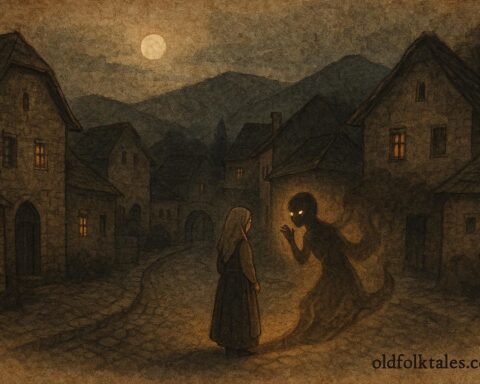
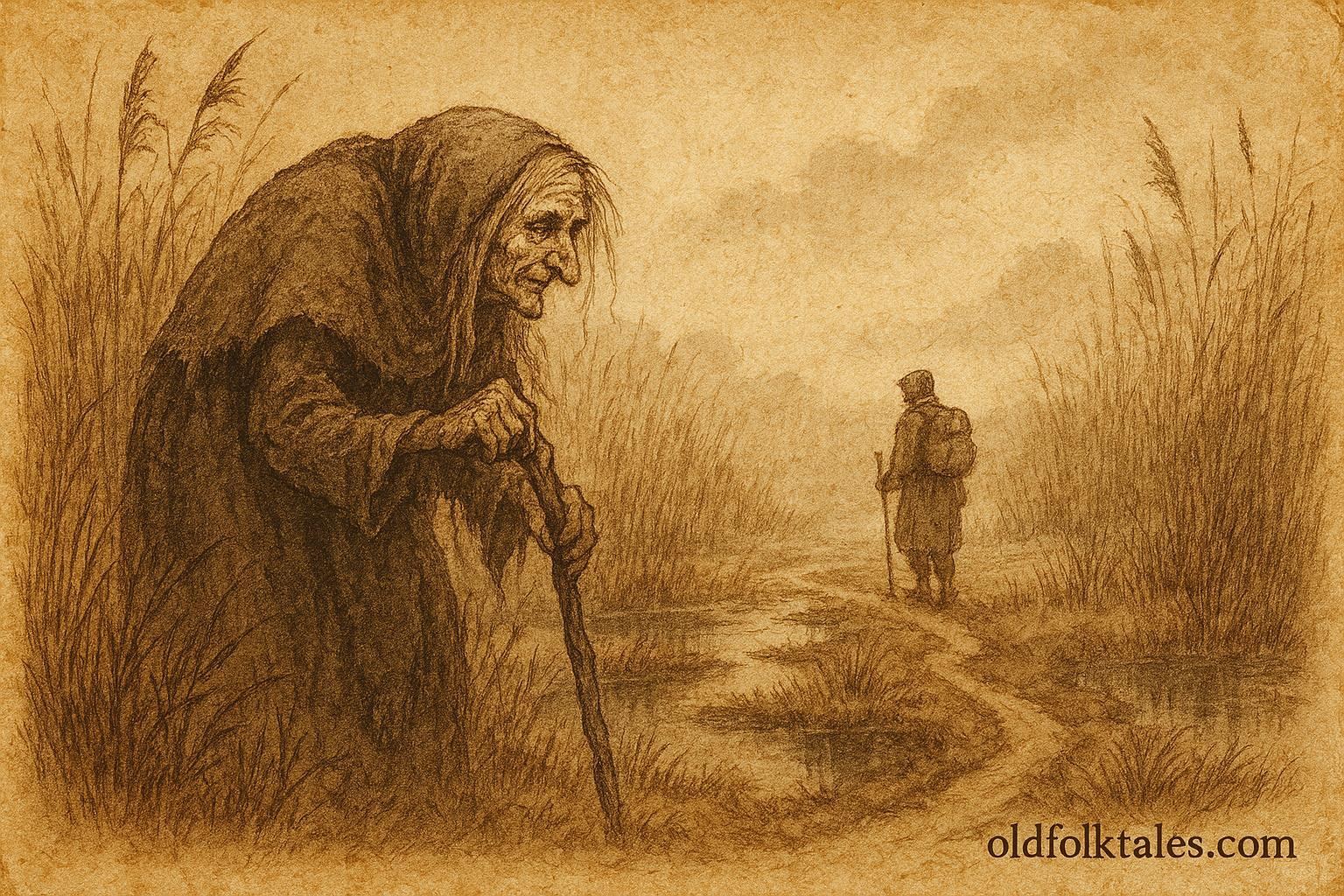
From the mist ahead emerged a figure bent and thin, wrapped in rags the color of dried mud. Her back curved like a sickle. When she raised her head, her teeth caught the gray light—hard, metallic, unmistakably iron.
“Where do you go, merchant?” she croaked.
He gripped the reins but did not flee. Instead, greed steadied him.
“I travel onward,” he said. “But I have heard tales of treasure hidden here. You look as though you know the marsh well.”
The crone’s iron teeth showed in something like a smile.
“Treasure?” she rasped. “Yes. Deep beneath the black water. Follow where I point. You will find what others have missed.”
She lifted a long, knotted finger toward a narrow break in the reeds, a place where the earth appeared almost solid.
Without hesitation, the merchant turned his cart from the path.
The ground held at first. Then it trembled.
The wheels sank slowly, almost gently. The horse struggled, eyes rolling white. The merchant leapt down, clutching his purse, but each step carried him deeper. Mud swallowed his boots, his knees, his cries.
The reeds closed behind him.
By morning, nothing remained but still water and drifting fog.
The marsh keeps what is given to it.
The Second Seeker
Word of the merchant’s disappearance reached nearby villages, but it did not quiet the rumors of treasure. Instead, it sharpened them.
A young man, poor and restless, decided that fortune favored the bold. He carried no cart this time, only a spade and a sack. He told no one where he was going.
When he reached the marsh, he did not speak his thoughts aloud. But the swamp hears even what is not voiced.
The mist thickened quickly, curling around his shoulders. He walked faster.
Again, the Iron-Toothed Crone appeared.
Her rags hung heavy with damp. Her iron teeth glinted between cracked lips.
“You seek something,” she said.
He swallowed but nodded.
“There is treasure,” she continued. “Enough to change your life. Dig where the willow bends over still water. Dig deep.”
She vanished as suddenly as she had come.
The young man found the willow. Its branches trailed in dark water. The earth beneath seemed firmer than elsewhere. He began to dig.
The first layer gave easily. The second oozed black sludge. By the third, the hole filled faster than he could clear it.
Still, he dug.
He did not notice how the ground shifted behind him, how the willow’s reflection rippled though no wind stirred.
When at last he tried to climb out, the edges collapsed inward. The more he struggled, the deeper he slid.
The swamp accepted him without a sound.
The Humble Traveler
Not all who crossed the marsh sought gold.
One spring morning, when mist rose gently from thawing ground and birds called from distant dry patches, a traveler approached the swamp path on foot. His boots were worn. His cloak was patched. A small pack rested against his back.
He had no cart, no spade, no purse heavy with coin.
He paused at the edge of the reeds and bowed his head slightly.
“I ask only safe passage,” he murmured. “I have far to go and little to offer but respect.”
The path ahead shimmered with moisture.
He walked carefully, placing each step with patience. When he heard water shift nearby, he did not veer toward it. When he glimpsed something glinting beneath the surface of a pool, he did not reach for it.
The mist gathered before him.
From it stepped the Iron-Toothed Crone.
Up close, she seemed less monstrous than rumor claimed. Her back was bent, yes. Her garments ragged. But her eyes, sharp and watchful, held neither madness nor hunger.
“Why do you cross my swamp?” she asked.
“For the road beyond,” he replied. “If there is a way that does not anger the land, I would be grateful to know it.”
She studied him, iron teeth flashing briefly as her lips parted.
“You do not seek what lies beneath?”
“I seek only to pass unharmed.”
The reeds rustled softly.
At length, the crone nodded.
“The marsh shifts,” she said. “Follow where the reeds lean east. Step only where you see pale grass beneath the water. And do not turn aside, no matter what you think you see.”
The traveler bowed deeply.
“Thank you.”
He followed her directions exactly. Twice he glimpsed shapes beneath the surface that looked like chests bound in metal. Once he thought he saw coins glittering among roots.
He did not turn.
The ground grew firmer. The mist thinned. Before long, solid earth lay beneath his boots.
When he looked back, the swamp lay quiet and endless. The crone was gone.
But in his pocket, he found a small smooth stone he had not placed there, white and dry, warm despite the chill air. He carried it with him for years, and wherever he walked thereafter, he never lost his way.
The Meaning of the Marsh
In time, the tale of the Iron-Toothed Crone spread across the Polesia marshlands. Some spoke of her as a witch. Others called her a guardian. A few insisted she was the swamp itself, given shape to judge those who entered.
Yet the pattern was clear.
Those who came seeking wealth where none was owed were swallowed by shifting earth and black water. Those who entered with humility, asking only what they needed, were shown safe passage.
The swamp was not cruel. It was exacting.
It mirrored the hearts of those who crossed it.
And so villagers taught their children: when you approach the boundary between what you have and what you desire, tread carefully. Greed can sink a man faster than mud. Respect may guide him through dangers unseen.
To this day, when mist gathers over southern Belarus and reeds whisper in the dusk, some say the Iron-Toothed Crone still walks there, iron teeth gleaming faintly, watching, waiting, and weighing the hearts of travelers.
Moral Lesson
Greed blinds judgment and leads to ruin, while humility and respect offer protection. The swamp stands as a moral boundary: it does not punish without cause, but it reflects the intentions of those who enter it.
Knowledge Check
1. Who is the Iron-Toothed Crone in Belarusian folklore?
She is a supernatural swamp guardian from Polesia marshland folklore who tests travelers’ intentions.
2. What happens to greedy travelers in the story?
Those seeking hidden treasure are misled into the marsh and become lost or swallowed by the swamp.
3. How does the humble traveler survive the Polesia swamp?
He asks only for safe passage, listens carefully, and resists temptation.
4. What does the swamp symbolize in this Belarusian folktale?
It represents a moral boundary that reflects greed or humility in those who cross it.
5. Why are the crone’s teeth described as iron?
Her iron teeth emphasize her fearsome nature and symbolize unyielding judgment.
6. What cultural region does this folktale come from?
It originates from the Polesia marshlands of southern Belarus.
Source: Belarusian folktale, southern Belarus. Documented in Lud Białoruski (1897) by Mikhail Federowski.
Cultural Origin: Polesia marshland folklore, Belarus.