Long ago, in a quiet household near the edge of a northern German village, there lived a husband and wife who longed deeply for a child. Though they had comfort, a home, and each other, their greatest wish remained unfulfilled.
In their garden stood a juniper tree, tall, fragrant, and evergreen even in the coldest months. Its branches whispered softly in the wind, and beneath it lay a patch of earth where the wife often sat, lost in thought.
Explore the wit and wisdom of Western Europe, where humor and virtue often go hand in hand
One winter’s day, as snow covered the ground like a white blanket, she stood beneath the juniper tree peeling an apple. As she worked, her knife slipped, and a drop of her blood fell onto the snow.
She looked down at the red upon the white and sighed.
“Oh,” she said softly, “if only I had a child as red as blood and as white as snow.”
From that moment, her heart was filled with hope.
Months passed, and her wish was granted. She bore a son, a beautiful child whose skin was pale as snow and whose cheeks glowed like rose petals. But her joy was short-lived. As the child came into the world, her strength left her.
Before she died, she made one final request.
“Bury me beneath the juniper tree,” she said.
And so it was done.
Time passed, as it always does.
The husband mourned deeply, but eventually remarried, bringing a new woman into the household. She, too, bore a child, a daughter.
But where the first wife had been gentle and loving, the second was harsh and cold.
She looked upon her stepson with growing resentment. His presence reminded her of the woman who came before her, and she could not bear the thought that he might inherit more love, or more favor, than her own child.
Day by day, her bitterness grew.
She spoke sharply to the boy, burdened him with chores, and denied him kindness. Yet the child endured quietly, unaware of the depth of her hatred.
One afternoon, when the father was away, the boy returned home from school. He approached his stepmother and asked innocently:
“Mother, may I have an apple?”
She stood beside a heavy wooden chest filled with apples. Her expression was strange, her eyes cold.
“Yes,” she said slowly. “Take one.”
As the boy leaned forward to reach into the chest, she suddenly slammed the lid down.
There was a terrible sound.
Silence followed.
The boy’s head lay separated from his body.
For a moment, the stepmother stood frozen, her breath caught in her throat.
Then panic overtook her.
“What have I done?” she whispered.
But fear quickly gave way to calculation.
She placed the boy’s head back upon his body and tied a scarf around his neck to hold it in place. Then she set him on a bench by the door, an apple in his hand, as though nothing had happened.
Soon after, the little daughter came home.
“Brother,” she said cheerfully, “give me an apple.”
When the boy did not respond, she grew confused.
“Please?” she asked again.
Still, there was no answer.
The stepmother, watching from a distance, spoke sharply. “If he won’t give it to you, then strike him.”
The girl hesitated, then lightly struck her brother.
At once, his head fell to the ground.
The girl screamed in terror.
The stepmother rushed forward, pretending alarm, and quickly gathered the child.
“Hush,” she said urgently. “It was an accident. We must not tell anyone.”
That night, she prepared a meal.
From the boy’s body, she cooked a stew and served it to her husband when he returned home.
He ate heartily, unaware of the truth.
“How delicious this is,” he said. “Where is my son? He has not come to greet me.”
The stepmother forced a smile.
“He has gone to visit relatives,” she replied. “He will return later.”
Meanwhile, the little daughter sat quietly, tears falling into her bowl.
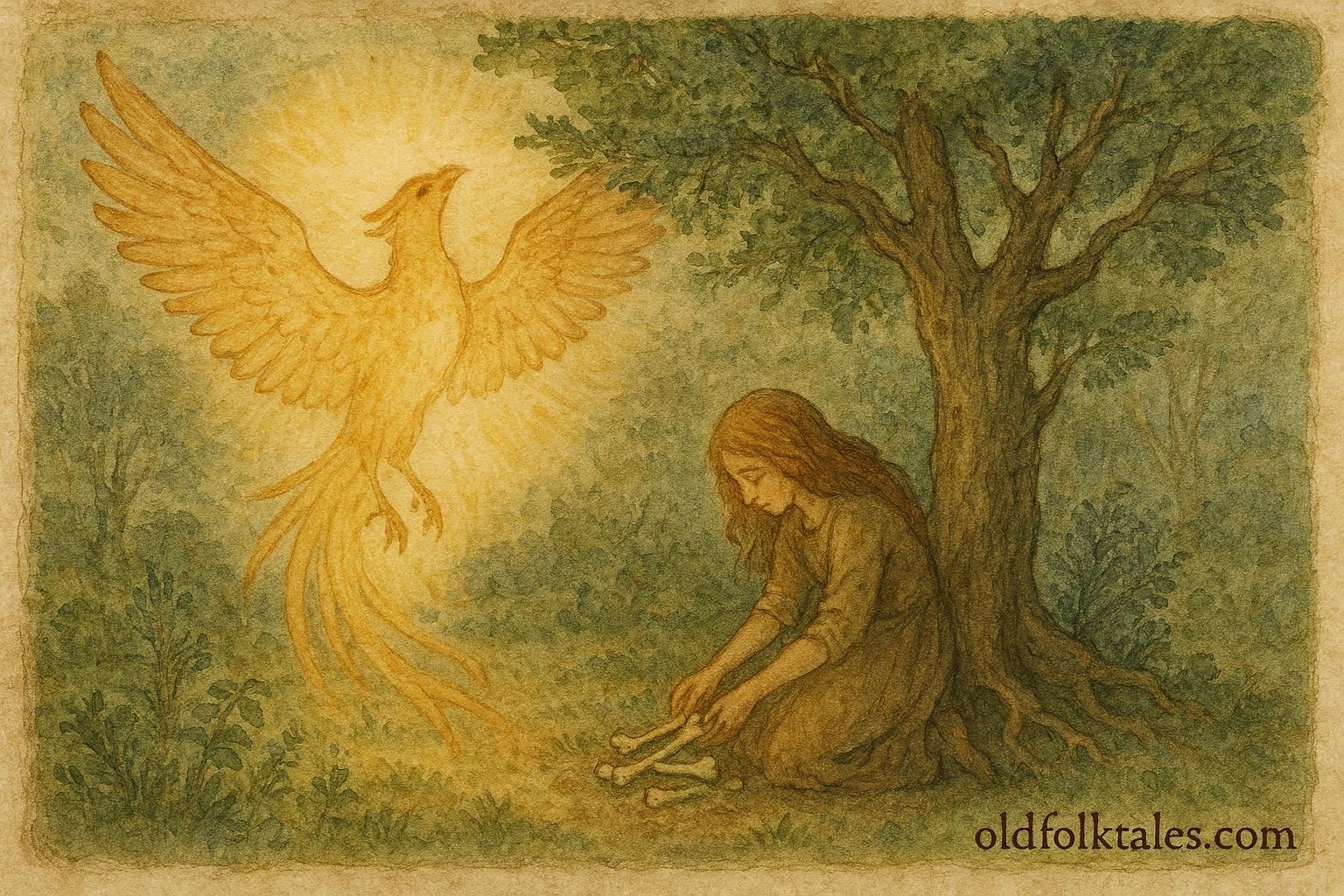
When the meal was done, she gathered the small bones that remained and carried them outside. With trembling hands, she placed them beneath the juniper tree.
The wind stirred.
The branches of the tree whispered once more.
And something remarkable began to happen.
From the earth beneath the juniper tree rose a fine mist. It shimmered and gathered, taking shape until, with a sudden burst of light, it became a bird, beautiful and radiant.
Its feathers shone with brilliant colors, and its eyes glowed with knowing.
The bird took flight.
It flew over the village, singing a song unlike any other.
Its voice was clear and haunting, carrying a tale that none could ignore.
In its song, it spoke of a child betrayed, of a cruel act hidden beneath silence, and of truth waiting to be revealed.
Those who heard it were struck with wonder, and unease.
The bird flew first to a goldsmith.
It sang its song, and the goldsmith, captivated, offered a golden chain in exchange for hearing it again.
The bird accepted and flew on.
Next, it came to a shoemaker, singing once more. The shoemaker, moved by the melody, gave a pair of fine red shoes.
Finally, the bird came to a mill, where workers listened in astonishment as it sang the truth again. In return, they gave a heavy millstone.
With these gifts, the bird returned home.
It perched above the house and began its song once more.
Inside, the father listened, drawn by the melody.
“What a beautiful bird,” he said, stepping outside.
The bird dropped the golden chain around his neck.
“How strange,” he murmured, yet he smiled.
The little daughter came next, her eyes wide with wonder.
The bird dropped the red shoes before her.
She slipped them on, and for the first time since her brother’s death, she smiled.
Then came the stepmother.
She stepped outside reluctantly, her face pale.
The bird’s song grew louder, its meaning unmistakable now.
The truth could no longer be hidden.
As she looked up, trembling, the bird released the millstone.
It fell swiftly, striking her.
And in that moment, justice was done.
Silence followed.
Then, as gently as it had come, the bird descended to the ground.
Before the eyes of the father and daughter, it transformed once more.
Where the bird had stood, the boy now appeared, alive, whole, and unharmed.
The father fell to his knees, overcome with joy and sorrow.
“My son,” he cried.
The family embraced, their grief lifted at last.
And beneath the juniper tree, where sorrow had once taken root, peace was restored.
Moral Lesson
Truth cannot be buried forever. No matter how deeply hidden, it will rise, bringing justice, restoring balance, and revealing the consequences of cruelty.
Knowledge Check
- What happens to the boy in The Juniper Tree folktale?
He is killed by his stepmother, but later returns through a magical transformation. - What does the juniper tree symbolize in the story?
It represents memory, transformation, and the connection between life, death, and justice. - How does the truth get revealed in the story?
The boy transforms into a bird that sings the truth to the people. - What role does the sister play in the story?
She unknowingly contributes to events but later helps by placing the bones under the tree. - What happens to the stepmother in the end?
She is punished when the bird drops a millstone on her. - What is the main theme of The Juniper Tree?
The story emphasizes that truth and justice will prevail, even after death.
Source: Grimms’ Fairy Tales (Kinder- und Hausmärchen), 1812
Cultural Origin: German (Northern German oral traditions)