In a quiet rural village in the Netherlands, where narrow paths wound between small cottages and fields stretched toward the horizon, there lived a humble shoemaker. His home was modest, his workshop small, and his means limited, but his hands were skilled, and his heart was honest.
For many years, he had made a simple living crafting sturdy shoes for the villagers. Farmers, laborers, and travelers alike came to him when their boots wore thin or their soles gave way. Though he worked from dawn until the fading light of evening, the coins he earned were never quite enough to lift him beyond hardship.
As seasons passed, his situation worsened.
Fewer customers came. Leather became harder to afford. The tools he relied upon grew worn with use. Slowly, quietly, poverty tightened its grip.
At last, there came a day when the shoemaker found himself with only a single piece of leather remaining, just enough to make one final pair of shoes.
He held the material in his hands that evening, running his fingers over its surface as though committing it to memory. If he crafted it well, perhaps he might earn enough to buy more supplies. If not… he dared not think of what would follow.
With careful attention, he cut the leather into the proper shapes, preparing it for stitching the next morning. Then, weary from long hours and heavy thoughts, he set the pieces neatly upon his workbench and retired for the night.
The Mysterious Work
When dawn broke, the shoemaker rose early, as was his habit.
He entered his workshop expecting to begin his task, but what he found stopped him in his tracks.
There, upon his bench, lay a finished pair of shoes.
They were not merely completed, they were exquisite.
The stitching was finer than any he had ever managed, each seam perfectly aligned, each curve shaped with remarkable precision. The leather, though the same piece he had prepared, now seemed transformed into something far more refined.
The shoemaker stood in silence, unsure whether to trust his own eyes.
Had he finished them in his sleep? Had someone entered his workshop in the night?
He examined the room closely, but nothing was disturbed. No sign of intrusion could be found.
Though puzzled, he did not question his good fortune for long.
That very day, a customer arrived, a traveler passing through the village. Upon seeing the shoes, the man was so impressed by their quality that he paid far more than the shoemaker would have dared to ask.
With the money, the shoemaker purchased enough leather to continue his work.
That evening, he prepared the materials once again, cutting them carefully and placing them upon the bench as before.
And once again, he went to bed.
Night After Night
The same wonder repeated itself.
Each morning, the shoemaker would find his work completed, perfectly crafted shoes waiting where unfinished pieces had been left the night before.
His reputation grew.
Word spread through the village and beyond: the shoemaker who produced shoes of unmatched quality. Customers came from neighboring towns, eager to buy his work. Soon, the once-struggling craftsman found himself no longer burdened by scarcity.
Yet with this newfound success came a question that would not leave him.
Who was responsible?
The shoemaker was not a man given to greed or suspicion. Rather, he felt a deep curiosity, and something more.
Gratitude.
For though he had done nothing to earn such help, someone, or something, was aiding him in his time of need.
At last, he resolved to discover the truth.
The Secret Revealed
One evening, instead of retiring to bed, the shoemaker extinguished his candle and hid quietly within his workshop.
The night grew still.
Outside, the village slept, and only the faint sound of wind brushing against the thatched roofs could be heard. Hours passed, and the shoemaker remained patient, scarcely daring to breathe.
Then, at the stroke of midnight, a soft movement stirred the room.
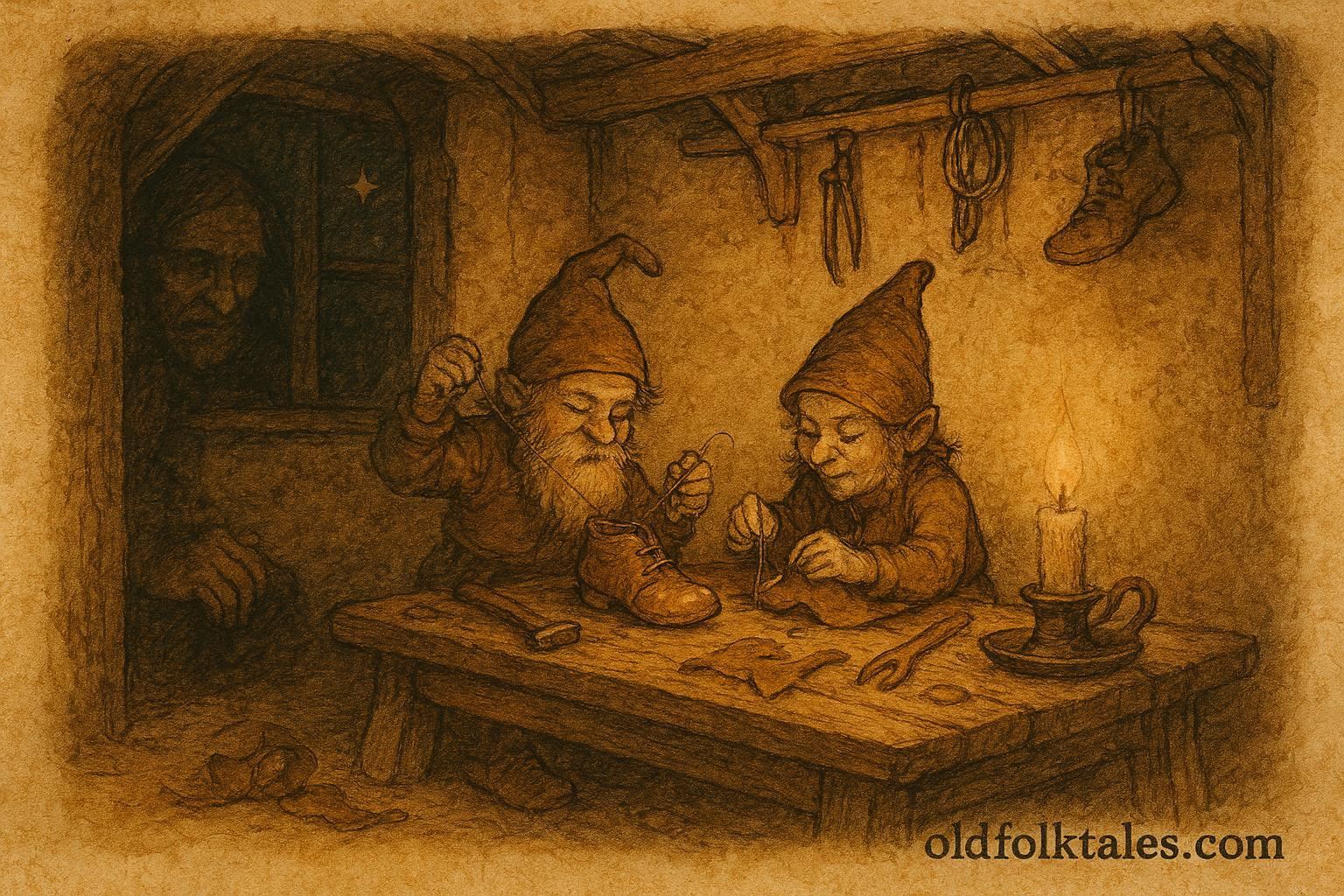
From a small corner near the hearth, two tiny figures emerged.
They were no larger than a man’s hand, yet moved with lively energy. Their forms were delicate, their clothing simple and worn. Despite their small size, their presence filled the workshop with a quiet, almost joyful purpose.
The shoemaker watched in amazement.
The tiny beings, Kabouters, as they were known in old Dutch tales, climbed onto the workbench and set immediately to work. With nimble fingers and remarkable speed, they stitched, shaped, and polished the leather with effortless skill.
Their movements were quick but precise, their cooperation seamless, as though they shared a single thought between them.
Yet as the shoemaker observed more closely, he noticed something that stirred his heart.
The Kabouters’ clothes were tattered. Their small garments, though neatly worn, were clearly old and thin, offering little warmth against the cold night air.
Still, they worked without complaint.
When their task was finished, they admired their handiwork for a brief moment, then slipped away as quietly as they had come.
The shoemaker remained hidden, deeply moved.
A Choice of Gratitude
By morning, his decision was made.
He could have continued as before, accepting the Kabouters’ help without question, allowing their labor to sustain his growing success.
But such a thought did not sit well with him.
These small beings had aided him in his greatest time of need, asking for nothing in return. To ignore their hardship would be an act of selfishness he could not justify.
Instead, he chose gratitude.
That day, he set aside his usual work and gathered materials of a different kind. With care and dedication, he crafted two tiny sets of clothing, warm, well-made garments suited to the size of his mysterious helpers.
Each piece was stitched with the same attention he gave to his finest shoes.
That evening, instead of leaving leather on the bench, he placed the small clothes where the Kabouters would find them.
Then, once again, he hid himself to watch.
The Kabouters’ Farewell
As midnight arrived, the Kabouters returned.
They climbed onto the workbench, ready to begin their work, but stopped at once when they saw what had been left for them.
For a moment, they simply stared.
Then, with evident delight, they rushed forward.
They examined the tiny garments with excitement, lifting them, turning them in their hands, marveling at their craftsmanship. Quickly, they set aside their worn clothes and dressed themselves in the new ones.
The transformation was immediate.
Clad in warm, well-fitting garments, the Kabouters seemed brighter, their movements filled with an even greater sense of joy.
They began to laugh softly, a sound like the gentle chime of distant bells.
Then, instead of returning to their work, they danced.
Around the workbench they moved, light and carefree, as though celebrating a gift long awaited. Their happiness filled the small workshop, leaving no doubt of their appreciation.
At last, one of them spoke, not loudly, but clearly enough for the shoemaker to hear.
“We are free now,” the little voice said. “No longer in need of labor.”
The other nodded.
“And we shall not return.”
With that, the Kabouters gave one final joyful turn, then slipped away into the shadows, disappearing as quietly as they had come.
A Life Changed
The shoemaker stepped from his hiding place, his heart full.
Though he knew their help had come to an end, he felt no regret.
What they had given him could not be measured only in finished shoes or earned coins. They had lifted him from despair, restored his livelihood, and taught him something far greater than skill.
In the days that followed, he returned to his work, this time by his own hands alone.
Yet the lessons remained.
He worked diligently, now with improved confidence and understanding. The experience of seeing such perfect craftsmanship had sharpened his own abilities, and his reputation continued to grow.
Though the magical help had vanished, its impact endured.
The shoemaker prospered, not through greed, but through honest labor, guided by gratitude and humility.
And though the Kabouters were never seen again, their presence lingered in the quiet corners of the workshop, in the careful stitches of every shoe, and in the heart of the man who had chosen kindness over selfish gain.
Explore the wit and wisdom of Western Europe, where humor and virtue often go hand in hand
Moral Lesson
This Dutch folktale teaches that gratitude and generosity bring lasting rewards, while humility ensures that blessings are not taken for granted. The shoemaker’s kindness toward the Kabouters shows that acknowledging unseen help leads to true and meaningful prosperity.
Knowledge Check
- Who are the Kabouters in Dutch folklore?
Kabouters are small magical beings in Dutch folklore who secretly help humans, especially during times of need. - How did the shoemaker receive help in the story?
The Kabouters completed his unfinished shoes at night, improving his craft and livelihood. - Why did the Kabouters stop helping the shoemaker?
They left after receiving clothes as a gift, as they were no longer in need of working. - What does the shoemaker’s action represent in the folktale?
It represents gratitude and generosity toward those who help us, even when unseen. - What is the main theme of The Kabouter and the Shoemaker?
The story highlights gratitude, humility, and the rewards of kindness. - Where does this folktale originate from?
It originates from rural villages in the Netherlands.
Source: Collected in Dutch Folk Tales and Legends by W. J. Hofdijk, 1871
Cultural Origin: Netherlands (rural village folklore)