Once upon a time, in a kingdom nestled between rolling hills and winding rivers in Hungary, there lived a wise and aging king. He had three sons, each bold and ambitious, and he wished to see them married to brides of exceptional qualities, brides whose virtues would complement the strength and wisdom of their future kingship.
The king summoned his sons one bright morning in the sunlit palace courtyard. “My sons,” he said, his voice echoing through the marble halls, “each of you shall seek a bride worthy of your station. But take heed: a bride’s beauty is fleeting, yet her character endures. Look not only with your eyes but with your heart.”
The eldest son, strong and proud, and the middle son, clever and ambitious, nodded with confidence. The youngest son, quiet and often overlooked, listened intently, his mind already weighing the king’s words. Unlike his brothers, he did not boast or demand attention.
The king continued, “To guide you, I give each of you a single golden token. Present it to the maiden whose virtue calls to you most. She will be your bride.”
With these instructions, the three princes set out from the palace. The eldest traveled east, seeking a maiden renowned for her beauty and wit. The middle son journeyed south, hoping to find a bride famed for her wealth and noble lineage. The youngest son walked north, quietly observing the villages he passed, helping farmers with their burdens, and listening to the stories of elders.
The eldest son soon arrived at a grand estate, where a young woman with golden hair and sparkling eyes awaited. Her beauty was undeniable, and her manner was gracious, but when the prince asked how she treated the poor, she smiled politely but offered no real answer. Disappointed by her vanity, he pressed his golden token into her hand anyway, thinking charm and elegance would suffice.
Meanwhile, the middle son found a maiden in a lavish castle, surrounded by treasures and finery. She was well-educated and adept at courtly manners, but when he inquired about her kindness or courage, she responded with calculated words that revealed little heart. Still, he gave her his token, convinced that wealth and refinement were the surest measures of a good match.
The youngest son, however, continued his travels through the villages, observing the lives of ordinary people. One afternoon, he saw a young woman helping an elderly neighbor carry firewood, while simultaneously soothing a frightened child whose sheep had wandered into a thorny thicket. Her movements were graceful yet practical, her smile warm and genuine.
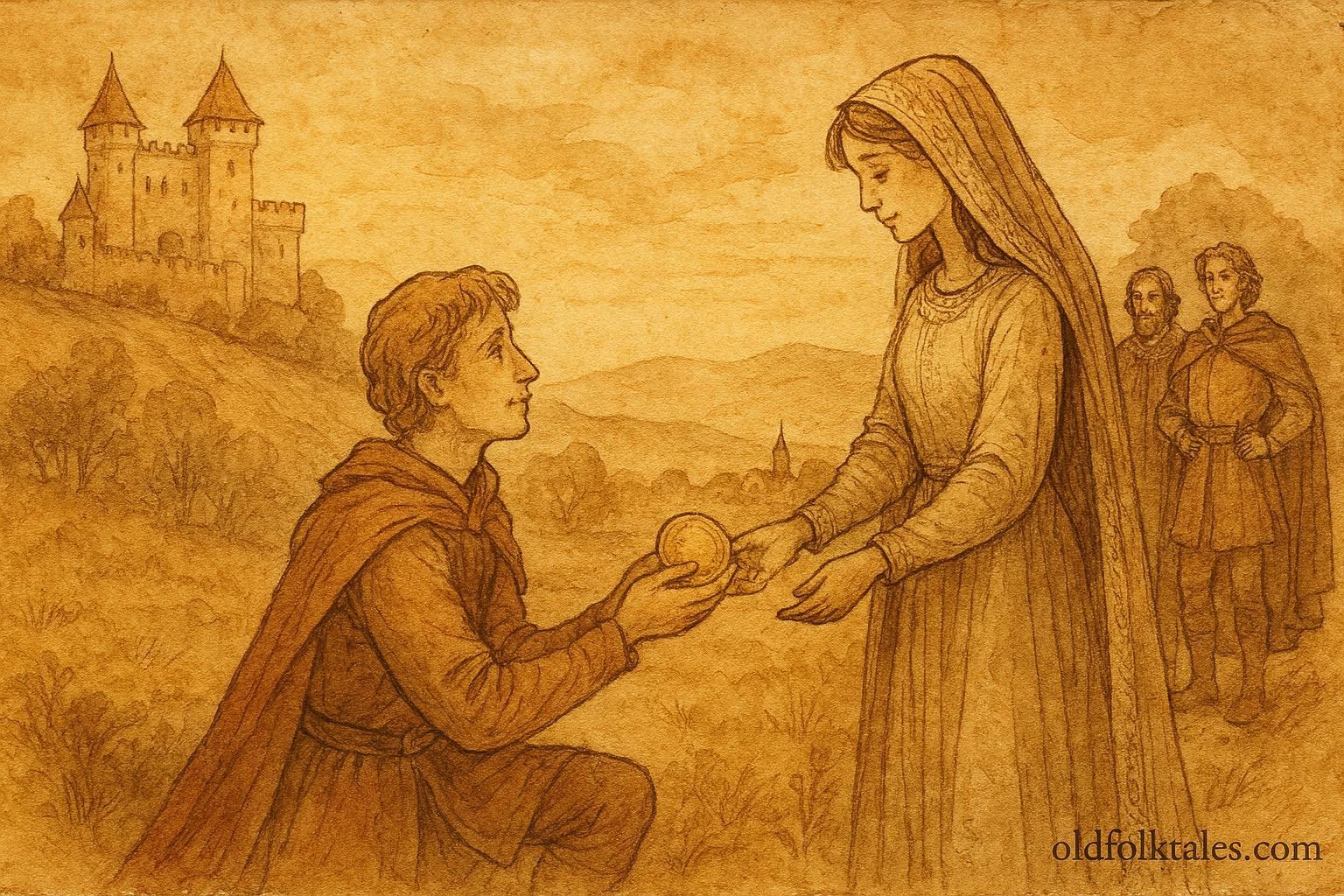
The youngest son approached her humbly. “Fair maiden,” he said, “I have traveled far seeking a bride of great virtue. You show compassion and courage in ways that touch the hearts of those around you. Would you accept this token and journey with me to the palace?”
The young woman’s eyes sparkled with surprise and delight. “I accept,” she replied. “But I do not seek wealth or grandeur, only honesty, kindness, and the chance to serve wisely alongside you.”
As the princes returned to the palace, each carrying his chosen bride, the king awaited in the grand hall. The eldest and middle sons presented their tokens proudly, while the youngest son’s bride stood quietly by his side, her hands folded and eyes calm.
The king observed each pair carefully. When he addressed the eldest and middle sons, he noticed that their brides’ beauty and refinement were evident, yet something was missing, a warmth of heart, a strength of spirit, a genuine regard for others.
Finally, he turned to the youngest son and his bride. “You, my youngest, have chosen wisely,” the king said. “This maiden’s deeds, not just her words, reveal a character both humble and strong. True worth is not measured by appearance or wealth but by compassion, integrity, and courage.”
To test the virtues of the brides, the king devised three trials over the coming weeks. The first was a challenge of wisdom: each bride was given a puzzle that required both logic and empathy. The eldest bride solved it with cleverness but ignored the needs of others in her solution. The middle bride’s approach was elegant but focused on prestige and recognition rather than truth. The youngest bride, however, considered all aspects of the problem, consulted with villagers and helpers, and offered a solution that benefited all parties.
The second trial was of courage. The king sent the brides to aid villagers threatened by a storm that had flooded fields and torn roofs from homes. The eldest bride hesitated, worried for her own comfort; the middle bride attended, but mainly to demonstrate her bravery before the court. The youngest bride, in contrast, worked tirelessly to help families secure their homes, rescue livestock, and tend to the sick and frightened.
The final trial was of character. The king secretly observed the brides interacting with palace staff and servants. The eldest and middle brides often criticized or dismissed those they considered beneath them, while the youngest bride treated everyone with respect, offered guidance without arrogance, and displayed genuine concern for the welfare of all around her.
At the conclusion of the trials, the king convened the court in the grand hall, his voice resonant with pride. “It is clear to me now which of these brides embodies the virtues that our kingdom needs. Let it be known: the youngest son, who often walks humbly and observes keenly, has chosen a bride of true heart and noble spirit. Together, they will lead with wisdom, compassion, and justice.”
The court erupted in applause, and even the eldest and middle sons bowed in acknowledgment of their brother’s discernment. The youngest prince and his bride were wed in a ceremony that honored not only their union but the virtues that had guided them: humility, courage, kindness, and insight.
The kingdom thrived under their guidance. Fields flourished, disputes were resolved with fairness, and the people’s hearts were filled with hope and trust. The tale of the youngest son and his wise bride spread through villages and towns, reminding all that appearances can deceive, but character reveals true worth.
Years later, when children asked the youngest prince, now king, about the secret to his success, he smiled and said, “Look beyond what dazzles the eye. Seek virtue, kindness, and courage, and you will find treasures no wealth can match.”
And so, the kingdom prospered, a shining example of how humility, wisdom, and genuine compassion can triumph over pride, superficiality, and haste.
Moral Lesson
True worth is measured by character and virtue, not wealth, beauty, or status. Patience, humility, and kindness lead to enduring success and respect.
Knowledge Check
1. Why did the king send his three sons to find brides?
To choose wives of exceptional virtue whose character would complement their future rule.
2. How did the youngest son select his bride?
By observing her actions of kindness, courage, and compassion in daily life, not her appearance.
3. What were the three trials the brides faced?
Wisdom (solving a puzzle with empathy), courage (helping villagers in a storm), and character (treatment of palace staff).
4. How did the eldest and middle brides fail the trials?
They focused on beauty, wealth, prestige, or self-interest rather than virtue and service.
5. What qualities made the youngest bride stand out?
Humility, compassion, courage, respect for others, and practical wisdom.
6. What cultural origin does this story represent?
Hungarian folklore, emphasizing virtue, humility, and the moral testing of character.
Source: Elek Benedek, Hungarian Fairy Tales (1895)
Cultural Origin: Hungary