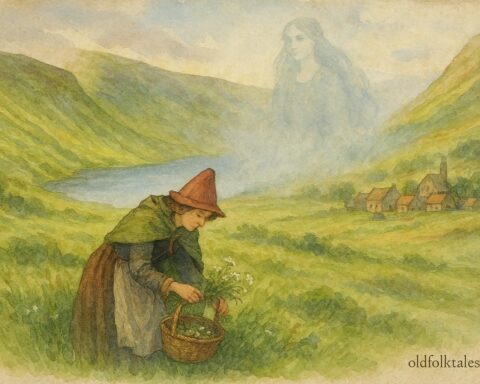
In the quiet, mist-laden hills of Carmarthenshire, where the Black Mountain rises in gentle majesty and the winds carry whispers of ancient tales, there lies a lake known as Llyn y Fan Fach. Its waters are clear and still, reflecting the sky like a mirror, yet those who lived nearby knew better than to think it ordinary. Beneath its calm surface dwelled mysteries older than memory, and among them was the tale of a woman who came from the depths of the lake itself.
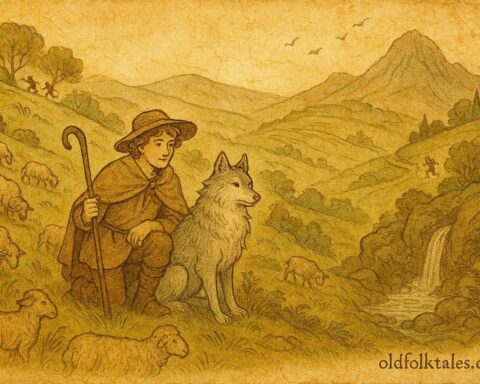
In a small village not far from the lake lived a young farmer, diligent and humble, who spent his days tending sheep along the mountain slopes. Though hardworking, his life was solitary, marked by the quiet rhythm of the land and the passing of seasons. Each morning, he would drive his flock toward the high pastures, where the air was fresh and the silence broken only by the wind and the distant cry of birds.
It was during one such morning that his life changed forever.
As he approached the shores of Llyn y Fan Fach, he noticed something unusual. The surface of the water shimmered in a way he had never seen before, as though touched by unseen hands. Drawn by curiosity, he stepped closer.
Then he saw her.
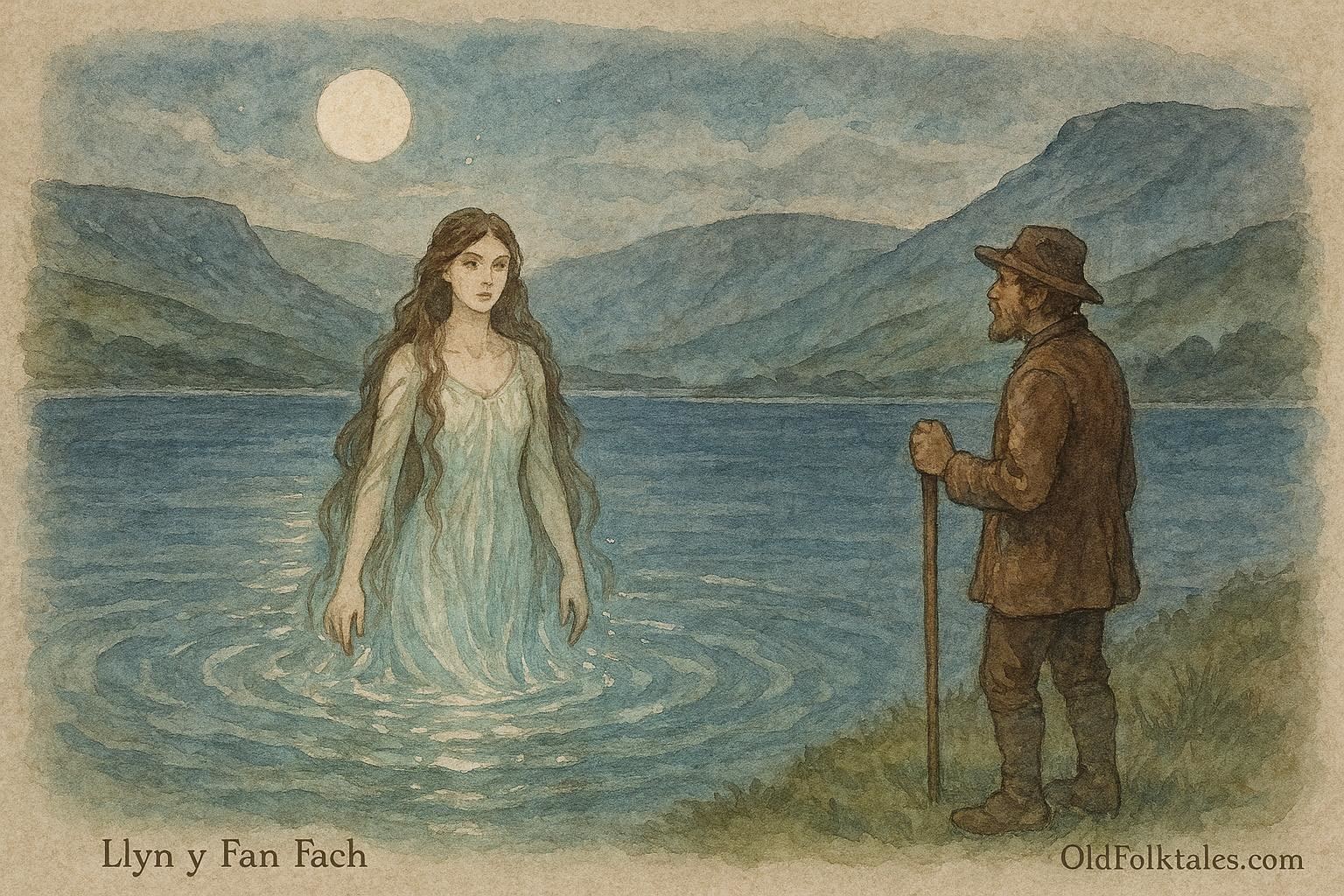
From the lake emerged a woman of extraordinary beauty, her form rising gracefully from the water as though she belonged to it. Her hair flowed like dark silk, her skin pale and luminous, and her eyes held a depth that seemed to mirror the lake itself. She stood at the edge of the water, neither fully of the land nor entirely of the depths.
The farmer was struck silent, his heart pounding with awe and wonder. He had never seen such a being, and yet he felt no fear, only a strange sense of reverence.
Gathering his courage, he approached her gently and spoke. He offered her bread, a simple gesture of hospitality. The woman regarded him with calm curiosity, yet when she tasted the bread, she shook her head. “This is too hard,” she said softly, her voice like the ripple of water.
The farmer returned the next day, bringing softer bread, hoping to please her. Again, she refused, saying it was still not right.
Determined, he came once more, this time with perfectly baked bread, soft and light. When she tasted it, she smiled. It was then that she spoke words that would bind their fates together.
“I will come with you,” she said, “and be your wife, but only on one condition.”
The farmer listened intently.
“You must not strike me,” she continued, “not even three times without cause. Should you do so, I will return to the lake from which I came, and all that I have brought with me will vanish.”
The farmer, eager and filled with hope, agreed without hesitation.
And so, the Lady of Llyn y Fan Fach left the water and went with him to his home.
Their marriage brought prosperity beyond anything the farmer had known. The lady brought with her cattle of remarkable strength and beauty, animals unlike any seen before. They multiplied quickly, filling the fields and bringing wealth to the household. The farm flourished, and the farmer’s life transformed from one of quiet struggle to abundance.
Yet more than wealth, there was harmony. The lady moved through the home with grace, her presence bringing a calm and order that seemed almost otherworldly. Though she was kind and gentle, there remained something distant about her, a reminder that she belonged, in part, to another realm.
Years passed, and the couple had children, who grew strong and healthy under their care. The farmer loved his wife deeply, though he never forgot the condition she had set. He guarded his actions carefully, mindful of his promise.
But human nature is imperfect, and even the most careful heart can falter.
The first incident occurred during a joyful occasion, a christening in the village. Laughter filled the air, and the gathering was lively. Yet the lady, though present, appeared solemn, her expression distant. When the farmer urged her to join in the celebration, she remained still. In a moment of impatience, he tapped her lightly, saying, “Why so sad on such a happy day?”
She turned to him, her gaze steady. “That is one,” she said quietly.
The farmer’s heart sank. He had not meant harm, yet the condition had been broken once.
Time passed, and the memory faded, though not entirely.
The second incident came at a funeral, where sorrow hung heavy over the gathering. The lady, however, seemed strangely serene, even smiling faintly. The farmer, confused and troubled, nudged her again. “Why do you smile when others mourn?” he asked.
She looked at him once more, her expression unchanged. “That is two,” she said.
Now the farmer grew uneasy. He realized how easily his promise could be broken, even without intention. He resolved to be more careful, to guard his actions with greater vigilance.
But fate, as often in such tales, moves in ways beyond control.
The third incident came on an ordinary day, without ceremony or gathering. The farmer, distracted and weary from work, found himself frustrated over a small matter. In a moment of thoughtless reaction, he struck her lightly once more.
The moment hung in silence.
The lady stood still, her eyes filled not with anger, but with quiet certainty.
“That is three,” she said.
The farmer’s heart broke as he realized what he had done. “No,” he pleaded, “I meant no harm. Stay, please stay.”
But the lady shook her head gently. “The promise has been broken,” she replied.
Without another word, she turned and walked toward the lake.
The farmer followed, desperate, calling out to her, but she did not stop. As she reached the water’s edge, she called to the cattle she had brought. One by one, they rose and followed her, as though summoned by an unseen bond.
Before his eyes, the wealth that had filled his life began to vanish. The fields emptied, the abundance faded, and the life he had known slipped away like water through his hands.
The lady stepped into the lake, her form gradually merging with its surface. For a moment, she paused, looking back at the man she had once chosen. There was no anger in her gaze, only a quiet sadness.
Then she disappeared beneath the water, leaving the lake still and silent once more.
The farmer stood alone, his sorrow heavy upon him. The prosperity he had known was gone, and the home that had once been filled with harmony now felt empty. He returned to his farm, where life resumed its former hardship, yet he carried with him the memory of what had been, and the knowledge of what had been lost.
In time, the story of the Lady of Llyn y Fan Fach spread across Carmarthenshire and beyond. It was told as a tale of love and loss, of promises made and broken, and of the delicate balance between the human world and the unseen realms that exist beside it.
The lake remained, its surface calm and reflective, yet those who passed by remembered the story. They spoke of the lady who had emerged from its depths, of the farmer who had gained and lost everything, and of the lesson that lingered long after the tale was told.
For in the end, the story was not merely about a mysterious woman or a vanished fortune. It was about the importance of honoring one’s word, of respecting boundaries, and of understanding that some gifts, once lost, can never be reclaimed.
Moral Lesson
The Lady of Llyn y Fan Fach teaches that love requires respect, and promises must be honored with care. Even small actions can carry great consequences, and breaking trust can lead to irreversible loss.
Knowledge Check
- Who is the Lady of Llyn y Fan Fach?
- A mysterious lake maiden who becomes the farmer’s wife under strict conditions.
- What condition does she set for marriage?
- That she must not be struck three times without cause.
- What happens when the farmer breaks his promise?
- She returns to the lake, taking her cattle and wealth with her.
- What themes are central to this Welsh folktale?
- Love and loss, respect for boundaries, and consequences of broken promises.
- What does the lake symbolize in the story?
- A connection to the supernatural world and hidden forces beyond human understanding.
- What lesson does the farmer learn?
- That even unintentional actions can break trust and lead to lasting consequences.
Source: Myths and Legends of Wales, Marie Trevelyan, 1909, Wales.
Cultural Origin: Carmarthenshire, Wales