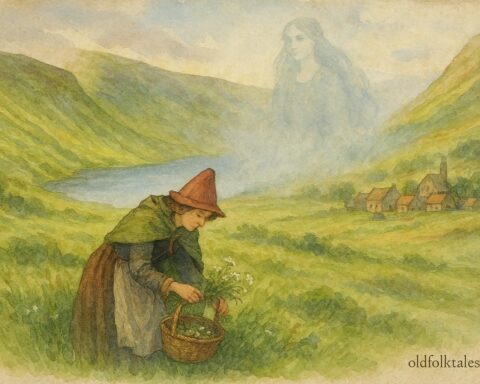
In the heart of Breconshire, surrounded by rolling hills and mist-laden valleys, lies Llangorse Lake. Its waters, dark as polished jet under cloudy skies and luminous as silver in the moonlight, have long been said to harbor secrets beyond the reach of ordinary men. The villagers spoke in hushed tones of a mysterious lady who emerged from the lake, appearing to those who approached with reverence, or punishing those whose hearts were greedy or disrespectful.
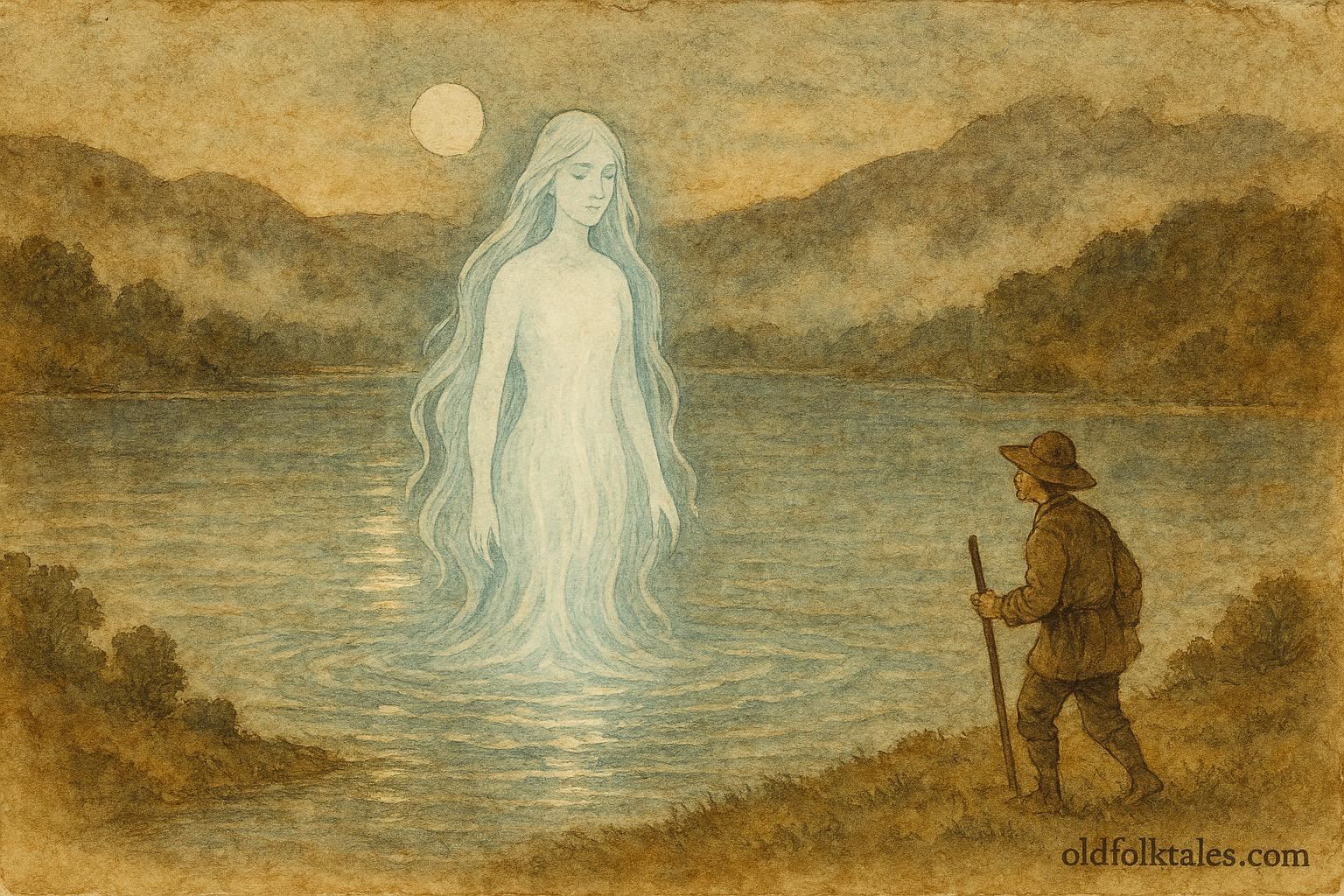
It was told that on still nights, when the wind slept and the hills echoed only the soft lapping of water against the shore, a figure would rise from the lake. She was a maiden of extraordinary beauty, her hair flowing like liquid gold, her eyes glimmering with the color of the deep waters, and her gown shimmering as though spun from the moon itself. She moved with a grace that made her seem part of the water, as if she had stepped from the lake’s very depths.
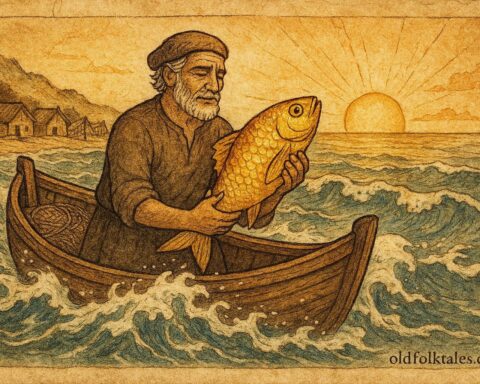
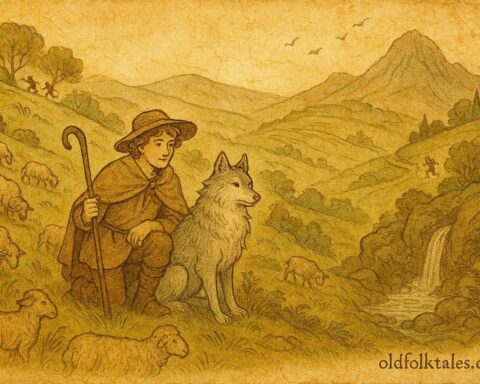
For generations, the people of Breconshire lived in awe of her presence, sharing tales of her kindness and her justice. Those who were honest, respectful, and humble found their troubles eased. A fisherman whose nets had failed might suddenly find them heavy with fish; a shepherd who honored the lake’s margins with offerings of bread or milk might be saved from a wolf or sudden storm. But those who approached the lake with greed, seeking wealth or power, were said to vanish into its dark waters, or return empty-handed, shivering and ashamed, as if the lake itself had rejected them.
One spring, as the mists still clung to the valleys and the heather began to bloom, a young farmer named Dafydd wandered to the lake. He had heard stories of the Lady’s mercy and punishment since childhood, yet his heart carried a blend of hope and caution. Dafydd’s family had suffered a poor harvest, and he came seeking guidance, not for greed, but to learn how best to care for his land and kin.
He approached the shore carefully, leaving his shoes on the soft grass and bowing his head in respect. The waters were still, mirroring the pale morning sky, and the only sound was the distant cry of a heron. Then, almost imperceptibly, the surface rippled. A delicate voice, melodic and clear, rose from the lake.
“Who walks with pure intent at the edge of Llangorse?” it asked.
Dafydd’s heart quickened, but he answered honestly. “It is I, Dafydd of the valley. I seek your guidance, Lady of the Lake. I wish only to care for my family and honor your waters.”
The ripples widened, and the maiden emerged fully, her form radiant, as if the sun itself had taken human shape. She smiled upon Dafydd, and her voice flowed like the gentle stream that fed the lake.
“Your heart is honest,” she said. “I shall aid you, for kindness and respect deserve reward.”
With that, the water swirled around her fingers, rising in a gentle column. When it fell, it carried fish of every size and color, and along the lake’s edge grew reeds and flowers that would protect Dafydd’s fields and pasturelands. Overcome with gratitude, Dafydd bowed deeply, promising to maintain the lake’s sanctity and honor its guardian. From that day, his family prospered, and the villagers spoke of Dafydd’s encounter as proof that the Lady of the Lake rewarded humility and virtue.
But not all who came to Llangorse were so pure of heart. A wealthy merchant from a distant village, hearing of the lake’s treasures, arrived with thoughts of silver and profit. He carried sacks to gather fish, herbs, and even water, intending to sell them at the markets. He scoffed at the tales of the Lady and demanded that the lake provide riches to his hand alone.
The moment his fingers touched the water, the surface darkened, and the Lady appeared in a towering form, her eyes fierce and deep. The wind whirled across the hills, and the lake churned as if it had grown a voice of warning.
“Greed has no place here,” she declared, her tone both beautiful and terrifying. “Those who seek to take without respect shall find only emptiness.”
The merchant screamed as the lake’s waters rose, forming hands of mist that pushed him back. His baskets emptied, his fish leapt from his grasp, and his coins sank into the lake as if devoured by shadow. Humiliated and frightened, he fled, never to return. From that day, the villagers recounted his tale as a cautionary lesson: to approach Llangorse Lake with reverence, not selfish desire.
Many nights, travelers and villagers would leave small offerings by the lake, a loaf of bread, a cup of milk, or a bundle of wildflowers. In return, the Lady would provide safety for their livestock, guidance for lost children, or protection from storms that threatened the valley. Her presence was subtle yet unmistakable: a shimmer on the water, a sudden breeze, a soft voice calling travelers away from danger.
Over the years, the Lady of the Lake became more than a figure of folklore; she was a symbol of the delicate balance between human ambition and nature’s power. Parents spoke of her to their children, not only as a protector but as a moral guide. She embodied the principle that the earth and its spirits respond to both reverence and transgression, rewarding the humble and punishing the selfish.
The tales of her mercy and justice reached beyond Breconshire, carried in the songs of bards and the whispers of travelers passing through the valleys. Yet she remained elusive, her full form visible only to the virtuous. Some claimed that even a glimpse of her shimmering gown, reflected in the moonlit waters, could bring dreams of wisdom and courage. Others swore that a careless or greedy observer would see only a dark ripple, a shadowy warning of what might come to those who disregarded her power.
In every telling, the Lady’s lessons were consistent: respect the waters, honor the land, care for those weaker than yourself, and avoid taking what is not freely offered. Her magic was not capricious, but deliberate, guiding those who sought the good and correcting those whose hearts were marred by selfishness.
Generations later, on misty mornings, villagers still claimed to hear her voice carried across the lake. Travelers reported sudden gusts that diverted them from hidden bogs, and children who strayed too near the water found themselves inexplicably drawn back to safety. The Lady of Llangorse Lake remained a silent guardian, testing hearts, rewarding kindness, and ensuring that the moral balance of the valley endured.
In this way, the legend of the Lady of the Lake of Llangorse persisted: a tale of beauty, mystery, and morality. Her presence reminded the people of Breconshire that respect for nature, humility, and integrity were not mere words but the principles that governed life and survival in a world intertwined with the magical and the unseen.
Moral Lesson
The Lady of Llangorse Lake teaches that kindness, respect, and humility bring protection and reward, while greed and selfishness invite misfortune. Human morality and reverence for nature shape the balance between safety and danger, blessing and punishment.
Knowledge Check
1. Where does the Lady of the Lake reside?
In Llangorse Lake, Wales.
2. How does the Lady respond to kindness?
She rewards the respectful with safety, guidance, and prosperity.
3. What happens to those who approach the lake with greed?
They are punished; their possessions may vanish, and they face humiliation or danger.
4. What themes are central to the story?
Respect for nature, reward and punishment, human morality, mystical femininity.
5. How do villagers honor the Lady?
By leaving offerings such as bread, milk, or flowers and maintaining reverence for the lake.
6. What lesson does the tale convey about human behavior?
That humility, kindness, and respect for nature lead to protection and blessings, while greed brings misfortune.
Source: Adapted from British Goblins by Wirt Sikes, 1880.
Cultural Origin: Breconshire, Wales