In the countryside of central and northern Portugal, where old roads cross beneath open skies and rivers slip quietly through fields and forests, there are places the people pass without lingering. These are the crossroads where paths meet without signposts, and the riverbanks where mist rises at dusk. Long before such places were marked on maps, they were known by memory and caution, for they were believed to be thresholds, neither wholly belonging to one place nor another. It was at such places that travelers sometimes encountered the Lady of the Seven Skirts.
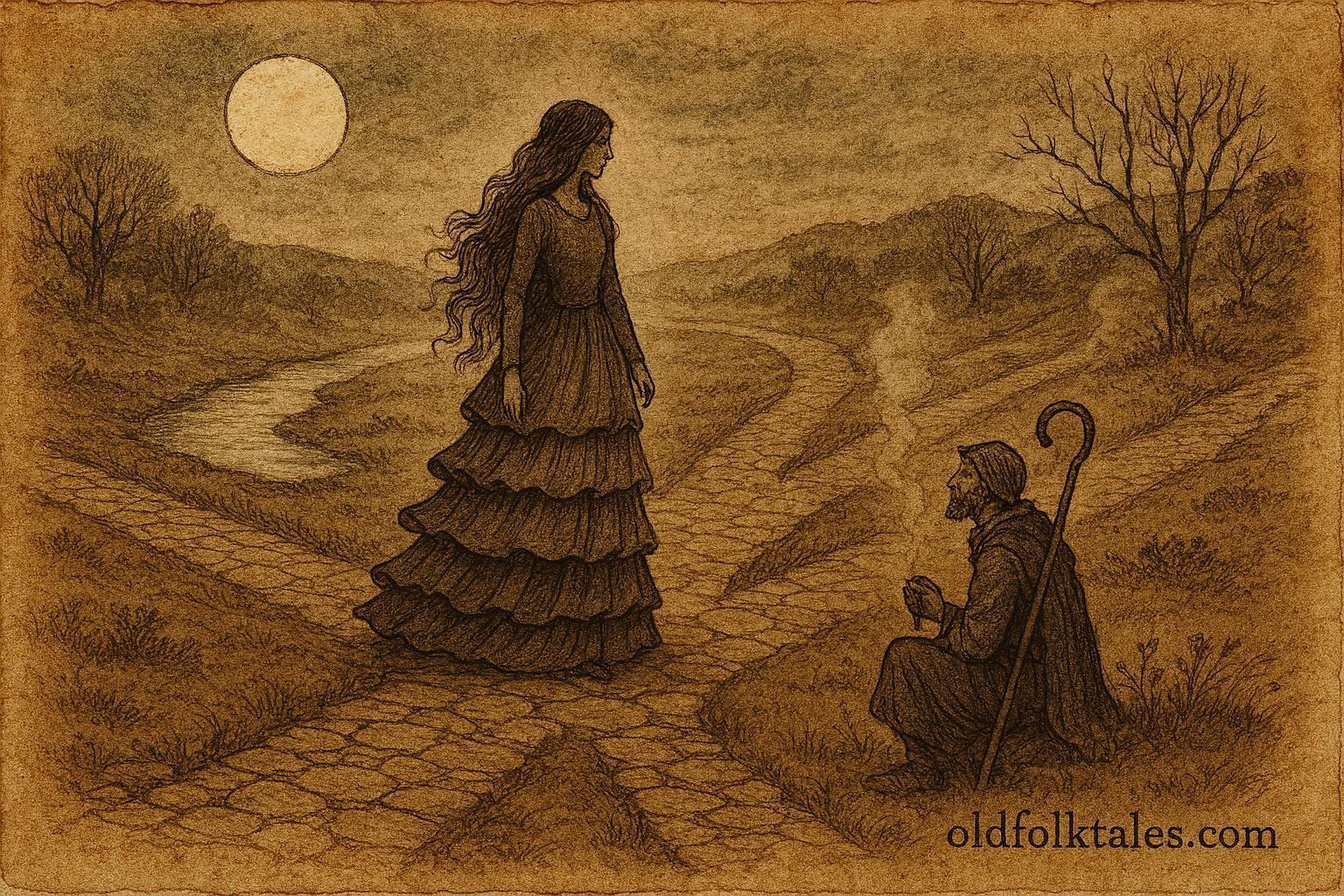
No one knew where she came from. Some claimed she rose from the river mist at twilight; others swore she stepped out from behind stone markers at crossroads where travelers hesitated. She appeared as a woman of striking presence, neither young nor old, her face calm and unreadable. She wore seven skirts layered one over another, each of a different color and weight, moving softly as she walked.
Those who saw her felt at once both drawn and uneasy, as if they stood before something beautiful but powerful, something that demanded respect.
The elders warned that the Lady was not to be followed lightly. She did not harm without cause, nor did she reward without reason. What she offered was not wealth given freely, but a test, one that revealed the truth of a person’s heart.
One evening, a young shepherd named Tomé was driving his flock home along a narrow road that crossed an open plain. The sun had dipped low, staining the sky gold and red, and the air smelled of dust and grass. When he reached the crossroads where three paths met, he saw her standing there, as still as a statue.
Her skirts brushed the earth lightly, and though the air was warm, a chill passed through him.
“Good evening,” she said, her voice gentle and clear.
Tomé returned the greeting, lowering his eyes in respect. He had heard the stories, and fear stirred in him, but it did not rule him.
“You are traveling alone,” the Lady observed. “Do you know where your path leads?”
“I know where I am going tonight,” Tomé replied. “Home.”
She smiled faintly. “Many think they know their way. Few know why they walk it.”
She turned and began to walk along one of the paths, her skirts whispering as she moved. After a few steps, she paused.
“If you follow,” she said, “do so without greed and without fear.”
Tomé hesitated. His sheep shifted behind him, uneasy. He thought of the warnings, but he also thought of his own heart, which sought neither riches nor favor, only understanding. Leaving his flock safely penned nearby, he followed at a respectful distance.
As they walked, the land around them changed subtly. The air grew cooler, the sounds of night deeper. At last, the Lady stopped near a riverbank where the water flowed dark and smooth.
She lifted the first of her seven skirts.
Beneath it lay not gold, but a mirror-like surface that reflected Tomé’s own face. He saw himself as he was, tired, honest, imperfect.
“Do you know this man?” she asked.
“I do,” Tomé said quietly.
She nodded and lowered the skirt.
One by one, she lifted the others. Beneath each lay a different truth: a memory of kindness, a moment of doubt, a choice made in silence, a fear faced and one avoided. None were treasures of wealth. All were revelations of character.
When she lifted the seventh skirt, there was nothing beneath it at all, only the dark earth.
“Not all truths are gifts,” she said. “Some are simply burdens we must carry.”
She stepped back, and the world seemed to settle into itself again. The river flowed as before. The night insects resumed their song.
“You may go,” she told him. “Remember what you have seen.”
Tomé returned home before dawn. His life did not change in fortune, but he walked with steadier steps, guided by a deeper sense of purpose.
Not all who met the Lady were like Tomé.
There was a merchant once, traveling late with heavy purses and heavier ambitions. When he encountered her at a river crossing, he followed eagerly, already dreaming of what her skirts might hide. He pressed close, asking questions, demanding answers.
When she lifted her skirts for him, he saw only what he desired, gold, jewels, promises of gain. Reaching out, he grasped at them.
At once, the ground beneath him shifted. He found himself lost among twisting paths, his goods scattered, his sense of direction gone. At dawn, he emerged miles from where he had begun, poorer in spirit if not in coin.
And there were others, those who followed in fear, trembling at every step. To them, the Lady revealed nothing at all. She led them in circles until they fled back the way they had come, unchanged and untested.
Over time, people learned that the Lady of the Seven Skirts did not judge by strength or status. She answered only to intention. Crossroads and riverbanks remained her chosen places, for they mirrored the choices each traveler carried within.
To this day, some say that if you walk with humility and without desire to possess what is not yours, you may glimpse her at dusk. And if you do, it is not the secrets beneath her skirts that matter, but what you bring with you when you choose to follow.
Moral Lesson
True reward comes not from seeking gain, but from approaching the unknown with humility, respect, and an honest heart.
Knowledge Check
1. Where does the Lady of the Seven Skirts usually appear?
At crossroads and riverbanks, places of transition and choice.
2. What do the seven skirts symbolize?
Hidden truths, moral tests, and layers of human character.
3. Why is Tomé rewarded while others are not?
He follows without greed or fear, seeking understanding rather than gain.
4. What happens to greedy followers?
They are misled, confused, or left spiritually poorer.
5. How does the Lady judge those who follow her?
By intention, not status, wealth, or courage alone.
6. What cultural belief does this folktale reflect?
Respect for liminal spaces and moral testing in Portuguese folklore.
Source: Portuguese oral folklore, recorded in regional collections, late 19th century (c. 1885–1895)
Cultural Origin: Central and Northern Portugal