In the sun-drenched hills of Provence, where lavender and thyme scented the wind and rocky paths wound between olive groves and terraced fields, lived Monsieur Seguin, a kindly old farmer known for his flock of goats. Among them was a young, spirited goat, lively and curious, whose heart yearned for adventure beyond the safety of the pen.
Monsieur Seguin loved his goats and tended them with care. He built strong fences and supplied fresh water and sweet hay every morning. Yet he knew the temper of the mountains, with their wild winds, steep cliffs, and prowling wolves. Many a goat had longed for freedom and found it too late, becoming prey to the dangers that lay in the craggy hills. He often warned the young ones, speaking gently but firmly: “Do not wander too far, my little ones. The mountains are beautiful, but they are not safe.”
Journey into the charm of British wit and Irish wonder through centuries of folk tradition
This particular goat, however, was unlike any he had known. She gazed with longing at the distant peaks, her eyes reflecting the silver streams and sunlit rocks beyond the enclosure. While the other goats grazed quietly, she leapt and bounded, imagining herself scaling the cliffs, feeling the wind rush past her ears, tasting the green shoots hidden on untrodden paths. Every day, her desire for freedom grew stronger, more insistent.
One morning, after Monsieur Seguin had left to tend the fields, she saw her chance. The sun was high, spilling golden light across the hills, and the pen door had been left ajar while he carried a bale of hay inside. Without hesitation, she pushed the gate and bounded into the open. The mountains rose before her like a kingdom of possibility, filled with cliffs, meadows, and the soft scent of wild herbs. The thrill of liberty filled her heart.
For the first hours, she explored with unrestrained joy. She climbed rocks, leapt over crevices, and felt the wind whip through her fur. Streams gurgled at the bottom of ravines, and birds swooped overhead in the cloudless sky. She nibbled on tender shoots that grew between stones, drank from crystal pools, and reveled in her independence. Never before had she felt so alive, so unbound. She was, in every sense, the queen of the mountains.
Yet the mountains were not without their dangers. In the shadows of twisted pines and between jagged cliffs lurked predators, and the keen scent of a wandering goat would not go unnoticed. As the sun began to dip and cast long, orange shadows across the peaks, she became aware of a subtle change in the air, a tension that whispered caution. The rustling of the shrubs, the quiet snapping of twigs underfoot, and a low, chilling howl carried across the valleys.
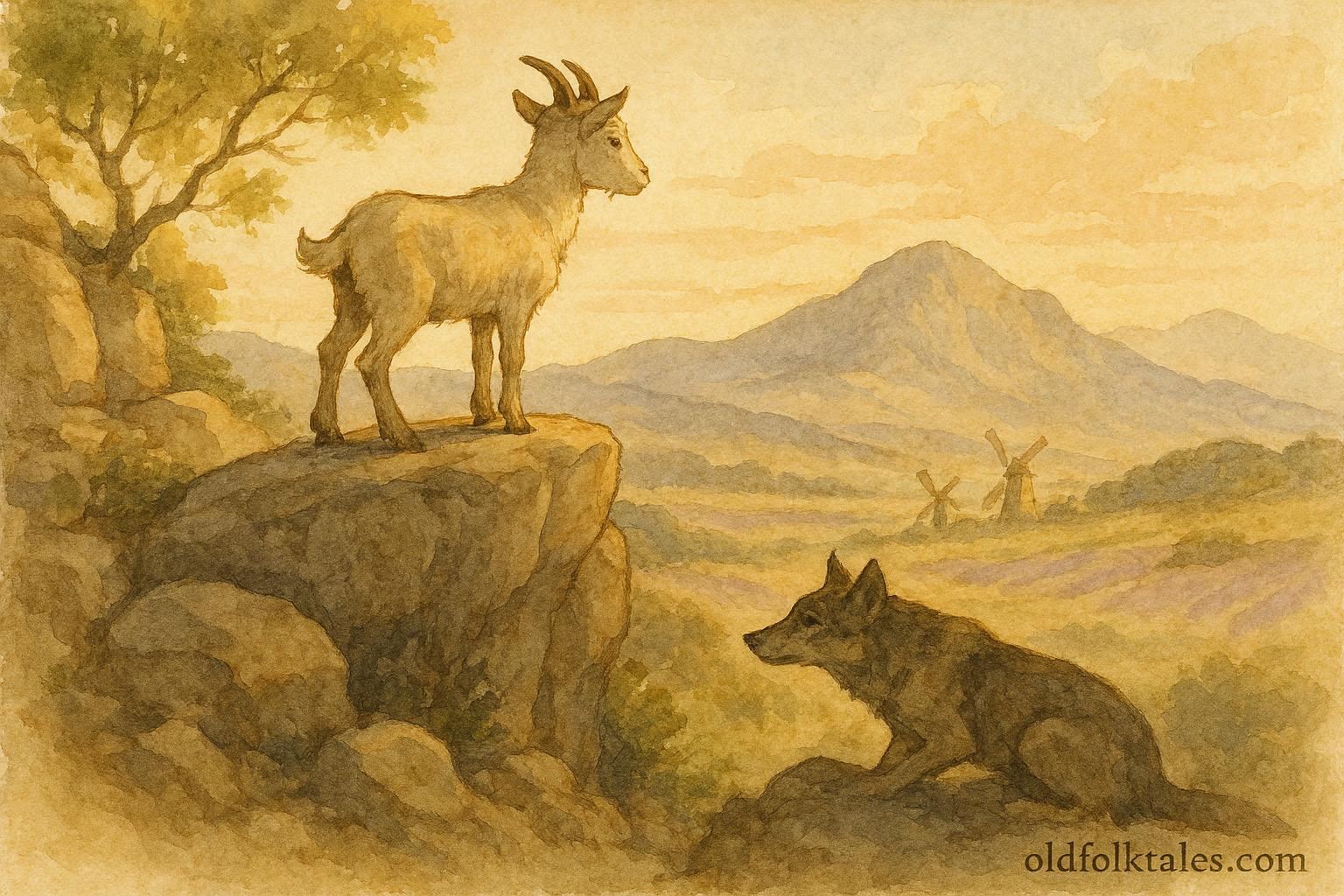
It was then she saw him: a wolf, lean and powerful, emerging from the cover of a rocky outcrop. His eyes glinted with hunger, and his movement was silent yet deliberate. The goat froze for a moment, heart pounding. She realized too late the risk she had taken, the safety she had abandoned for a few hours of freedom. Instinct propelled her forward; she bounded along the cliffs, her hooves finding precarious footing among the rocks, seeking refuge in the labyrinth of the mountains.
The wolf pursued, agile and relentless. The chase stretched across the sun-dappled slopes, a ballet of life and danger. At first, the goat’s speed and nimbleness kept her ahead, and for fleeting moments, she felt the joy of survival, the exhilarating proof of her courage. Yet fatigue slowly crept into her muscles. The mountains, though breathtaking, were unforgiving. Rocks that had seemed easy to navigate now threatened to trip her, and the shadows deepened, obscuring her path.
As night fell, the wind howled like a chorus of unseen spirits, and the goat’s heart sank with dread. The wolf’s eyes gleamed in the growing darkness, and his silent approach reminded her of the wisdom in Monsieur Seguin’s words. Freedom, she realized, carried a cost, and her recklessness had placed her life in jeopardy.
Despite her terror, she refused to surrender easily. She leapt higher, ran faster, and climbed steeper paths, determined to prove that courage could match cunning. Yet the wolf, patient and calculating, conserved his strength, waiting for her to falter. The mountain air was cold, and her energy waned. Each bound demanded more than the last; each heartbeat rang loud in the quiet night.
Eventually, exhaustion overcame her. She stood on a narrow ridge, the wolf close behind, the precipice on one side and sheer rocks on the other. In that moment, she understood the true balance of freedom and safety. She had tasted independence, and it had been intoxicating, but it had also brought her face to face with mortality. Her chest heaved as she contemplated her next move, wishing for the comfort of her pen, the gentle hand of Monsieur Seguin, the protection of walls she had once scorned.
Then, as if summoned by her need, the first rays of dawn spilled across the peaks. Mist lifted from the valleys, revealing familiar shapes and paths. In that moment, the wolf hesitated, the light and the mountain’s edge confusing his senses. The goat seized her chance. With a desperate burst of strength, she leapt toward a safer, narrower ledge that the wolf could not follow. Her hooves found purchase, and she scrambled forward until she reached a hidden trail known to the shepherds and goats of the region.
Though she had escaped the immediate danger, the lesson of the mountains remained etched in her heart. She returned to the village by mid-morning, limping slightly and breathless, but alive. Monsieur Seguin was waiting at the pen, worry etched on his face. When he saw her safe, he sighed with relief and gently guided her back inside. He did not scold her harshly; rather, he understood the pull of the mountains, the longing for independence, and the lessons that life taught through experience.
The young goat never forgot her adventure. She often gazed toward the peaks, remembering the freedom she had felt, the danger she had faced, and the thrill of being alive in the wild. Yet she also came to respect boundaries, to balance desire with caution, and to appreciate the shelter and care of her home. She had learned that courage and recklessness could feel similar, but wisdom lay in knowing when to heed warnings and when to act boldly.
Monsieur Seguin’s other goats noticed the change in her. She moved with a quiet confidence, a tempered boldness, and a glimmer of understanding in her eyes. They, too, seemed to sense the lessons she had learned: that the call of the wild could be alluring, but the world beyond safety was fraught with peril. And so, the tale of the laid-back goat became a story told to young ones on long Provençal evenings, a tale of freedom, bravery, and the delicate balance between adventure and caution.
Discover the timeless charm of French, Dutch, and Belgian stories filled with cleverness and heart
Moral Lesson
La Chèvre de Monsieur Seguin teaches that freedom and adventure come with risks, and that courage must be tempered with wisdom. Recklessness can lead to danger, but understanding consequences, learning from experience, and respecting guidance ensures survival while still honoring the spirit of independence.
Knowledge Check
- Who is the main character of the story?
- A young, spirited goat who longs for freedom beyond her pen.
- What dangers does the goat face in the mountains?
- Steep cliffs, treacherous terrain, and a predatory wolf.
- What lesson does the goat learn from her adventure?
- That freedom carries risks and wisdom must guide courage.
- What themes are central to this Provençal folktale?
- Courage versus recklessness, the call of the wild, consequences of disobedience, and mortality.
- How does Monsieur Seguin respond to the goat’s return?
- He welcomes her back safely, understanding the lessons learned from experience without harsh punishment.
- What cultural elements are highlighted in the story?
- The rugged landscapes of Provence, pastoral life, shepherding traditions, and the human-animal relationship in folklore.
Source: Alphonse Daudet, Contes du lundi, 1873, Provence, France.
Cultural Origin: Provence, France