In the deep valleys of the Basque Country, where rivers cut silver paths through forests of oak and beech, there are places the villagers avoid after sunset. These are not dangerous crossings, nor are they marked by broken ground or swift currents. They are quiet bends in the river, shaded by overhanging branches, where the water runs smooth and dark even under moonlight. It is there, the elders say, that the Lamia dwells.
The rivers of the Basque lands have always been more than water. They are boundaries and pathways, sources of life and memory. Along their banks, generations have grazed animals, washed clothes, and drawn drinking water. And woven through these ordinary acts is the knowledge that the river listens, and sometimes watches.
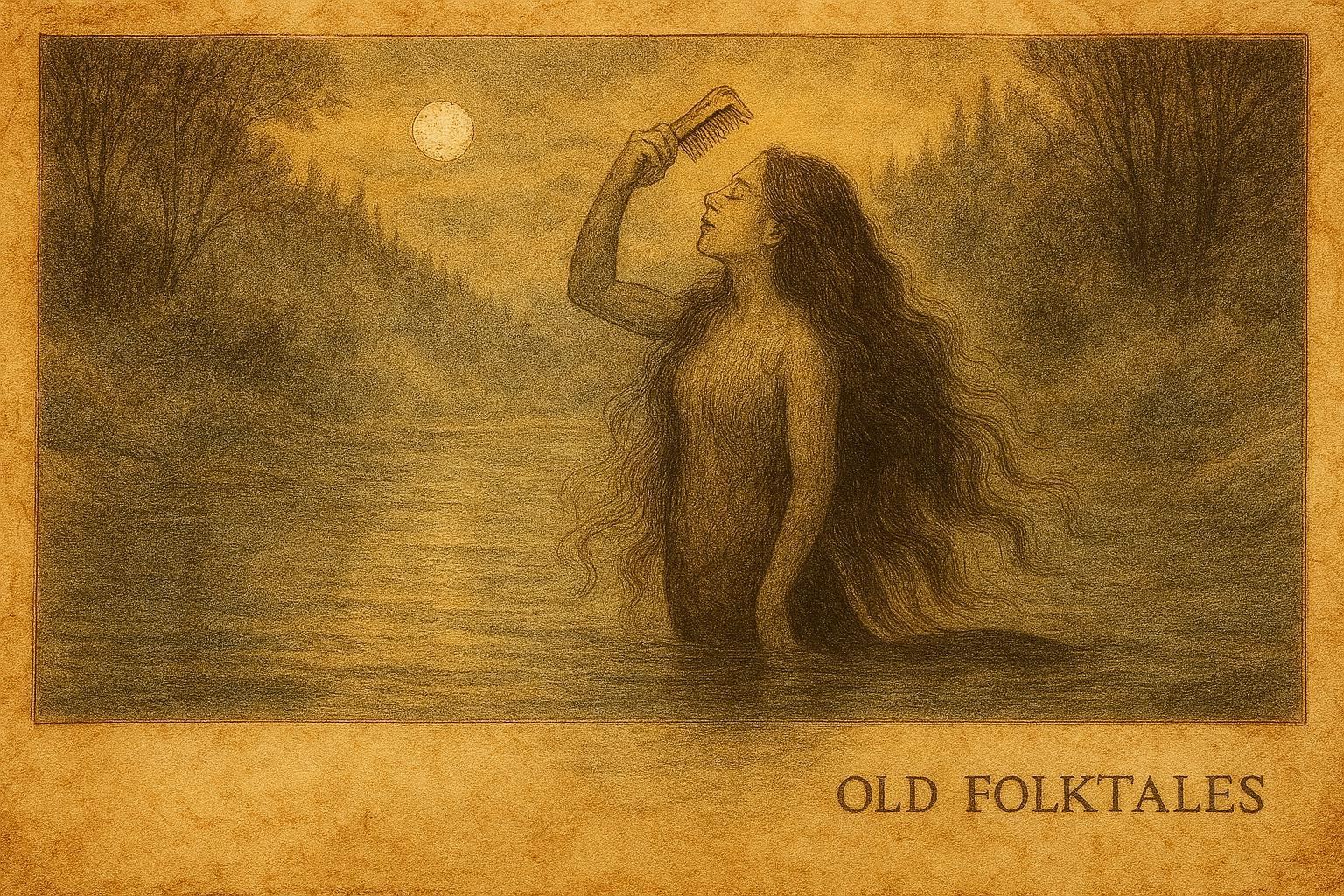
The Lamia is said to appear as a woman of rare beauty. Her hair is long and pale, falling like silk down her back. In the hush of twilight, she sits upon smooth river stones or low branches that lean over the water. Always, she carries a golden comb, which she draws slowly through her hair as though time itself has paused to watch.
But the Lamia is never entirely what she seems.
Those who have seen her closely, and lived to speak of it, say her feet are not human. Some claim they are shaped like a bird’s claws, light and sharp. Others swear they are scaled like a fish’s tail, glimmering faintly beneath the surface of the stream. Whatever the truth, the Lamia’s feet betray her nature as a being neither fully human nor fully of the wild, but something that belongs to both.
She does not seek attention. She does not call out to travelers. The Lamia waits to be noticed.
It is said that those who come upon her by chance feel a strange pull, not of desire alone, but of curiosity. The river seems quieter. The forest leans inward. The moment stretches. And in that stillness, a choice is made, though the traveler may not realize it yet.
Some greet her with courtesy, as one might greet a stranger encountered in solitude. Others watch in silence, unsure whether what they see is real. A few, foolish or cruel, laugh, whisper, or mock, believing her to be a trick of the light or a woman unworthy of respect.
It is then that the Lamia reveals who she truly is.
To those who show kindness, she remains gentle. Her voice, when she speaks, is soft as running water. She may offer guidance across the river, warn of flooding, or grant a blessing that follows the traveler home in subtle ways, a healed animal, a successful harvest, a journey that ends safely against all odds.
But the Lamia does not forgive betrayal.
Those who stare too long, who speak sweetly only to later ridicule her difference, or who seek to expose her secret nature to others, find the river turning against them. Paths once familiar become confusing. Bridges seem farther than they should be. Some stumble into cold water where the footing should be firm. Others feel an unshakable sense of being watched, judged, and followed.
The punishment is not always immediate, but it is certain.
One story tells of a young herdsman who encountered the Lamia while crossing a river at dusk. He greeted her politely, and she smiled. For many weeks afterward, his flocks prospered, and his family knew no hunger. Yet pride took root in his heart. He spoke of the beautiful woman by the river, embellishing his tale, laughing as others urged him to reveal more.
One night, he returned to the river, hoping to see her again and prove his story true. He called out loudly, mocking the secrecy of her hidden feet. The water rose without rain. The current pulled hard. By morning, his flocks were scattered, his fortune gone, and he would never again cross that river without trembling.
Such stories are not told to frighten children, but to teach restraint.
The Lamia does not punish curiosity. She punishes disrespect. She tests not strength, but character. The golden comb she carries is said to reflect the truth of the one who looks upon her, those who see only beauty learn nothing, while those who see difference and respond with humility gain wisdom.
Some claim the Lamia was once human, bound to the river by an ancient vow or curse. Others insist she is as old as the rivers themselves, a guardian spirit shaped by water and stone. José Miguel de Barandiaran, who gathered these tales, noted that the Lamia occupies a moral role rather than a monstrous one. She enforces balance between humans and the natural world, reminding them that nature is not theirs to dominate.
The villagers learned to live accordingly.
They greeted the river before crossing. They spoke softly at dusk. Children were taught never to mock what they did not understand. Even laughter, they were told, carries weight when spoken near running water.
And though few now claim to have seen the Lamia clearly, many still believe she is there. On quiet evenings, when the river reflects the sky like polished stone, some say they glimpse a flicker of gold among the reeds. Others hear the faint sound of combing, rhythmic and patient, echoing just beneath the wind.
The Lamia waits as she always has, not to lure, but to judge.
And the river remembers every choice made upon its banks.
Moral Lesson
The Lamia of the Basque Rivers teaches that respect matters more than appearance, and kindness reveals truth where mockery invites loss. Those who honor nature and difference are rewarded, while betrayal, especially of trust, never goes unanswered.
Knowledge Check
1. What physical detail reveals the Lamia’s supernatural nature?
Her bird-like or fish-like feet.
2. Where does the Lamia appear?
Along secluded rivers of the Basque Country.
3. What object does the Lamia carry?
A golden comb.
4. How does the Lamia treat kind travelers?
She rewards them with protection, guidance, or quiet blessings.
5. What behavior brings punishment from the Lamia?
Mockery, betrayal, and disrespect toward her true nature.
6. What does the Lamia symbolize in Basque folklore?
The moral balance between humanity and the natural world.
Source: José Miguel de Barandiaran, Mitología Vasca, 1960
Cultural Origin: Basque Country, Northern Spain