Along the southern coast of Ireland, where Atlantic waves crash against rugged cliffs and mist drifts over hidden coves, stories are still told of Clíodhna, a radiant fairy queen whose beauty rivaled the dawn and whose sorrow shaped the tides of Munster.
Her legend, preserved in Irish tradition and recorded by Geoffrey Keating in Foras Feasa ar Éirinn, speaks of forbidden love, the pull of fate, and the unyielding power of the sea.
Explore the wit and wisdom of Western Europe, where humor and virtue often go hand in hand
Clíodhna’s story is not merely a romance. It is a tale of longing between worlds, of what happens when love challenges the ancient boundaries between the mortal realm and the Otherworld.
Queen of the Otherworld
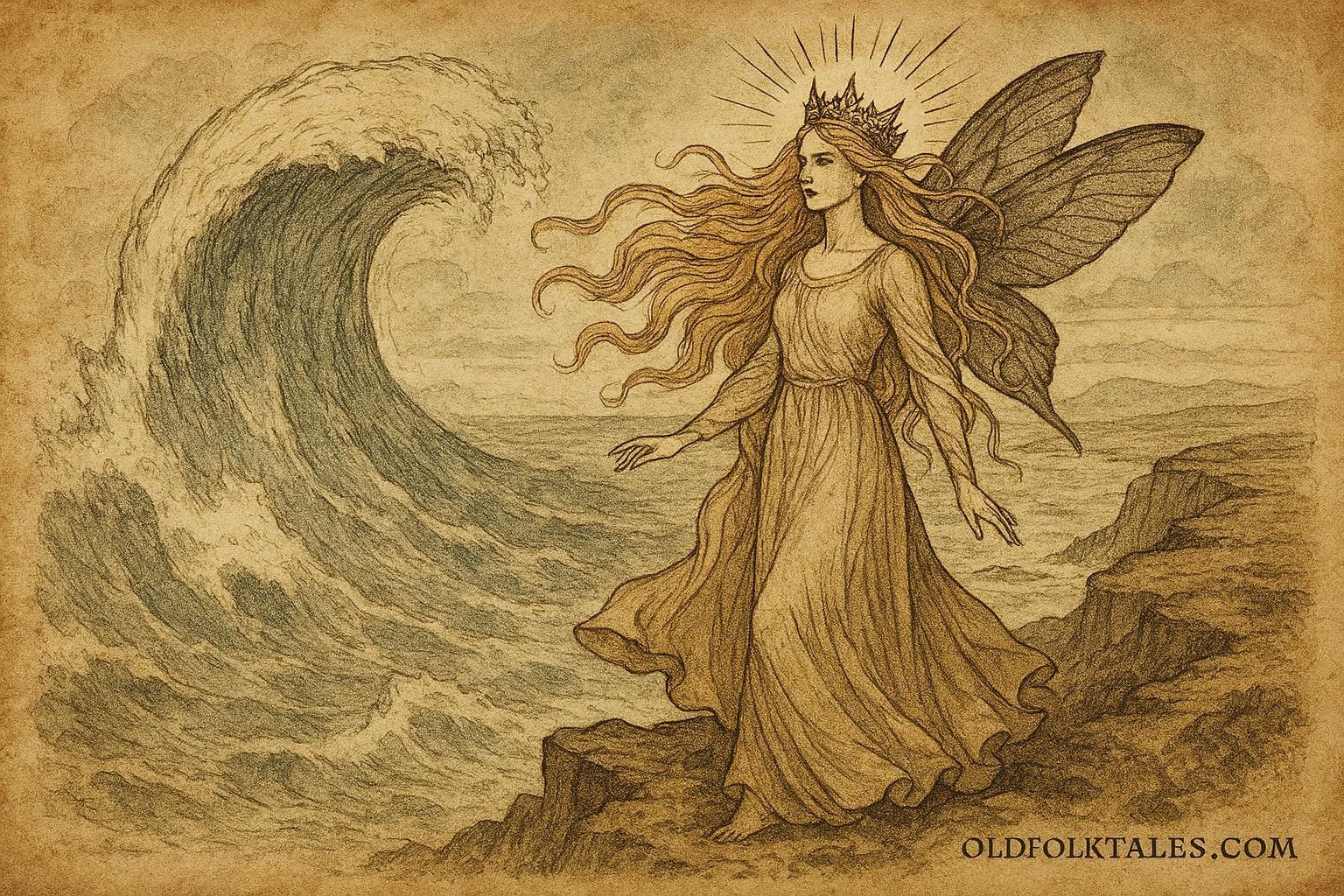
In Irish mythology, Clíodhna was no ordinary fairy. She was a queen among the Aos Sí, the luminous beings of the Otherworld, a realm of eternal youth, music, and beauty that existed parallel to human Ireland.
Her palace was said to lie beneath the waves or within enchanted hills. She possessed three magical birds whose song could heal the sick and lull the weary into gentle sleep. Mortals who glimpsed her described golden hair flowing like sunlight across water and a presence that shimmered like sea foam.
She was powerful. She was revered.
And yet, she desired something the Otherworld could not offer: mortal love.
Love Across Worlds
The legends tell that Clíodhna fell in love with a mortal man—sometimes named Ciabhán in later retellings, a warrior or chieftain of Munster. Drawn by his courage and humanity, she chose to leave her immortal realm to dwell among people bound by time.
This decision was no small defiance. The Otherworld was not meant to be abandoned lightly. To choose mortality meant accepting loss, aging, and vulnerability.
But love, in Irish folklore, often defies logic.
Clíodhna lived beside her beloved on the southern coast, experiencing the rhythm of human life, the warmth of touch, the fragility of days measured by sunrise and sunset.
For a time, she was content.
The Wave of Clíodhna
Yet fate cannot be undone so easily.
One version of the legend recounts that while her lover was away at sea, Clíodhna wandered the shore. The ocean, which had once marked the boundary of her former realm, called to her.
A great wave rose suddenly from the Atlantic—towering, unstoppable. Known in Irish as “Tonn Chlíodhna” (Clíodhna’s Wave), it swept her from the land and carried her back into the sea.
Some say the wave was sent by Manannán mac Lir, lord of the sea, reclaiming what belonged to the Otherworld. Others say it was destiny itself, correcting the imbalance caused by her departure.
Her mortal lover never saw her again.
From that day forward, Clíodhna became associated with the tides along the coast of County Cork. Fishermen claimed that her presence could be felt in powerful swells before storms. Her name remained tied to the sea’s unpredictable force.
Fairy Queen and Banshee
In later Irish tradition, Clíodhna’s legend evolved. She was sometimes connected with the banshee figure, an otherworldly woman whose cry foretold death among certain noble families of Munster.
Rather than a malevolent spirit, she became a guardian presence—watching over lineages and lands she once loved.
This transformation reflects the fluid nature of Irish folklore. Deities, fairy queens, and ancestral spirits often merge over centuries, adapting to new beliefs while retaining ancient roots.
Clíodhna thus bridges mythic eras: from pagan fairy queen to folkloric guardian of the coast.
The Power of Nature
Central to Clíodhna’s story is the sea itself.
In Irish culture, the ocean is not passive scenery. It is alive, unpredictable, and sacred. It connects Ireland to distant lands but also isolates it. It nourishes through fishing and trade, yet destroys through storms.
The wave that carries Clíodhna back is not random, it is nature asserting its power. It symbolizes forces greater than personal desire.
Love may challenge boundaries, but certain laws, of nature, of fate, remain beyond human or fairy control.
Historical Context
When Geoffrey Keating recorded Irish myths in the 17th century, Ireland was undergoing intense political and cultural change. His work sought to preserve Gaelic history and mythology in the face of outside influence.
Including Clíodhna’s legend was not simply storytelling, it was cultural preservation.
The myth connects the land and sea of Munster with ancient spiritual identity. Even as Ireland shifted politically, its stories anchored people to place.
A Story of Bittersweet Beauty
Unlike tales where love triumphs or evil is defeated, Clíodhna’s story ends in separation.
There is no rescue. No reversal.
Instead, there is transformation.
She becomes part of the landscape itself, woven into tide and wave. Her presence endures not in domestic happiness, but in natural rhythm.
This bittersweet tone is distinctly Irish. Many Irish legends accept sorrow as part of beauty, acknowledging that love and loss often walk together.
Journey into the charm of British wit and Irish wonder through centuries of folk tradition
Moral Lesson
Love is powerful but not always enough to overcome fate. Nature and destiny shape human life in ways beyond control. Yet even in loss, transformation and legacy remain.
Knowledge Check
1. Who is Clíodhna?
A fairy queen of Munster in Irish mythology.
2. What choice does she make?
She leaves the Otherworld to live with a mortal man.
3. How does her story end?
A great wave carries her back to the sea.
4. What natural feature is associated with her?
Tonn Chlíodhna, or Clíodhna’s Wave, along the Munster coast.
5. What central theme defines her legend?
Love across worlds and the inevitability of fate.
6. Who recorded her legend in the 17th century?
Geoffrey Keating in Foras Feasa ar Éirinn.
Source: Geoffrey Keating, Foras Feasa ar Éirinn (c. 1634; English editions 1723 onward).
Cultural Origin: Ireland, particularly Munster and County Cork.